Stronger ringgit cuts entry cost for Malaysians investing in Australian property
KUALA LUMPUR (Feb 26): A strengthening ringgit is lowering the capital outlay required for Malaysian investors entering the Australian property market, according to Knight Frank Malaysia. The benefit is most pronounced for buyers financing purchases with ringgit-denominated loans.
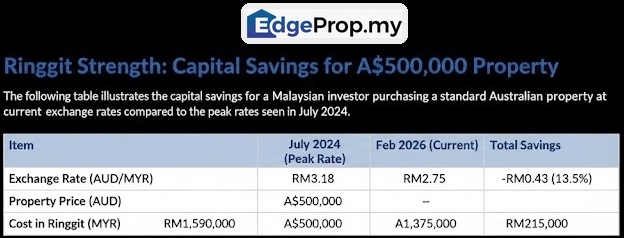
The ringgit was trading at approximately RM2.75 against the Australian dollar as at Feb 25, strengthening from RM3.18 in July 2024. Knight Frank Malaysia said this movement reduces capital requirements for local purchasers and mitigates currency exposure on loans for newly built homes and vacant land.
“A ringgit-based buyer today requires significantly less capital to acquire the same Australian asset compared to five years ago,” said Jenny Neoh Channing, associate director of Australian Properties at Knight Frank Penang.
“This difference alone can equate to several years of rental income or materially lower leverage, while mitigating the effects of currency fluctuations on loans for newly built homes and vacant land.”
Knight Frank also cited projections from Mitsubishi UFJ Financial Group (MUFG), which expects the ringgit to maintain its upward trajectory against other currencies through year-end, with a projected peak of RM3.70 against the US dollar.
Malaysians among top foreign investors in residential land
Malaysia was the ninth largest source of foreign investment into Australian residential land, amounting to A$111.6 million (RM308.5 million) between July 2023 and June 2024, according to the Australian Tax Office’s Register of Foreign Ownership of Australian Assets report.
Knight Frank Malaysia said demand continues to be underpinned by bilateral ties, migration flows and education links between the two countries.
Data from the Australian Bureau of Statistics’ latest Census recorded 165,616 Malaysian-born residents in Australia as at 2021.

Between January and September 2025, Australia recorded 415,760 net permanent and long-term arrivals—the highest on record for that period and 6% above the previous record set in 2024, according to migration data cited by the firm.
“The latest migration data reveals a significant surge in confidence. Between January and September 2025, Australia saw a record-breaking 415,760 net permanent and long-term arrivals—the highest in history for that period,” said Neoh.
“For Malaysian investors and property seekers, these numbers reflect the depth of Australia’s economic and demographic momentum.”
Australia also hosted more than 13,000 Malaysian students in 2025. A 9% increase in international student numbers is targeted for 2026 following the Australian government’s designation of Southeast Asia as a priority region.
Build-to-rent pipeline expanding
Rising migration levels are contributing to sustained rental demand, supporting growth in Australia’s build-to-rent (BTR) segment.
Incoming foreign investment into new dwellings has been concentrated in Victoria, New South Wales and Queensland, according to Knight Frank Malaysia.
The firm highlighted Melbourne and Sydney as cities that have consistently ranked within the top 10 in global liveability studies.
The BTR segment—comprising professionally managed developments built specifically for long-term rental—is maturing as an institutional asset class.
According to Knight Frank’s Australia Horizon Report 2026, 4,660 BTR units were delivered nationwide in 2024. An estimated 6,000 units are expected in 2025, with a further 4,000 forecast for completion in 2026.
“With multiple global and local groups eager to build out a BTR platform to take advantage of Australia’s structural undersupply of rental accommodation and demographic tailwinds, we anticipate that BTR developments will continue to perform as a segment, while easing ongoing housing shortage concerns,” said Neoh.
Tighter regulatory environment for foreign buyers
Despite the currency advantage, foreign purchasers face stricter regulatory and fiscal requirements.
Foreign buyers of Australian real estate are subject to:
1) Temporary ownership ban: A restriction introduced in 2025 prohibits foreign nationals from purchasing existing homes until 2027.
2) Stricter oversight: The Foreign Investment Review Board has implemented tighter regulations and significantly higher application fees.
3) Increased stamp duty: Higher surcharges apply to property transfers involving foreign entities.
4) Withholding tax: Non-residents are subject to a 15% withholding tax on property transactions.
5) Annual land levies: Owners must pay annual land taxes, often coupled with absentee owner surcharges.
“Despite recent policy changes, due compliance will allow Malaysians to continue leveraging Australia as an investment destination, supported by economic stability, population growth and sustained rental demand,” said Neoh.
Unlock Malaysia’s shifting industrial map. Track where new housing is emerging as talents converge around I4.0 industrial parks across Peninsular Malaysia. Download the Industrial Special Report now.
Follow Us
Follow our channels to receive property news updates 24/7 round the clock.


Telegram


Latest publications
View AllFollow Us
Follow our channels to receive property news updates 24/7 round the clock.
Malaysia's Most
Loved Property App
The only property app you need. More than 200,000 sale/rent listings and daily property news.