Cross-border collaboration fuels Malaysia’s rise as Asean’s industrial crossroads
This article first appeared in the Industrial Special Report in November 2025.
Cross-border collaboration is taking on a larger role in Malaysia’s industrial expansion, as global manufacturers deepen regional diversification and seek more predictable market access. New trade agreements with major partners and stronger links with Singapore, China and Northeast Asia are accelerating this shift, positioning Malaysia as a key production node in an increasingly multi-country supply chain network.
The momentum is reflected in rising foreign interest across Malaysia’s key industrial corridors, supported by clearer policy direction, and competitive operating costs.
Malaysia recorded RM190.3 billion in approved investments in 1H2025, an 18.7% increase year-on-year, driven largely by manufacturing, and digital infrastructure commitments from foreign firms, says CIMB Securities in an exclusive commentary to EdgeProp on Nov 7.
Foreign manufacturers are viewing Malaysia as a stable mid-point in the regional production stack. CIMB Securities places Malaysia “between higher-cost, innovation-driven Singapore, and labour-intensive Vietnam and Indonesia”, making it suitable for mid- to high-value manufacturing, engineering, and components production.
The country’s expanding network of bilateral agreements is also strengthening investor confidence and reinforcing Malaysia’s role in a decentralising Asean production system. Most recently, trade clarity was sharpened through the Agreement on Reciprocal Trade (ART) with the US signed on Oct 26, and a free trade agreement (FTA) with South Korea on Oct 27, marking Malaysia’s 19th FTA to date.
Competition intensifies in industrial corridors
For property agencies operating on the ground, the change is visible in buyer behaviour.
PropNex Malaysia’s Industrial Real Estate Division sees this repositioning firsthand. “The most active foreign direct investment sources currently come from China, Singapore, and with increasing interest from Taiwan and Japan,” its chief operating officer Evon Heng tells EdgeProp. “Multinational companies from the US are coming, too.”
Many of these firms are not just relocating capacity, they are establishing regional nodes. Heng notes that buyers include China+1 manufacturers, Korean and Japanese component makers, and Singapore-based corporations seeking scalable land or production space.
CIMB Securities identifies four corridors delivering the strongest value proposition: the Johor–Singapore Special Economic Zone (JS-SEZ), South Klang Valley/Integrated Development Region in South Selangor (IDRISS), Penang’s electrical and electronics (E&E) belt, and the Malaysia–China Kuantan Industrial Park (MCKIP) cluster.
JS-SEZ: the region’s twin-engine strategy
CIMB Securities views the JS-SEZ as a major driver of Asean supply chain resilience: “The SEZ provides a robust platform for Singapore-headquartered firms to utilise Johor as a manufacturing base while keeping their headquarters (HQ) and research operations in Singapore”.
One example is South Korea’s SPC Group, which shifted its regional production to Nusajaya Tech Park while maintaining HQ functions in Singapore.
Heng says her agents have observed that foreign investors are now “actively asking about JS-SEZ incentives, land tenure clarity, conversion timelines, approvals, accessibility to ports and highways, and electricity and water capacity”.
South Klang Valley: KLIA Aeropolis, and IDRISS reshape location strategy
Selangor’s southern districts are rapidly becoming Malaysia’s next logistics and manufacturing engine. The IDRISS corridor, covering 40,000 acres, is attracting high-impact sectors including managed industrial parks, aerospace, and data centres. The region’s appeal is strengthened by new road investments from Permodalan Negeri Selangor Bhd (PNSB), IJM Corporation Bhd, and Lim Seong Hai Capital Bhd.
CIMB Securities’ analysis indicates rising interest from investors who traditionally preferred Shah Alam or North Klang Valley, but are now pivoting south because of better land availability and Kuala Lumpur International Airport (KLIA) connectivity.
Penang’s electronics belt sees sustained interest
PropNex sees growing activity in Batu Kawan and Bukit Minyak, driven by “strong interest from Taiwanese E&E players.” High-spec build-to-suit (BTS) demand remains steady, particularly from firms needing customised compliance, ceiling heights, and power capacities.

ECER: MCKIP leads heavy industry expansion
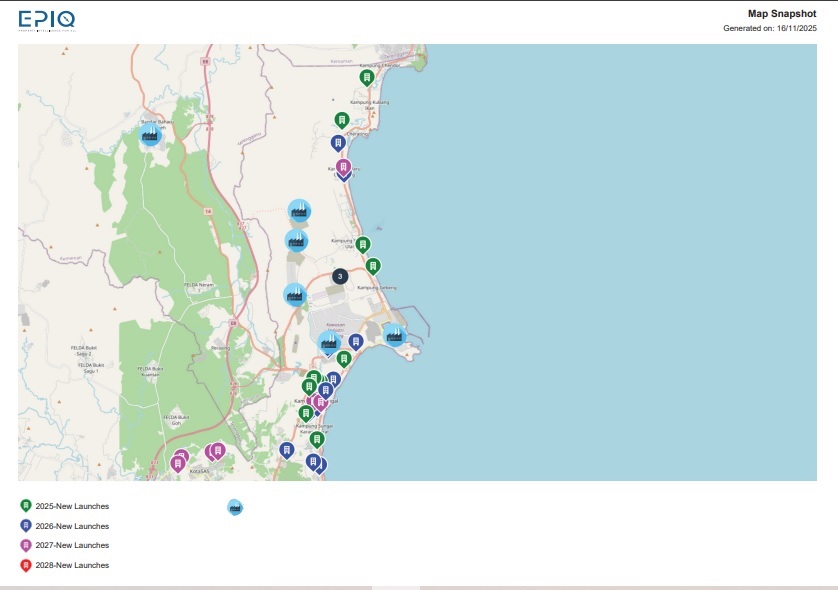
East Coast Economic Corridor (ECER)’s MCKIP cluster is nearly at full occupancy, pushing expansion to MCKIP 3 and the new Malaysia–China Kuantan Industrial Logistics Park (MCKILP). CIMB Securities highlights IJM Corp’s growing role in the East Coast, leveraging port ownership, and China partnerships as the East Coast Rail Link (ECRL)’s 2027 launch approaches.
Financing needs shape investment decisions
CIMB Securities notes that trade financing instruments are playing an increasingly important role in helping foreign firms enter Malaysia. These include supply chain financing for component heavy industries, working capital lines to stabilise early operations, and hedging tools to manage currency volatility.
The bank observes strong demand for brownfield upgrades and facility expansions in mature clusters such as Shah Alam, and Puchong in Selangor; Bayan Lepas in Penang; and Senai in Johor, as companies seek to scale without long construction periods.
Foreign investors, according to PropNex, often prioritise access to reliable utilities, regulatory clarity, and infrastructure readiness. “Ready-built factories remain attractive for operators that prioritise immediate operations, while high-value manufacturers from Korea, Japan, and China tend to require customised facilities” Heng says.
Environmental, social, and governance (ESG) requirements vary by industry, although green power availability, and basic sustainability are becoming common criteria of site evaluations.
Domestic investors move into industrial assets
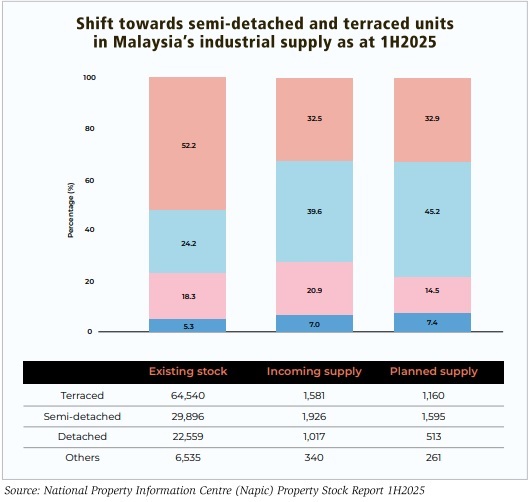
An emerging trend is, domestic investors are diversifying into industrial lots and small factories, leading to rental yields of 5–8%—outperforming many residential assets, according to PropNex.
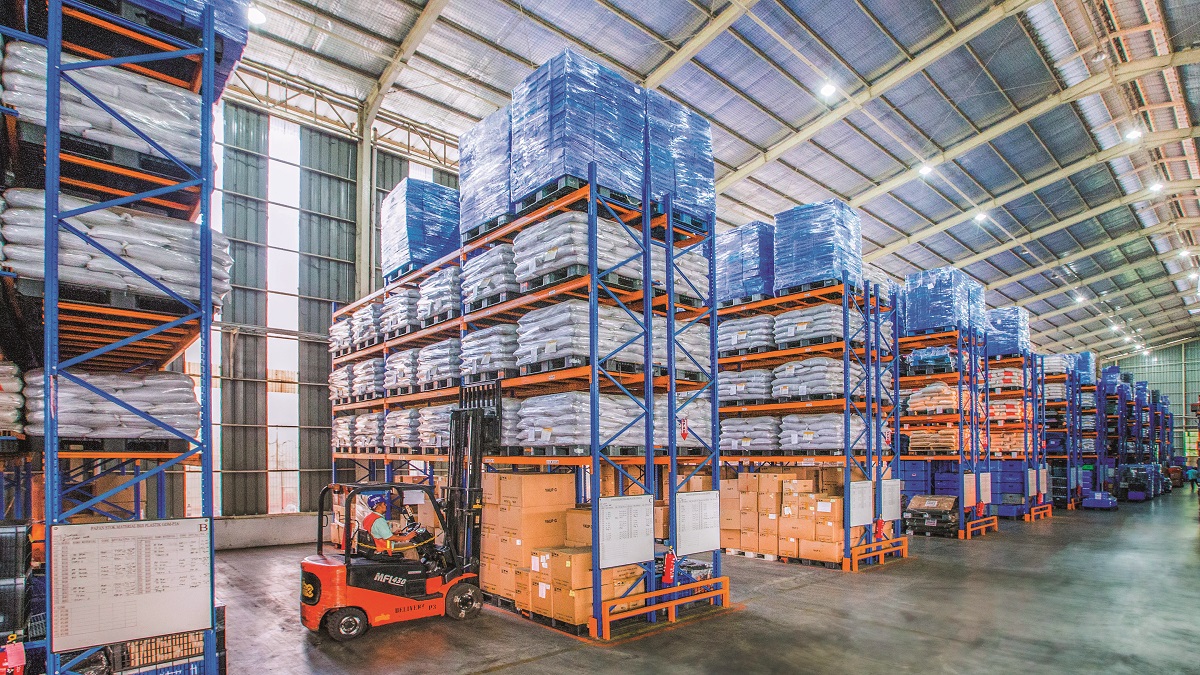
In the secondary market, Heng says that demand is “dominated by owner-occupier small and medium enterprises (SMEs),” led by food processing, light manufacturing, automotive parts, and e-commerce micro-fulfilment.
According to her, the most sought-after products include:
* Semi-detached factories <15,000 sq ft
*Logistics warehouses 30,000–50,000 sq ft • Facilities with high ceiling clearance and 3-phase power
To remain competitive, Heng advises owners of older assets to “refurbish and upgrade to meet tenant needs, implement basic ESG measures, and offer flexible lease terms”.
Looking ahead: A multi-nodal Asean production map
Both CIMB Securities and PropNex agree that Malaysia’s industrial growth will increasingly depend on cross-border partnerships that combine:
*Singapore’s innovation ecosystem
*China’s manufacturing scale
*Japan and Korea’s high-value technologies
*Malaysia’s land availability, utilities and mid-level engineering talent
CIMB Securities’ watchpoints for the next 3–5 years include Malaysia’s green-energy transition, digital infrastructure rollout, SEZ progression, and global supply decentralisation, all of which will influence rental growth, return on invested capital, and land appreciation across the country’s industrial corridors.
“As multiple regional ecosystems gain relevance instead of a single globalised supply chain,” CIMB notes, “Malaysia is positioning itself not just as a production hub, but as a collaborator in technology, innovation and sustainability.”
Unlock Malaysia’s shifting industrial map. Track where new housing is emerging as talents converge around I4.0 industrial parks across Peninsular Malaysia. Download the Industrial Special Report now.
Follow Us
Follow our channels to receive property news updates 24/7 round the clock.


Telegram


Latest publications
View AllFollow Us
Follow our channels to receive property news updates 24/7 round the clock.
Malaysia's Most
Loved Property App
The only property app you need. More than 200,000 sale/rent listings and daily property news.