Talent is Malaysia’s hidden engine for manufacturing growth
This article first appeared in the Industrial Special Report in November 2025.
Malaysia’s manufacturing sector is gaining momentum as domestic and foreign investors expand across electrical and electronics (E&E), electric vehicles (EVs), and advanced logistics—but industry leaders say the country’s defining competitive edge will hinge on whether it can build, attract, and retain skilled talent.
Global real estate and investment management consultancy JLL Malaysia managing director Jamie Tan says investors increasingly view Malaysia as a country in transition.
“They see Malaysia as being on a transitional journey from a reliable production base to a true design-and-innovation hub,” he tells EdgeProp in an exclusive note.
Moving beyond assembly roles into innovation
Tan says Malaysia has strong technical and managerial capabilities in back-end manufacturing and supply-chain operations, but the next phase depends on strengthening front-end design, and engineering capabilities.
And signs of progress are emerging.
Manufacturers are increasingly demanding build-to-suit (BTS) facilities tailored to highly specialised production.
“These manufacturers require highly specialised facilities with specific floor loadings, ceiling heights, HVAC systems, clean rooms and other tailored specs,” Tan says, noting that the rise of BTS environments reflects the increase in advanced talents.
Provided with these complex semiconductor, data-centre and manufacturing facilities, local engineering and project-management talent is now capable of delivering.
“Local companies are designing, prototyping and assembling their own EVs, which shows we’re moving beyond assembly-only roles into upstream design and innovation,” he says, referring to Proton, and Perodua. He also highlights Penang-based Silicon X’s locally-designed Field Programmable Gate Array (FPGA) chip, and Southeast Asia’s first advanced chip-testing facility in Cyberjaya, Selangor as markers of rising sophistication.
TVET at the centre of upskilling push
Malaysia has the industrial ecosystem to support higher-value activities, but skilled capacity remains uneven. Skilled roles currently make up just 25% of private-sector employment, according to Department of Statistics Malaysia (DOSM)’s 4Q2024 data—highlighting the need to deepen the talent pool for high-tech industries.
Tan says state-linked Technical and Vocational Education and Training (TVET) pathways under the Johor–Singapore Special Economic Zone (JS-SEZ) are promising examples of closer alignment between education and industry.
“These programmes integrate handson vocational training with real industry placements; that’s how you build a future-ready workforce,” he stresses.
He adds that Malaysia must anticipate emerging roles in EV systems, battery manufacturing, automation, chip design, and artificial intelligence (AI).
“With the right investments in skills and innovation, our multilingual, midskill workforce can become a real competitive advantage.”
Limited supply increases competition for talent
Malaysia’s shift towards more advanced industries is also transforming industrial development, recruitment patterns, and training needs; but companies are facing intensifying competition within a scarce talent pool.
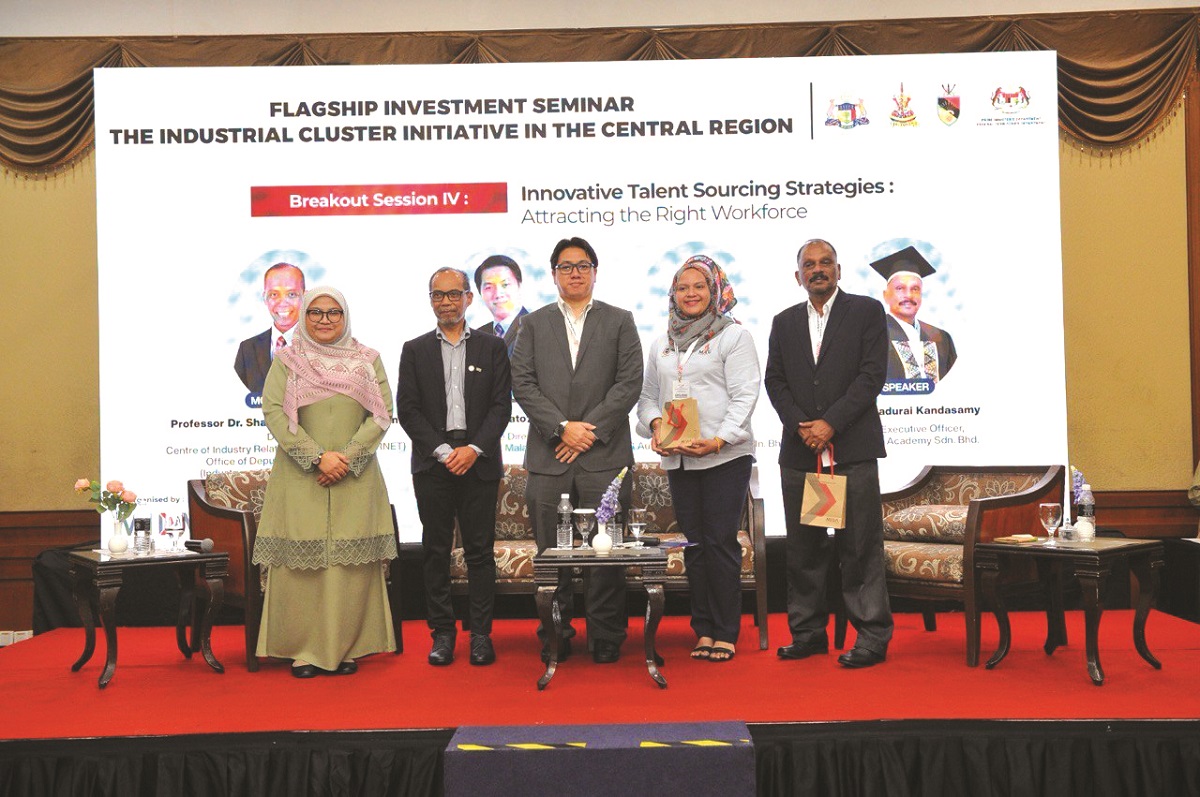
“The talent pool is limited, so we usually advise clients on company branding, and flexibility. Strong brands, and flexible work arrangements like remote work are now major draws,” human resource solutions company PERSOL Malaysia associate director Kamarul Dato Marzuki told EdgeProp after his panel session in the Malaysian Investment Development Authority (Mida)’s “Central Region Industrial Cluster Development Initiative” seminar on Nov 12 in Kuala Lumpur.
AI-enabled recruitment tools are also accelerating hiring. “Previously, sourcing a profile might take days—now, it’s seconds,” he said.
Training institutions are responding.
Another panellist, Accelskill Academy CEO Annadurai Kandasamy said the education–industry divide remains, but collaboration is improving.
“To bridge this, we bring industry into our organisation, so students can train with the latest technologies, and strategies,” he told EdgeProp. Programmes like Akademi Dalam Industri (ADi) place students directly in company environments, producing job-ready graduates aligned with high-impact sectors such as EVs and data centres.
However, retention remains an ongoing challenge.
“You can never fully control retention ... even high pay doesn’t guarantee loyalty,” MAG Auto Garage Services Sdn Bhd managing director Dr Azlina Ahmad told EdgeProp at the same event.
Her firm focuses on hands-on exposure, and first-mover advantage. “Timing is critical—being second risks fading out,” she said.

Why talent now defines Malaysia’s manufacturing advantage
As global supply chains reorganise, Malaysia’s industrial competitiveness increasingly depends on whether its workforce can support higher-value production. Three forces are driving this shift:
1. The regional “skill race” Vietnam, and Thailand are rapidly expanding engineering programmes linked to EVs, automation, and semiconductors. To stay ahead, Malaysia must widen access to TVET, strengthen English proficiency, and accelerate mid-career reskilling.
2. Rising complexity of industries
Malaysia’s new wave of investors— from chip back-end testing to EV prototyping, and data centres—require workers familiar with robotics, coding, system integration, and advanced materials. These sectors demand specialised technical depth, not generic manufacturing labour.
3. Judged on capability, not just cost
Multinational investors now increasingly assess:
*Skill competency
*Retention rates
*Project-management expertise
*Speed of talent deployment
With competing economies raising incentives, Malaysia’s differentiator is no longer lower operating costs, but a workforce that can innovate, troubleshoot, and scale.
This shift explains the private sector’s push for BTS facilities, industry-linked TVET, and AI-driven recruitment.
..........
Unlock Malaysia’s shifting industrial map. Track where new housing is emerging, as talents converge around Industry 4.0 parks across Peninsular Malaysia. Download the Industrial Special Report now.
Follow Us
Follow our channels to receive property news updates 24/7 round the clock.


Telegram


Latest publications
View AllFollow Us
Follow our channels to receive property news updates 24/7 round the clock.
Malaysia's Most
Loved Property App
The only property app you need. More than 200,000 sale/rent listings and daily property news.