Bathroom myth: What you don’t know about fires could kill you
This article appeared in the April 9, 2026 issue of the monthly print edition. Subscribe now.
We must give credit to Federal Territories Minister Hannah Yeoh for her recent blunt reminder to those living in stratified buildings: if a fire breaks out, the bathroom is not your sanctuary.
It is a message that needs to be repeated until it becomes common knowledge.
As Malaysia’s urban landscape continues to stretch skywards, more of us are calling condominiums, serviced apartments, and high-rise public housing “home”. These buildings offer a modern, efficient lifestyle, but they also bring a set of unique safety challenges that many residents are simply not prepared for.
The minister’s remark is a vital wake-up call. It is time to clear up the misconceptions that lead to tragedy, and start building a genuine culture of fire safety among residents, building managers, and policymakers alike.

Grim reality behind the numbers
The Malaysia Fire and Rescue Department (Bomba) Annual Report 2025 makes for sobering reading. It confirms what many in the industry have long feared — residential fires remain the deadliest category in the country.
While a factory fire might make headlines for its massive financial toll, it is in our homes where the real human tragedy unfolds. Between 2018 and 2024, an average of 111 lives were lost every year to fire, most of them behind residential doors.
The risk remains unacceptably high. Many of these incidents are chalked up to what we call the “3L Syndrome” — lupa (forgetfulness), lalai (negligence), and leka (complacency).
In 2025 alone, structural fires made up 76% of all cases, with over half of the 98 recorded fatalities occurring in residential homes. We are not just losing precious lives; we are losing our hard-earned wealth, with property losses hitting a staggering RM2.09 billion last year.
Datuk Khirudin Drahman, the former fire safety division director of Bomba Malaysia, has spent years studying the aftermath of these fires. This Bomba legend’s forensic analysis reveals a consistent, heartbreaking pattern — most victims are not killed by the flames, but by smoke inhalation, and the fact that they don’t realise there is a fire until it is too late.
Whether it’s an older terrace house with outdated wiring, or a high-rise unit without a simple smoke alarm, the result is often the same — residents are incapacitated before they can even reach for the door.
Fatal fallacy of the washroom ‘refuge’
The idea that a bathroom is a safe place to hide because it has water and tiles is a dangerous myth, likely reinforced by bad movies, or old-fashioned advice. In reality, a residential bathroom is one of the last places you want to be in during a fire.
The real killer is smoke — specifically the toxic cocktail of carbon monoxide and hydrogen cyanide it carries. Bathrooms are typically small, poorly ventilated spaces. Once smoke finds its way in, oxygen levels plummet in seconds.
These rooms aren’t built with fire-rated barriers, and since many lack windows, you’re essentially trapped in a box with no way to get fresh air or signal for help.
From a rescue perspective, it’s even worse.
When Bomba personnel enter a smoke-filled unit, they are trained to sweep the bedrooms, living areas, and balconies first. A locked bathroom door is a hidden corner that can lead to fatal delays. The minister is right — you cannot assume the bathroom will protect you. It won’t.
High-rise risks: a different beast
A fire in a high-rise doesn’t behave like a fire in a landed house. Smoke and heat don’t just stay put; they race through corridors, ventilation shafts, and lift wells. When you have hundreds of people in a single building, the risk of panic is high, especially if people don’t know where their exits are.
Most modern Malaysian high-rises are actually quite safe by design, built to the strict standards of the Uniform Building By-Laws (UBBL). They are equipped with sprinklers, smoke control systems, and fire-rated stairwells. But — and this is a big “but” — those systems only work if the management maintains them, and if the residents know how to use them.

What you should do when the alarm sounds
Preparation shouldn’t start when you smell smoke; it starts today. If that alarm goes off, you need to move.
*Get out immediately: Use the fire stairs. Never, under any circumstances, take the lift. You don’t want to be trapped in a metal box that might stop on the floor where the fire is at its worst.
*Know your backups: Don’t just rely on the main exit. Know at least two ways out of your unit and your building.
*Contain the danger: As you leave, close doors behind you. It sounds simple, but a closed door can buy someone else precious minutes by slowing down the smoke.
*Stay low: If there’s smoke, get on your hands and knees. The air near the floor is the only air worth breathing.
*If you’re trapped: If the corridor is a wall of black smoke, stay in your unit. Move to a balcony or a room with a window, seal the bottom of the door with wet towels, and call 999. A balcony is a much safer place to wait for rescue than a bathroom.
Management isn’t just for collecting fees
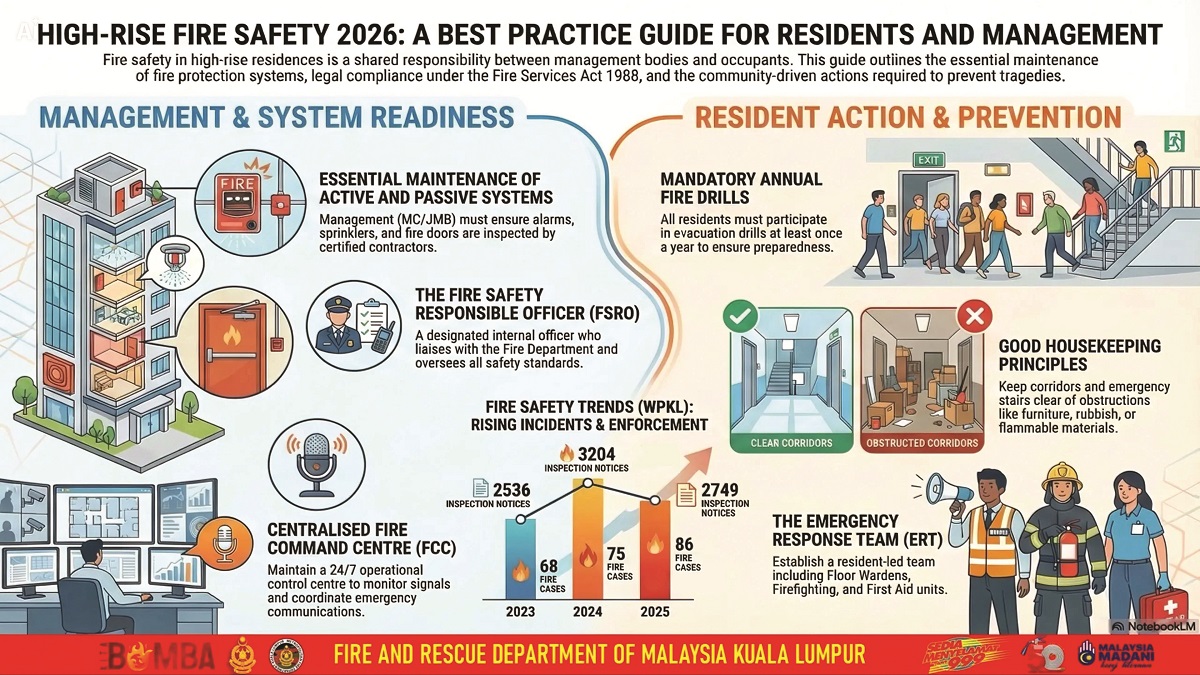
Building safety rests heavily on the shoulders of the joint management bodies (JMBs) and management corporations (MCs). They have a legal duty to ensure that the fire panels are working, the hose reels have pressure, and the emergency lights actually turn on.
Just as importantly, they need to enforce a zero-tolerance policy for obstructions. We’ve all seen it — stairwells turned into storage for old cupboards or corridors clogged with bicycles. In a fire, those aren’t just nuisances; they are death traps.
Managers need to run fire drills, and residents need to show up. If you haven’t had a drill since you moved in, you should be asking your JMB/MC why.
Culture of safety begins at home
Ultimately, fire safety is a community effort. Talk to your family. Do your kids know how to unlock the front grille in the dark? Do you have a fire extinguisher, or have you spent that money on a fancier coffee machine instead?
Khirudin often speaks about the “3P concept”: precaution, prevention, and protection. It’s the “shield of safety” for every home.
1. The “one home, one extinguisher” rule: Every household can afford one; but few actually have one.
2. Practise EDITH: Exit drills in the home. Try escaping your house in total darkness. If you can’t find your keys or open the grille in 30 seconds, you’re at risk.
3. Good housekeeping: Declutter. Less junk means a lower fire load.
The first five minutes of a fire are everything. We can keep our cities modern and vibrant, but only if we also keep them safe. It’s time to move beyond the myths and take responsibility for the air we breathe and the homes we build.
This article is written by Datuk Chang Kim Loong, honorary secretary-general of the National House Buyers Association (HBA), with input from Datuk Khirudin Drahman @ Husaini, former fire safety division director of Malaysia Fire and Rescue Department
..........
EdgeProp's monthly print edition is out! Free delivery is available for selected regions. Subscribe now.
Follow Us
Follow our channels to receive property news updates 24/7 round the clock.


Telegram


Latest publications
View AllFollow Us
Follow our channels to receive property news updates 24/7 round the clock.
Malaysia's Most
Loved Property App
The only property app you need. More than 200,000 sale/rent listings and daily property news.