Changing the game: How TRX reshapes the appeal of KL CBD
This article appeared in the May 12, 2026 issue of the monthly print edition. Subscribe now.
From the old streets of Jalan Raja Chulan and Bukit Bintang to the glittering, globally recognised skyline of KLCC, Kuala Lumpur’s city centre has unfolded in distinct layers, each marking a new chapter in its urban evolution.
Weaving into the tapestry, the emergence of Tun Razak Exchange (TRX) marks a pivotal next phase in KL’s urban storyline; one that not only strengthens the city’s global appeal but also redefines the relationship between people and their environment. Conceived from the outset as more than a commercial hub, TRX is a state‐driven initiative designed to recalibrate the financial and property ecosystem at the heart of the capital.
Positioned as Malaysia’s international financial district, the mammoth 70-acre undertaking is being curated as a fully-integrated urban ecosystem where offices, retail, residences, and public spaces seamlessly connect, interact and leverage each other within a transit-oriented master plan.
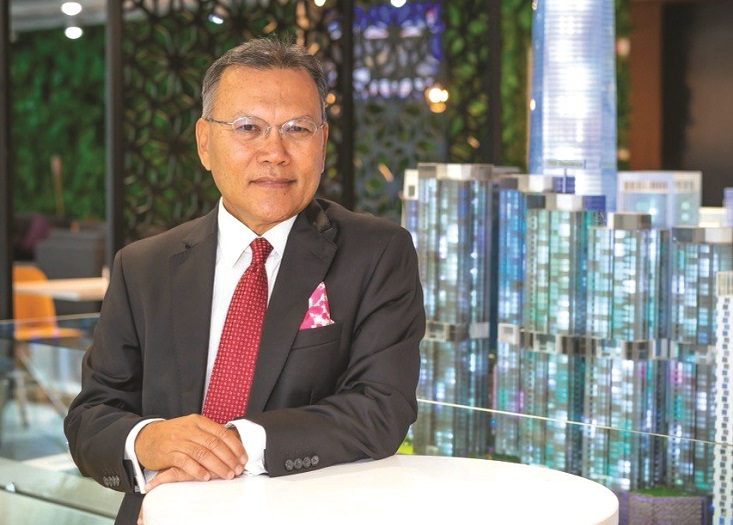
From that perspective, TRX City Sdn Bhd CEO Datuk Azmar Talib explains that the opening of the mall component in late 2023 was a key milestone in the transformative impact of TRX. Today, the vicinity is not just attracting strong footfall from locals, but from regional and international visitors, particularly from Indonesia and China.
“Shoppers, tourists and families now form a significant portion of our daily visitor base. This is very much by design. TRX has always been more than a financial district. It is a lifestyle destination. We believe the old model of a sterile, business only CBD (central business district) has been overtaken by the global shift towards mixed-use, experience-led districts.
“TRX is Malaysia’s answer to that evolution, and the footfall numbers affirm that the market has responded positively,” Azmar tells EdgeProp in an exclusive interview.
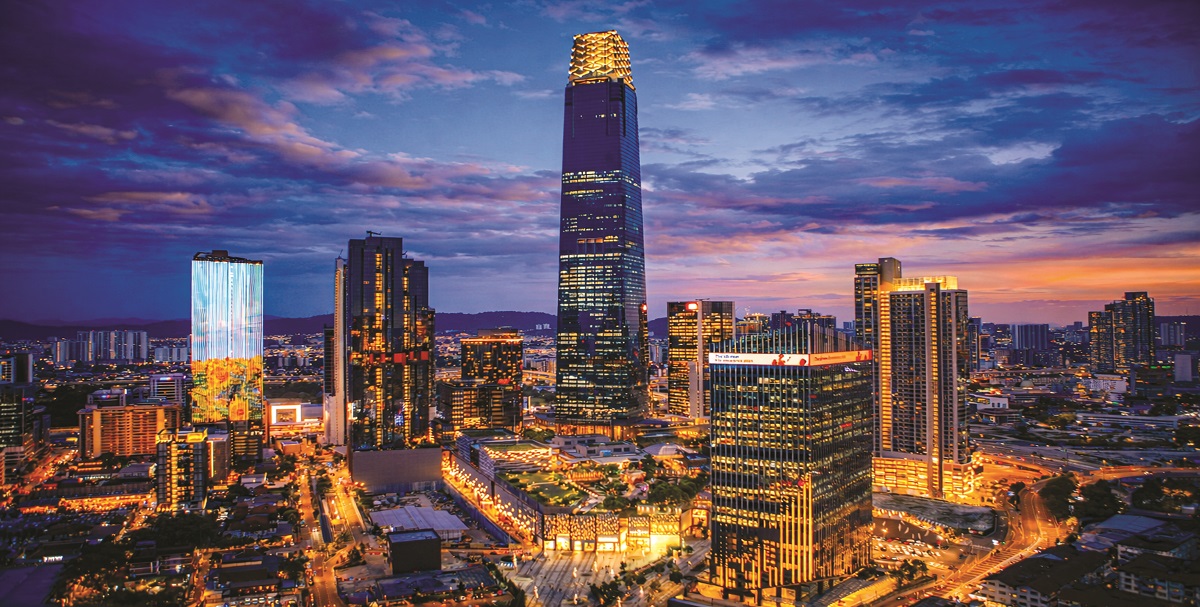
With a large portion of the emerging new precinct already developed, TRX is anchored by a cluster of landmark developments that define its commercial identity. These include Exchange 106, a 106-storey tower developed by Mulia Group, which serves as the flagship office asset within the district, alongside Menara Prudential, Menara IQ TRX, and Menara AFFIN, which house financial institutions and multinational tenants.
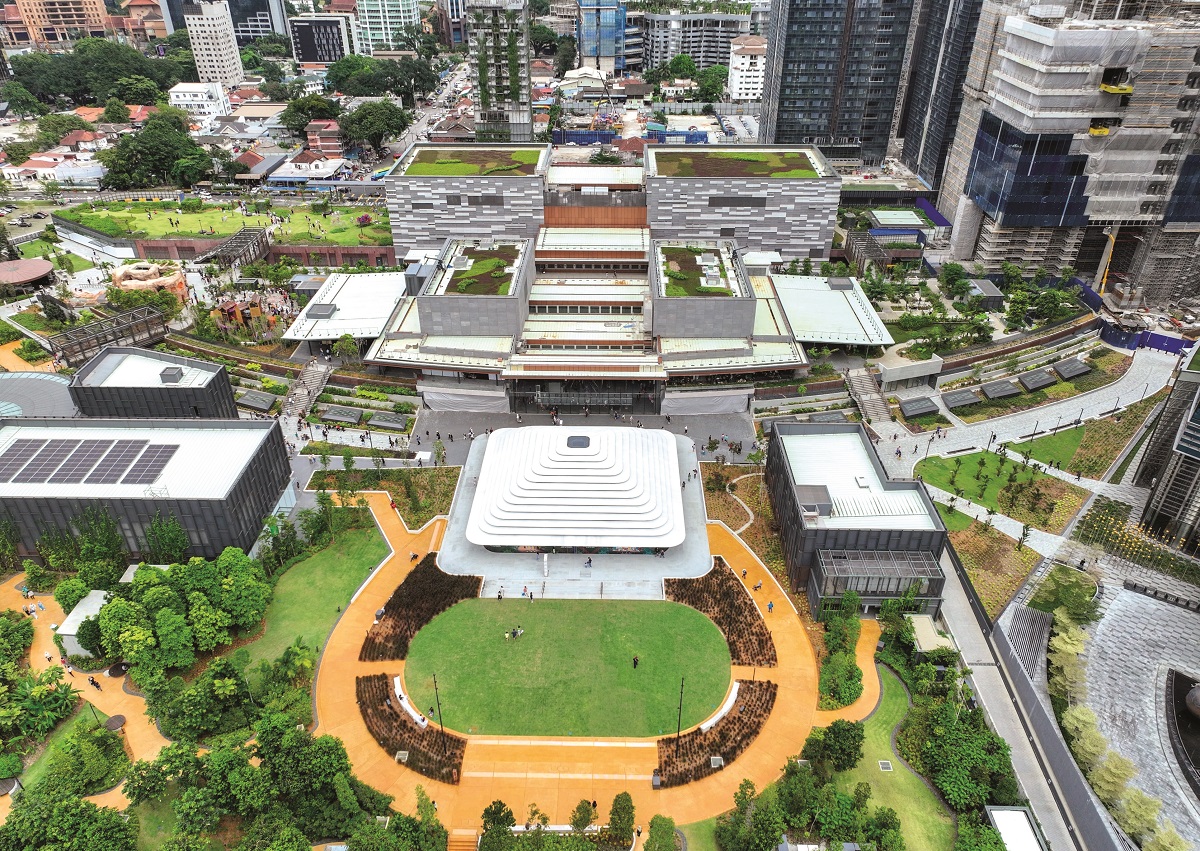
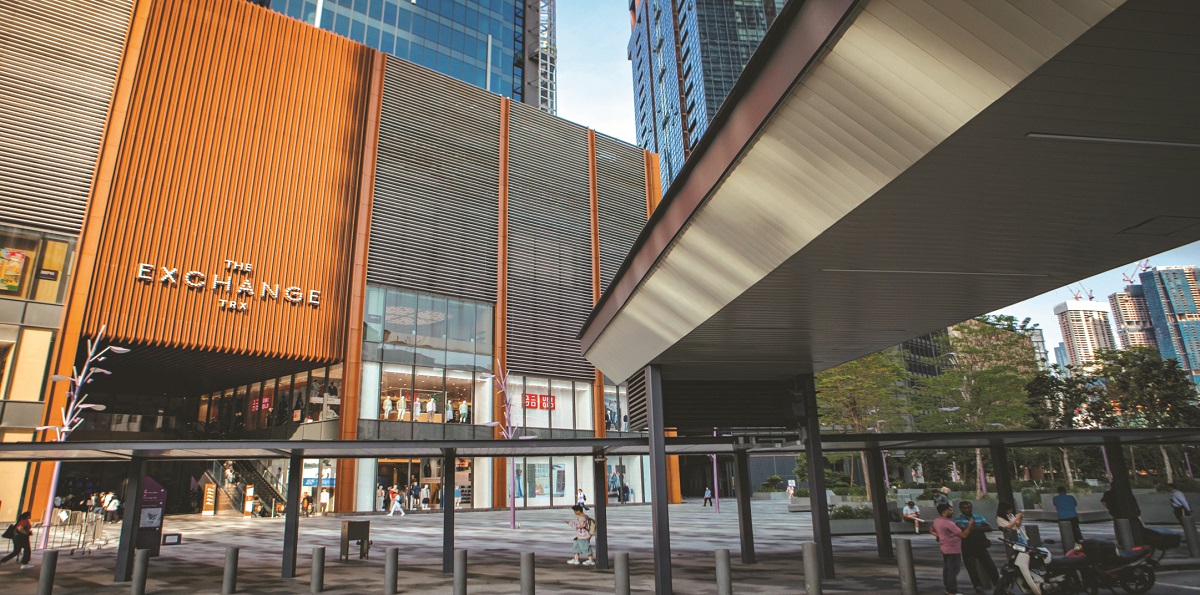
The retail and lifestyle component is led by The Exchange TRX, jointly developed by Lendlease and TRX City, integrating a major shopping attraction, public park space, and supporting lifestyle amenities within the same master plan.
A noteworthy feature of this lifestyle layer is TRX City Park, an approximately 10-acre elevated green space sitting atop the retail development, designed as the precinct’s central public park with landscaped gardens, walking trails, event spaces, water features, and F&B outlets integrated into an urban rooftop environment.
Azmar points out that the park, along with TRX’s wider public realm, accounts for 23% of the overall development, and this is not incidental. It is a deliberate strategic choice that reflects a belief that the public realm is a core economic enabler, not just an amenity.
“The public realm supports commercial activity, retail vibrancy, and event-led activities — from concerts and bazaars to sporting meets, and city-level arts and culture events — positioning TRX as one of KL’s leading social gathering spaces.
“Designed as an integrated extension of the built environment and office towers, it enhances footfall, dwell time and visibility for surrounding businesses, directly reinforcing TRX’s commercial proposition,” he explains.
Meanwhile, the residential component is anchored by TRX Residences, developed by Lendlease in partnership with TRX City; and Core Residence developed by CORE Precious Development Sdn Bhd, a joint venture between China Communications Construction Group (CCCG) and WCT Holdings Bhd.
This forms part of a broader live-work-play ecosystem directly connected to the MRT interchange station (the largest and only MRT interchange in the city) and surrounding commercial towers. It was reported that as of May 2025, daily footfall at the TRX MRT station stood at approximately 50,000.
A flight-to-quality destination
Azmar explains about half of TRX’s plots are now completed and operational, with more coming into play over the next few years. The latest addition is Menara Ethos PwC Malaysia’s incoming headquarters (HQ), marking the 10th development within the cluster.
“[Currently,] we have around 120 companies operating out of TRX, approximately 400 retail and F&B brands in the mall, and close to 20,000 knowledge workers across the district, which is a number that will continue to grow as more components come onstream.
“What’s significant is the quality and nature of these occupants. TRX has become a clear flight-to-quality destination, where global firms are consolidating into fewer but higher-calibre locations,” he adds.
On the corporate front, Azmar says TRX has attracted major international and regional financial institutions including HSBC, Ant International, Prudential, MUFG, Principal, and Bin Zayed International, alongside local champions such as AFFIN and KAF, as well as leading professional services firms, and global technology names such as Huawei and Apple.
He states that office occupancy has crossed 80% by net lettable area, which is a strong signal of institutional confidence in TRX as Malaysia’s premier international business address.
“Our tenant mix spans multinational financial institutions, professional services firms, fintech players, insurance providers, fund managers, and global technology and communications companies. About half of our occupants are in finance and technology-related services, consistent with TRX’s mandate as Malaysia’s purpose-built international financial centre.
“Around 90% of our office tenants are international. We have seen new market entrants establishing their first Malaysian presence here, companies expanding and upgrading their operations, and multinational corporations (MNCs) relocating or consolidating their regional HQs into TRX. The continued interest from fund managers, digital services players and fintech firms, many of whom previously had limited presence in Malaysia, is particularly encouraging,” he states.
“In retail, we have a strong mix of international luxury brands, regional lifestyle concepts, and flagship dining and entertainment operators,” he adds.
From a national standpoint, Azmar says TRX strengthens Malaysia’s competitiveness by anchoring international finance, professional services and innovation within a single, internationally recognisable district.
Making an expanded impact, a catalyst of urban renewal
More than a decade after its inception, the TRX vision can now be seen transitioning from blueprint to market reality. What began as a large-scale infrastructure and placemaking exercise is increasingly being reflected in property fundamentals, from office leasing demand and rental benchmarks to residential pricing and retail positioning.
Beyond this, early signals suggest TRX is not just establishing itself as a premium business address, but also reshaping surrounding districts in measurable ways.
Azmar says TRX City is working closely with Kuala Lumpur City Hall (DBKL) on the Jalan Gading enhancement (connecting TRX to Bukit Bintang), which is currently underway, involving road and facade upgrades, traffic redirection, and new pedestrian-friendly streetscaping designed to host outdoor F&B, pop-up activities, and arts and culture installations.
“The new sidewalks with greenscaping have already improved the pedestrian experience, and we’ve seen smoother traffic along Jalan Imbi as a result,” he points out.

Azmar says the TRX’s master plan was deliberately designed to be “porous” to promote seamless pedestrian movement and ensure inclusivity with surrounding areas including Imbi, Bukit Bintang, and in time, Pudu.
“The broader ambition is to create a seamless, walkable corridor connecting TRX to Bukit Bintang’s shopping belt, reinforcing the district’s role not just as a business hub, but as a genuine contributor to KL’s urban liveability.
“Pedestrian and vehicular experience have been upgraded through improved walkways, beautified back lanes, landscaped plazas, and better traffic flow management,” he explains.
Visibly, TRX is raising the profile of surrounding vicinities, and it is driving fresh impetus to upgrade. Land values are being recalibrated, older assets are facing renewed repositioning pressure, and neighbouring areas such as Bukit Bintang are experiencing shifts in footfall, connectivity, and tenant behaviour.
Infrastructure and policy certainty driving long-term positioning
Beyond that, TRX’s transformation is underpinned by infrastructure and policy alignment.
The precinct is directly integrated with the MRT network, including interchange connectivity between major lines, while road upgrades and pedestrian linkages are improving accessibility between TRX and surrounding districts. The SMART Tunnel and internal traffic systems further enhance mobility by separating through-traffic from local circulation.
“TRX has catalysed meaningful urban rejuvenation across its surroundings with vibrant new shop clusters, improved vehicular connections, friendlier pedestrian infrastructure, and an integrated public transportation network via the TRX MRT Interchange linking to Greater KL.
“It has also transformed the boundaries and profile of KL’s CBD, promoting walkability and extending the city’s commercial spine from KLCC through Bukit Bintang to TRX,” Azmar says.
Knight Frank research and consultancy executive director Amy Wong also points out that TRX carries a profile that is relatively rare in the Klang Valley context: a precinct with a clear policy mandate, an established financial district identity, and an MNC-grade tenant base that gives investors something concrete to underwrite.
“The designation of TRX as KL’s (or Malaysia’s) international financial district has been a meaningful driver of investor interest,” she says.
“Beyond attracting occupiers, it has provided the kind of policy certainty that institutional capital looks for when assessing long-term commitment to a precinct,” Wong adds.
Wong also cites Knight Frank group managing director Keith Ooi, who says investors are sharpening their focus on long-term fundamentals, assets that can deliver sustainability, efficiency and adaptability.
“On those criteria, TRX-grade assets are in a different category from most of the existing KL office stock.
“We see that capital growth will remain selective across the broader market. Rental growth is expected to favour prime, well-specified offices, while older or less well-located assets face continued pressure. For investors, the implication is clear: the upside is concentrated in a small number of precincts, and TRX is among them,” she explains.
The question is no longer about whether TRX will have an impact, it is now about how far that influence will extend, and which parts of KL’s property market stand to benefit the most as the precinct matures.
Property value growth visible, but gaps appearing between old and new
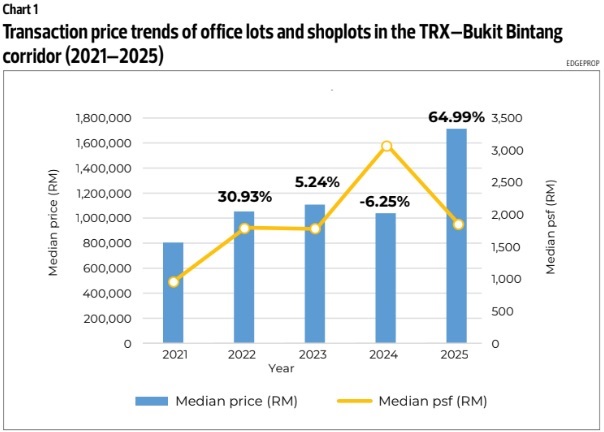
An overview of EdgeProp EPIQ data on the office lot and shoplot market in the TRX and Bukit Bintang corridor revealed notable movements in 2024 and 2025 (Chart 1). Median commercial property prices rose from RM1.04 million in 2024 to RM1.71 million in 2025, but median psf values dropped from RM3,081 psf to RM1,866 psf over the same period.
Property consultants actively engaged in the area also note that land values around the corridor are being recalibrated upwards, particularly along key arteries such as Jalan Tun Razak, Jalan Imbi, and Jalan Barat.
Furthermore, they observe that older commercial sites are increasingly being repositioned for mixed-use or high-rise redevelopment strategies, reflecting a broader shift in investor expectations.
New capital is also flowing into luxury residential towers, boutique hospitality assets, and Grade A office developments aligned with TRX’s positioning as a financial ecosystem rather than a standalone CBD.
Landmark assets such as Exchange 106 and The Exchange TRX Mall have emerged as prestige anchors for the entire vicinity, reinforcing institutional confidence while attracting multinational occupiers and premium retail brands.
Against this backdrop, Knight Frank’s Wong states that TRX is beginning to mature as a precinct, and the occupiers’ flight-to-quality trend has been well documented.
According to her, there is a clear and widening gap between what new Grade A assets command versus older stock, and the numbers reflect this.
“By 4Q2025, the new CBD, which includes areas within the Golden Triangle such as Bukit Bintang, was running at 77.4% occupancy (up from 76.8% the previous quarter), while the old CBD (traditional financial districts around Kotaraya, the area near Bursa Malaysia, and the former Maybank HQ) sat at 54.1%,” she says.
“New CBD rents are around RM7.37 psf per month against RM4.45 psf in the old CBD, a spread of over 65%,” she says.
She adds that investors underwrite that occupancy and rental differential when pricing assets, so capital values follow.
Exchange 106 is now at more than 75% committed tenancies of around 1.7 million sq ft, with anchor tenants including Huawei, Ant International, and Accenture.
“For older buildings, the pressure is unlikely to ease. Our view has been that older and lower-grade stock will need targeted upgrades, modernisation or asset repositioning to stay relevant,” she adds.
“Even then, the gap to a purpose-built, green-certified, MRT-connected development is a difficult one to close. Occupiers want large floor plates, typically 20,000 sq ft or more, strong ESG credentials and lifestyle amenities integrated into the development. Most older stock was never designed with that in mind,” she adds.
From a market standpoint, this divergence is increasingly structural rather than cyclical.
CBRE | WTW group managing director Tan Ka Leong says the TRX precinct is a relatively newly established international financial district, with a limited number of completed and leasing office buildings in its early development phase.
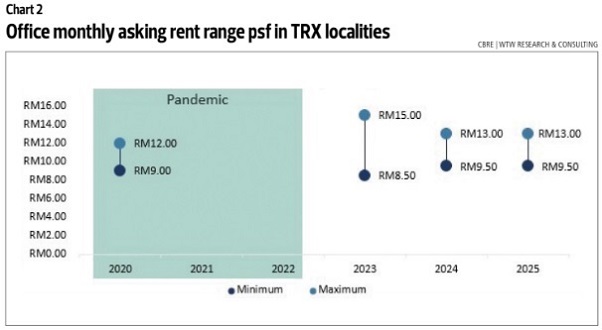
“In 2020, only two completed office buildings within the TRX catchment had observable rental evidence, namely Menara Prudential and Exchange 106, with asking monthly rents generally ranging from approximately RM9.00 to RM12.00 psf (Chart 2).
“The 2021–2022 period is excluded because of data unavailability, partly affected by disruptions during the Covid-19 pandemic,” he says.
He adds that from 2023 onwards, asking rents within TRX ranged from approximately RM8.50 to RM15.00 psf, reflecting variations across different office buildings within the precinct.
“In 2024–2025, rents have consolidated within a narrower band of approximately RM9.50 to RM13.00 psf, indicating improved pricing stability as early-stage headline pricing normalises, and increased leasing activity across multiple developments within TRX leads to more competitive market-based rent levels.
Demand inside TRX is splitting into tiers, not just one market anymore
Tan says specific rental benchmarks for office and retail units by size (1,800–3,000 sq ft) within TRX remain limited.
“Demand is currently anchored by financial institutions and related occupiers, in line with TRX’s positioning as an international financial district supported by government-led initiatives.
“In addition, corporate tenants, professional services firms, regional offices, as well as co-working and flexible workspace operators form a key part of the demand profile, many of which typically require medium to larger floor plates. These occupiers are attracted by TRX’s high-quality specifications, efficient layouts, and integrated amenities,” he explains.
At the same time, Tan says there is also an observable demand for smaller office units (e.g. below 3,000 sq ft), although this tends to be more selective.
“This segment is typically driven by boutique firms, representative offices, family offices, and smaller corporate teams.
“A portion of this demand is also accommodated through co-working and flexible workspace providers operating within the buildings, catering to occupiers seeking flexibility and shorter-term commitments,” he adds.
Commercial occupancy growth is real but the structure behind it matters
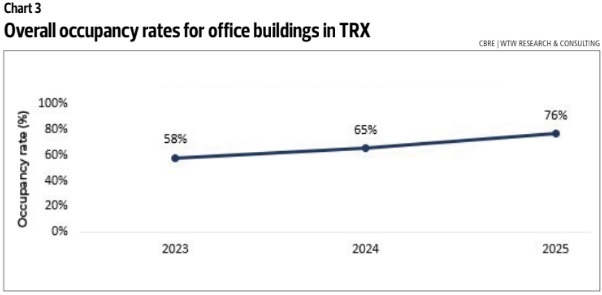
Tan adds office occupancy levels in the TRX area have generally improved since 2023 (Chart 3), although the movement should be interpreted with some reservations, given that several key buildings within the precinct are substantially owner-occupied.
“For owner-occupied developments such as Menara Prudential (413,000 sq ft NLA), Menara IQ TRX (568,000 sq ft NLA) and Menara AFFIN HQ (576,000 sq ft NLA), occupancy levels were already relatively high from 2023 onwards, at approximately 78% to 90%, before increasing further to around 94%–97% by 2025.
“This reflects primarily committed owner-occupier space rather than open-market leasing activity,” he says.
Tan states across KL’s office market, well-located prime office buildings have generally outperformed non-prime and older stock in recent years, particularly in terms of occupancy, tenant profile, and rental positioning.
“Demand has increasingly shifted towards buildings with efficient floor plates, ESG-compliant specifications, strong building management, and enhanced accessibility to transport and lifestyle amenities.
“This reflects a sustained post-pandemic emphasis on workplace quality, employee experience, and corporate branding,” he says.
He also points out that building age is not the sole determining factor of performance, with location, asset quality, and building management playing a more critical role in driving leasing performance.
“Within this context, office developments in the TRX locality are broadly benefiting from this structural shift in demand. As a relatively new purpose-built financial district, TRX is characterised by a high concentration of Grade A and premium Grade A office buildings, which align well with current occupier preferences for quality, efficiency, and integrated amenities.
“This has supported improving leasing momentum and occupancy performance across selected developments within the precinct, particularly market-leased assets such as Exchange 106, although outcomes continue to vary depending on building ownership structure, scale, and leasing maturity,” Tan says.
He adds the precinct is further supported by government-led initiatives and incentives aimed at encouraging occupier relocation and business establishment within TRX, which provide additional reinforcement to its positioning as a financial hub.
Knight Frank’s Wong adds that tenant composition reinforces the investment case.
“Demand in TRX has been driven by technology, finance and professional services sectors, fuelled by local expansions and new regional set-ups, with MNCs and larger firms increasingly seeking larger spaces to accommodate expanded operations.
“That occupier profile translates into income stability and lease covenant quality that the broader market cannot easily replicate,” she says.
Overall, while the value of surrounding commercial properties stand to benefit from the growing profile of TRX, long-term expectations should be moderated for older properties that cannot keep pace with the transformative impact it is having on the area, and the new barometer it is setting for quality expectation.
Retail transformation and spillover effects
Retail is another key pillar of TRX’s ecosystem.
On retail, Wong explains that The Exchange TRX has established itself within the already highly competitive Klang Valley retail scene.
“With over 500 experiential stores, a firstto-market brand line-up and the largest rooftop public park in KL, it has demonstrated strong footfall resilience and occupancy/rental performance to match,” she says.
“Grade A assets in integrated, well-connected precincts like TRX are diverging from older stock, and we expect that gap to widen as more supply enters the market and occupiers continue to trade up,” she says.
CBRE | WTW’s Tan agrees that the opening of The Exchange TRX Mall has introduced a new major retail node within KL’s CBD, contributing to a gradual rebalancing of retail demand across the Bukit Bintang–TRX corridor.
“However, its impact on established malls such as Pavilion KL has been more evolutionary than disruptive at this stage,” he adds.
Tan explains that rather than displacing existing retail centres, the opening of TRX Mall has expanded KL’s prime retail landscape.
He says malls such as Pavilion KL continue to maintain a relatively stable tenant mix and positioning as a prime luxury retail destination, supported by its established role within the Bukit Bintang retail cluster and strong international brand presence.
“This suggests that its core positioning remains intact, with demand anchored by luxury fashion, F&B, and experiential retail categories,” he says.
Tan adds The Exchange TRX Mall, in contrast, is still in the early stages of lease stabilisation and is attracting tenants that are increasingly prioritising presence within a new integrated financial district supported by office workers, residents, and surrounding catchment demand.
“Some retailers are adjusting their store locations, with certain brands operating in both established malls such as Pavilion KL and new destinations like The Exchange TRX Mall, rather than relocating entirely from one to the other.
“This reflects a gradual redistribution of retail demand as brands expand into emerging prime nodes while maintaining exposure in existing core retail centres.
Addressing the relationship between TRX and the Bukit Bintang shopping hub, Tan says that at this stage, the two destinations appear to be catering to partially different catchments and retail functions, with longer-term positioning still evolving as TRX matures.
At the same time, he explains the completion of TRX has generated some spillover leasing demand in nearby areas such as Bukit Bintang, Imbi and Pudu, although the impact is selective rather than broad-based.
“Bukit Bintang appears to be the primary relative beneficiary, supported by its established role as a prime retail, hospitality and mixed-use destination, its relatively diverse stock profile, and strong connectivity to TRX.
“The completion of TRX has contributed to increased daytime activity and reinforced overall CBD vibrancy, which in turn supports retail and F&B demand in the area. However, given its already mature positioning, the impact is more of reinforcement rather than a structural shift in demand,” he adds.
At the same time, demand remains differentiated across segments.
Tan says Imbi and Pudu have experienced more limited and selective spillover effects.
“Some demand is observed from cost-sensitive occupiers and SMEs seeking proximity to TRX at more affordable rents; however, overall leasing activity remains constrained by a relatively high proportion of older office stock with less competitive specifications.
“As a result, demand tends to concentrate in better-located or refurbished buildings with stronger accessibility and supporting amenities, while weaker assets continue to face leasing pressure,” he explains.
Moving to the next stage of TRX evolution
Looking ahead, Azmar says TRX’s sustained leadership will be defined by more than just its hardware, which are the buildings, infrastructure and public realm.
He reveals that the upcoming Monash University Malaysia campus at TRX will add another critical dimension, which is embedding knowledge, research and innovation within the financial ecosystem, and providing a direct talent pipeline that will strengthen TRX’s appeal to international firms seeking access to top-tier graduates and research capabilities right within the district.
In addition to Monash University Malaysia campus, newly-planned upcoming components in the southern precinct will complete TRX’s ecosystem and cement its standing as a fully established CBD with the full range of MICE (meetings, incentives, conferences, and exhibitions), lifestyle, and knowledge infrastructure that a world-class international finance centre (IFC) would require.
“It’s the software: the governance frameworks, digital services, talent experience, partnership ecosystems and community programming that makes TRX a place international talent wants to work, live and build careers in.
“As we enter TRX 2.0, our focus is on deepening this ecosystem, combining financial depth, innovation, talent and lifestyle so that TRX remains not only Malaysia’s purpose-built IFC, but a globally competitive business hub that continues to attract the world’s best firms and people,” Azmar concludes.
RESIDENTIAL MARKET: STEADY DEMAND WITHIN A PREMIUM ECOSYSTEM
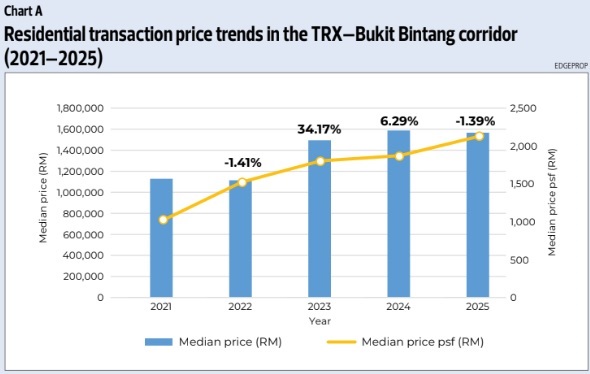
The residential market in the TRX and Bukit Bintang corridor showed stronger activity in 2024 and 2025, according to EdgeProp data (Chart A). Median transaction prices slipped from RM1.58 million in 2024 to RM1.56 in 2025, but median psf rose from RM1,873 to RM2,128 over the same period.
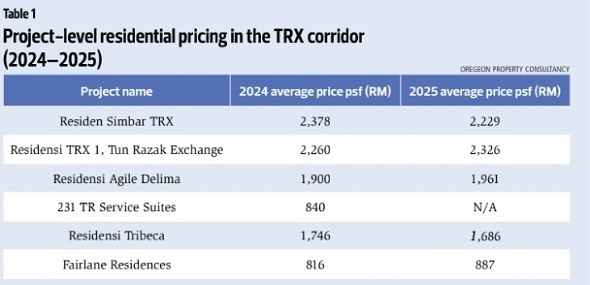
At project level, based on Oregeon Property Consultancy’s data, Residen Simbar TRX remained among the highest-priced developments in the vicinity at RM2,378 psf in 2024 and RM2,229 psf in 2025, while TRX Residensi I recorded RM2,260 psf and RM2,326 psf respectively.
This reflects the positioning of the TRX precinct and its immediate surrounding areas as a high-end, integrated urban living environment, supported by proximity to employ ment centres, lifestyle amenities and public transport.
UPCOMING AND PLANNED PROJECTS IN TRX
Lot C7.12 (TRX Financial Quarter), with PwC Malaysia headquarters as anchor tenant
Developed by TRX City Sdn Bhd, TRX Financial Quarter is a 39-storey Grade A office tower next to Menara IQ, expected to be completed in 2029. PwC Malaysia is set to relocate its headquarters here, occupying 200,000 sq ft as anchor tenant, out of the 800,000 sq ft net lettable area.
TRX Residences II
Developed by Lendlease, following the sold-out success of TRX Residensi I, it will be an elevated version of premium urban integrated homes in two towers, featuring oneto three-bedroom units.
Monash University TRX campus
Expected to be completed in 2032, the 22-storey vertical campus (~1.5 million sq ft) is a RM2.8-billion education hub for 22,000 students.
..........
EdgeProp brings you another month of data-driven insights, exclusive interviews, and market commentaries. Subscribe now for your free copy!
Follow Us
Follow our channels to receive property news updates 24/7 round the clock.


Telegram


Latest publications
View AllFollow Us
Follow our channels to receive property news updates 24/7 round the clock.
Malaysia's Most
Loved Property App
The only property app you need. More than 200,000 sale/rent listings and daily property news.