Urban renewal or administrative fantasy? Why many of the 139 identified areas may never be redeveloped
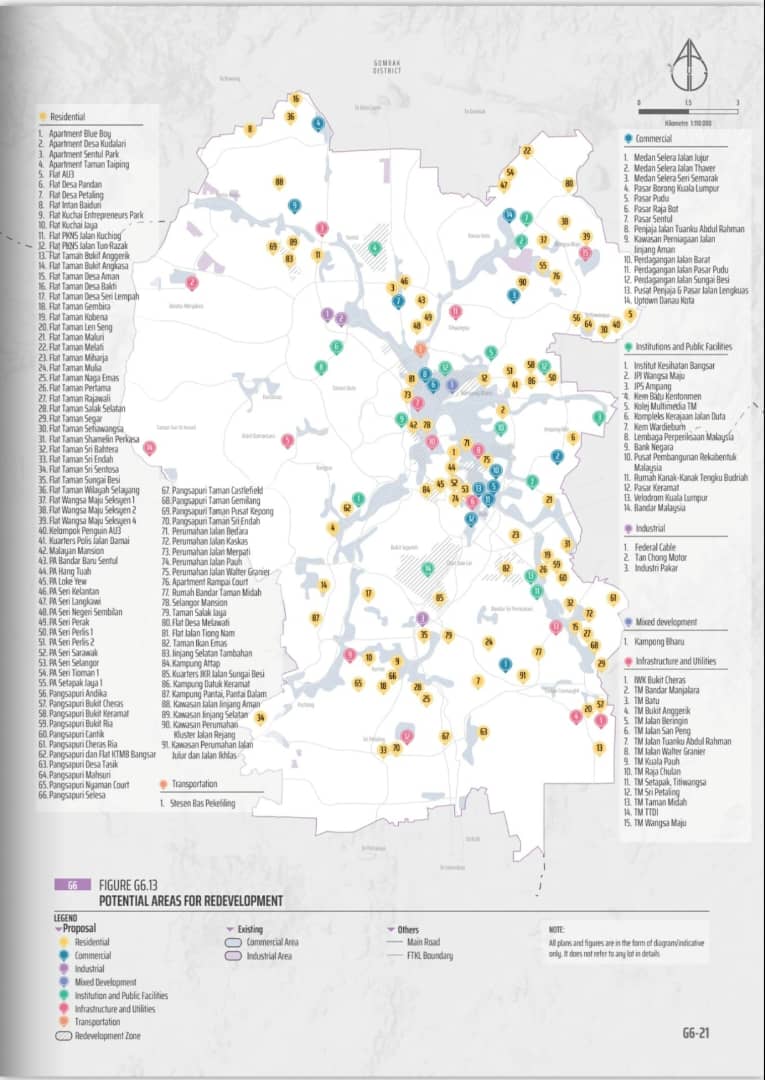
Housing and Local Government Minister Nga Kor Ming has repeatedly referred to 139 potential redevelopment areas in Kuala Lumpur in discussions surrounding the proposed Urban Renewal Act (URA). According to government statements, these areas comprise 91 residential locations together with 48 commercial, industrial, institutional and government-owned lands. The “fantasy” argument advanced is simple: Kuala Lumpur contains ageing and under‑utilised properties that require renewal to prevent urban decay.
However, the withdrawal of the URA Bill from Parliament in January this year has exposed a fundamental weakness in the government’s narrative. The existence of 139 identified redevelopment areas does not automatically mean that 139 areas are available, suitable or legally capable of being redeveloped. In reality, many of these areas fall outside the direct authority of the Housing and Local Government Ministry (KPKT), and some may not ultimately proceed to redevelopment.
The first question that must be asked is whether the public was given a realistic picture of these purported 139 redevelopment areas.
The KL Structure Plan 2040 (KLSP2040) identified 139 areas for potential redevelopment over a period extending to the year 2040. These include residential areas, brownfield sites, old industrial zones, transit‑oriented locations and institutional lands.
Yet the minister’s repeated references to these areas create a perception among some observers that they represent a readily available inventory waiting for implementation under the URA. Whether that perception accurately reflects their status remains open to question.
Military lands?
A redevelopment area is not merely a plot marked on a planning document. It must first satisfy ownership, planning, legal, operational, financial and political requirements. KPKT cannot simply identify a piece of land and declare that redevelopment will proceed.
This limitation becomes glaring when one examines the inclusion of military camps like “Kem Batu Kentonmen” at 4th Mile, Jalan Ipoh (now Jalan Sultan Azlan Shah) and “Kem Wardieburn” at Jalan Genting Kelang, Wangsa Maju.
Military land belongs to the Federal Government but falls under the exclusive control and operational jurisdiction of the Ministry of Defence (Mindef). Decisions affecting military bases involve national security, defence strategy, troop deployment, logistics and long‑term military planning. The Housing Minister cannot unilaterally direct the redevelopment of an army camp, as such land falls under the jurisdiction and operational control of the Mindef.
Even if a military camp were identified in KLSP2040 as a potential redevelopment area, any proposal would require consultation with, and potentially approvals from, the Mindef, other relevant government bodies and security agencies. In many cases, military installations cannot be relocated without substantial replacement infrastructure elsewhere. The experience of previous attempts to relocate military facilities demonstrates the complexity involved. Such exercises often take years or even decades to negotiate because replacement sites, funding and strategic requirements must first be resolved.
Consequently, presenting military camps as part of a pool of “redevelopment‑ready” areas could create a misleading impression of their readiness. These locations may appear attractive on planning maps but remain practically inaccessible for urban renewal purposes. The same concerns apply to government institutional lands.

Several identified areas reportedly involve government departments, public agencies, markets, food courts, orphanages and utility providers. Such lands serve public functions and cannot simply be transferred to developers just because a redevelopment scheme appears commercially attractive.
Infrastructure and utilities lands?
Utility companies maintain critical infrastructure that supports the functioning of the city. Electricity substations, water treatment facilities, telecommunications installations and transport depots are not vacant assets waiting to be monetised. Their relocation involves enormous costs and technical challenges.
In many cases, redevelopment would require replacement facilities before existing operations can be moved. The financial and operational requirements alone may affect the feasibility of redevelopment.
Bank Negara land?
Another frequently discussed example is land associated with Bank Negara Malaysia (BNM). BNM is not merely another government agency; it is the nation’s central bank and one of the country’s most important financial institutions. Its land holdings include operational facilities, administrative buildings, security‑sensitive installations and assets connected to the country’s monetary system.
The suggestion that BNM land should be regarded as a potential urban renewal location raises serious questions. Has BNM agreed to relocate? Has any feasibility study been conducted? Has any economic justification been presented? Has the Cabinet endorsed such a move?
To date, there appears to be no public indication that BNM intends to vacate strategically important properties for redevelopment purposes. If not, why should such institutional lands be included as examples supporting the need for a URA?
The inclusion of these types of institutional and strategic lands creates an inflated perception of redevelopment potential. This leads to a broader concern: does the figure of 139 redevelopment areas represent a realistic redevelopment pipeline, or a broader planning aspiration that will face significant implementation constraints?
URA plan only as credible as its feasibility
The public was repeatedly told that KL contains vast redevelopment opportunities and that the URA was urgently required to unlock them. Yet when one removes military camps, operational government facilities, utility installations and other institutional lands, the actual number of realistically-developable areas may be significantly lower.
This matters because public policy should be based on accurate information rather than headline figures. The debate surrounding urban renewal should focus on genuinely distressed residential neighbourhoods, ageing strata developments and abandoned projects where intervention is justified and necessary.
Instead, the government has chosen to bundle together a diverse range of areas with vastly different ownership structures and legal constraints. Such an approach risks overselling the benefits of the proposed legislation.
The irony is that the strongest case for urban renewal does not depend on military camps, utility facilities or BNM land. The real challenge lies within ageing residential developments where poor maintenance, inadequate sinking funds and deteriorating infrastructure have created genuine social and economic problems. These are the locations where policy attention should be concentrated. Unfortunately, by relying on an expansive list of 139 redevelopment areas, the government may have weakened rather than strengthened its argument.
Critics have questioned whether the identified areas are actually available for redevelopment, highlighting concerns over implementation feasibility. This lack of clarity has contributed to growing scepticism regarding the URA Bill and its implementation framework.
Urban renewal is undeniably necessary in many parts of KL. No serious observer disputes that ageing buildings and obsolete developments require intervention. However, urban renewal must be grounded in practical realities. A redevelopment programme is only as credible as its ability to be implemented, in particular:
1) Military camps require defence approvals.
Military camps fall under the jurisdiction of Mindef and involve national security considerations.
2) Government institutions require policy approvals.
Federal and state government lands involve additional layers of Cabinet and administrative approvals.
3) Utility sites require operational approvals.
Utility facilities require approvals from the respective operators, service providers and regulators before any relocation can even be contemplated.
*Bank Negara properties require central bank approval.
Land occupied by BNM cannot simply be earmarked for redevelopment without the Ministry of Finance and the central bank’s consent and strategic review.
None of these decisions fall within the unilateral powers of the Housing Minister.
Without such transparency, the headline figure of “139 redevelopment areas” risks creating unrealistic expectations among property owners, investors and the public. This public policy deserves rigorous scrutiny because urban renewal must balance redevelopment objectives with property rights, public interest and administrative realities.
Therefore, before any future attempt is made to revive the URA, the government should first publish a transparent, detailed assessment of each of the 139 identified redevelopment areas. Malaysians deserve to know which locations are realistically capable of redevelopment, which remain subject to inter‑ministerial approvals and which are unlikely ever to proceed. Stakeholder consultation is essential; those directly affected should have meaningful participation in decisions affecting their properties and communities.
Only then can the public assess whether the celebrated figure of 139 redevelopment areas represents genuine redevelopment opportunities or merely an exercise in administrative wishful thinking. Urban renewal should be based on achievable projects, not hypothetical possibilities. The distinction is crucial, because good policy begins with honest numbers.
This article is written by Datuk Chang Kim Loong, honorary secretary-general of the National House Buyers Association (HBA). HBA is a voluntary non-governmental and not-for-profit organisation manned wholly by volunteers.
HBA can be contacted at:
Email: [email protected]
Website: www.hba.org.my
Tel: +6012 334 5676
The views expressed are the writer’s and do not necessarily reflect EdgeProp’s.
..........
Read about emerging trends, data-backed insights, growing subsectors, and expert commentaries in EdgeProp print. Subscribe now for your free copy!
Follow Us
Follow our channels to receive property news updates 24/7 round the clock.


Telegram


Latest publications
View AllFollow Us
Follow our channels to receive property news updates 24/7 round the clock.
Malaysia's Most
Loved Property App
The only property app you need. More than 200,000 sale/rent listings and daily property news.