JLL: Chinese firms’ overseas drive is outpacing their corporate real estate strategy

PETALING JAYA (July 20): Chinese companies’ global push is forcing a rethink of how they manage bricks and mortar.
These Chinese firms now have an overseas footprint in 190 countries and regions and have registered nine consecutive years among the world’s top three sources of outward direct investment (ODI), according to a June 2026 whitepaper by Jones Lang LaSalle (JLL), Thriving Beyond: Corporate Real Estate Strategies for Chinese Companies Going Global. China’s ODI grew 7.1% in 2025 to US$174.4 billion (RM712.25 billion), yet JLL argues that corporate real estate (CRE) remains a weak link in how many companies plan and execute international expansion.
The report blends survey responses from 91 organisations — Chinese companies with overseas operations and the professional firms that advise them — with seven case studies covering office leasing and fit-out, retail rollouts, logistics, industrial facilities, data centres and Hong Kong Stock Exchange IPO preparation. Its central contention is that real estate decisions are still made in a fragmented, reactive way, often managed without specialist CRE support or systematic planning.
Greenfield expansion raises the stakes for real estate
These challenges are emerging as the structure of China’s ODI shifts. Greenfield investment has overtaken cross-border mergers and acquisitions (M&A) as the main channel from 2020 onwards. In 2025, Chinese greenfield projects reached US$100 billion, up 18% year-on-year and accounting for around 80% of total ODI.
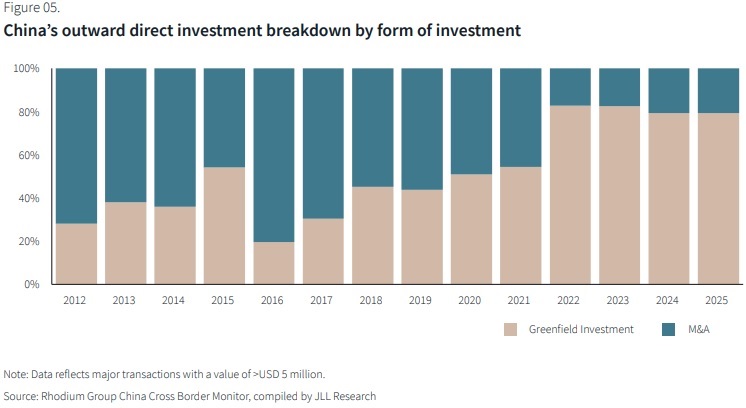
That means a greater share of overseas expansion now involves developing physical facilities — such as factories, offices and logistics assets — rather than acquiring existing businesses.
Once expansion takes that form, corporate real estate decisions become more central to business strategy. Site selection, planning approvals, utility capacity, labour catchments and leasing terms directly shape cost, timelines and risk, yet many companies appear to be making those decisions with processes better suited to straightforward domestic leases than complex assets in unfamiliar jurisdictions.
JLL notes that Malaysia is among the markets benefiting from this shift, particularly in manufacturing. Chinese investment has ranked among Malaysia’s top three sources of foreign direct investment for four consecutive years, with flows still concentrated in familiar hubs such as the Klang Valley, Penang (including Kulim in Kedah) and Johor, while newer locations like Kuantan in Pahang and parts of Perak are drawing attention for their port access and resource base.
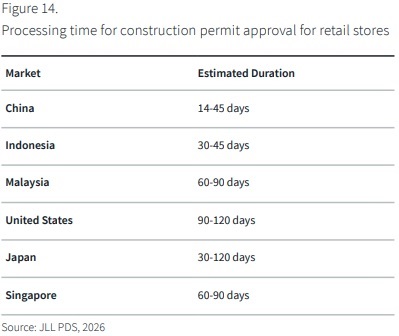
According to JLL’s Malaysia research team, Chinese manufacturers are using the country as a platform for integrated supply-chain localisation, tapping a skilled, multilingual workforce, a relatively straightforward legal framework and competitive land and utility costs.
They highlight Malaysia’s established semiconductor and electronics components ecosystem as a key attraction, and say many Chinese firms bring key suppliers with them, forming investment clusters that JLL says have coincided with three years of steady growth in the manufacturing sector.
Fragmented decisions, predictable problems
Against this backdrop of expanding physical footprints, JLL argues that many companies are still managing overseas real estate reactively rather than strategically.
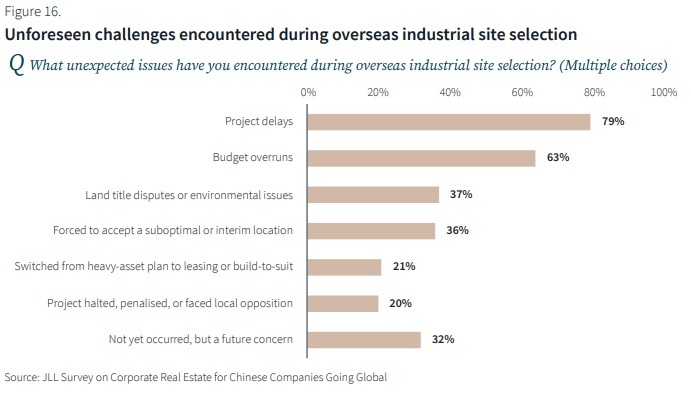
Among respondents that had carried out overseas real estate projects, 82% reported unexpected challenges during site selection alone. Within that group, 63% faced project delays that disrupted expansion timelines, 52% ran into budget overruns and 31% ended up in sub-optimal or interim locations simply to get operations started.
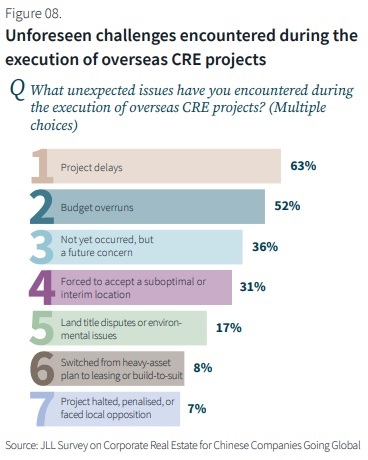
A further 17% encountered land title disputes or environmental issues, 8% were forced to abandon heavy-asset strategies in favour of leasing or build-to-suit arrangements and 7% suffered stoppages, penalties or local community opposition.
The causes are familiar. JLL’s survey identifies “differing expectations around response times” as the most common pain point, cited by 78% of respondents.
Many overseas real estate markets work on longer approval chains and rely heavily on email; while Chinese companies are used to compressed timelines and instant messaging as the default mode of business communication.
A second cluster of issues stems from unfamiliarity with local practices: 63% flagged gaps in understanding of lease structures, security deposits and credit standards, while 51% pointed to limited knowledge of local property markets and an inability to benchmark rents or assess supply.
The case studies put these numbers into context. In one logistics warehouse example, a Chinese operator expanding across Europe discovered that 7–10-year leases were standard, clashing with its preferred 1–3-year commitments.
Compliant dangerous goods warehouses, especially for lithium batteries, were scarce, and 24/7 operations — taken for granted in China — proved incompatible with labour and freight regulations near European city centres.
Another scenario describes a “hot location trap” in industrial parks: popular zones become crowded, pushing up land and rental costs, straining power capacity and intensifying competition for labour, eroding the clustering benefits that first attracted investors.
A six-pillar playbook — if companies choose to use it
JLL organises its recommendations into a six-pillar framework for improving how Chinese companies manage overseas property.
The pillars are: integrating CRE planning into global expansion strategy from the outset; deepening local market knowledge; clarifying decision-making protocols between headquarters and regional teams; building long-term advisory relationships instead of relying on ad-hoc vendors; advancing digital tools for portfolio management; and balancing lease structures and asset strategies in ways that consciously incorporate ESG considerations.
The survey suggests there is at least stated intent to move in that direction. About 75% of respondents said they plan to establish standardised overseas site selection processes within two years.
47% intend to engage external professional real estate advisers, 38% aim to develop a systemic overseas CRE strategy and 35% plan to create dedicated in-house CRE roles.
Demand for digital tools is another clear signal. 82% of respondents reported strong interest in digital real estate platforms, and 80% specifically highlighted the need for systems that can automatically generate fit-out cost estimates across multiple countries.
The survey points to growing demand for digital tools capable of supporting increasingly complex overseas real estate portfolios.
Overseas growth is feeding domestic office demand
The whitepaper also tracks how global expansion is feeding back into China’s own office markets.
Drawing on data from major Grade A markets in Beijing, Shanghai, Guangzhou, Shenzhen, Hong Kong, Chengdu, Nanjing, Hangzhou and Wuhan, JLL notes that Chinese companies with overseas operations have maintained robust leasing momentum over the past three years.
In sectors such as TMT (technology, media and telecommunications), retail, manufacturing, life sciences and energy, firms with international businesses account for more than 40% of total leasing volume within their sectors; in high-growth niches like automotive, integrated circuits, gaming, consumer electronics and e-commerce, that share exceeds 60%.
The survey adds a labour-market dimension. 78% of respondents said overseas expansion directly drove domestic headcount growth and office expansion, not only for frontline international teams but also for operations, marketing and supply chain functions.
In consumer electronics, JLL notes that more than 30% of large office leases (over 5,000 sq m) concluded in Shenzhen over the past two years were signed by consumer electronics companies and their supply chain partners, over 90% of which operate internationally.
Hong Kong features prominently in this domestic-overseas loop. The number of regional headquarters, regional offices and local representative offices established by mainland companies in the city surpassed 3,000 by 2025, after steady growth since 2010.
That year, mainland firms bought HK$13.9 billion (RM7.25 billion) of commercial property in Hong Kong, more than doubling their market share from 12.5% to 31%.
Among the headline deals was Alibaba Group and Ant Group’s HK$7.2 billion acquisition of office space at One Causeway Bay in the fourth quarter of 2025, designated as their international headquarters.
JLL also notes that, as of March 2026, Central Hong Kong office rents remained 42% below their 2019 peak despite a quicker-than-expected recovery, a gap that may continue to support leasing and investment activity.
JLL is both observer and participant
The whitepaper is not presented as a neutral academic study. JLL describes itself as a Fortune 500 commercial real estate services and investment management firm with annual revenue of US$26.1 billion, operations in more than 80 countries and a workforce of over 113,000.
The report was produced by its China and Hong Kong research teams, led by head of research for China Daniel Yao, and senior director of research for Hong Kong Cathie Chung.
The report also highlights services that align with the challenges identified in the survey, including advisory, transaction management, project delivery and asset valuation. The survey findings align with areas where JLL already provides advisory, transaction management, project delivery and valuation services, underscoring how demand for professional CRE support is rising alongside overseas expansion.
Pressure to professionalise is unlikely to fade
Taken together, the data points to continued structural demand for more professional CRE management among globally expanding Chinese companies.
The combination of cheaper prime office space in Hong Kong, continued greenfield industrial investment across Southeast Asia, the Middle East and Europe, and the operational complexity documented in JLL’s case studies suggest continued pressure for more structured CRE management.
Continuing to manage overseas real estate in a fragmented or ad hoc way appears increasingly difficult as portfolios expand.
JLL stops short of prescribing a single operating model. Instead, it argues that CRE needs to be brought into the strategic conversation earlier, supported by better data, clearer governance between headquarters and regions and more deliberate use of external expertise.
Whether companies adopt those practices remains to be seen, but the report suggests that doing so could help reduce many of the operational issues identified in the survey.
..........
Read about emerging trends, data-backed insights, growing subsectors, and expert commentaries in EdgeProp print. Subscribe now for your free copy!
Follow Us
Follow our channels to receive property news updates 24/7 round the clock.


Telegram


Latest publications
View AllFollow Us
Follow our channels to receive property news updates 24/7 round the clock.
Malaysia's Most
Loved Property App
The only property app you need. More than 200,000 sale/rent listings and daily property news.