The definition of ‘success’ is changing for Malaysian malls
This article appeared in the July 9, 2026 issue of the monthly print edition. Subscribe now.
At first glance, Malaysia’s retail sector, which plateaued following an immediate post-Covid-19 bump, appears to be back on the mend.
Over the past year, improving consumer confidence, a rebound in tourism, and marginally higher occupancy rates have nudged the market onto a steadier trajectory since mid-2025.
However, retail consultants point out that much of this positive momentum has been driven by the introduction of new malls on the nation’s landscape, which have injected innovative concepts and retail experiences to reinvigorate shoppers’ attention and retailers’ confidence.
And beneath this surface lies a widening divide. While new experiential malls thrive, many older suburban centres face mounting challenges, with some struggling for relevance, or even survival, in a rapidly evolving landscape.
Compounding the issue is an expected further influx of new malls in the country, which, according to the National Property Information Centre (Napic), will add approximately 2.3–2.5 million sq ft of retail space this year. This piles on an already highly competitive national retail landscape with approximately 186 million sq ft of existing retail space. For perspective, that’s about 41 Mid Valley Megamalls (including its car park space).
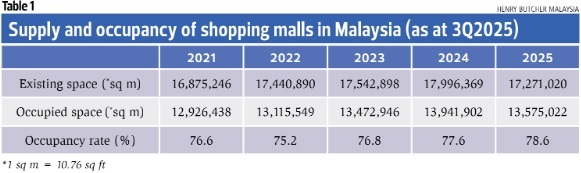
According to Henry Butcher’s Malaysia Property Outlook 2026, the supply of retail space actually witnessed a dip of 3.86% in last year’s third quarter, as some underperforming malls either closed down or stopped operating whilst undergoing refurbishment. This was despite a slightly improved average occupancy rate of 78.6% (from 77.6% in 2024) (Table 1), indicating that newer malls were driving the uptick.
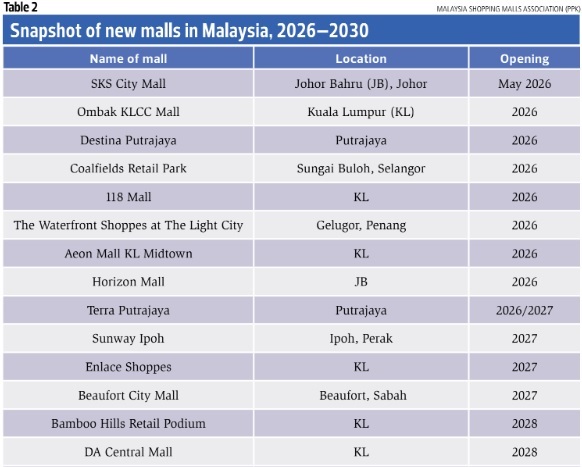
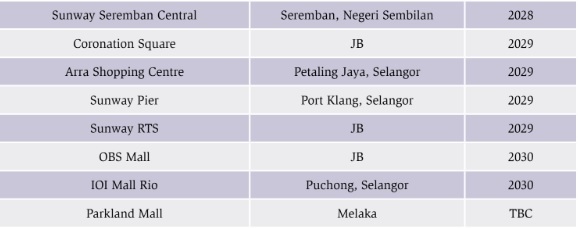
As mentioned, market pressures are set to persist as the 2026 pipeline introduces an estimated 1.2–1.3% of new retail space, with incoming experience-led destinations such as Ombak KLCC and Merdeka 118 Mall in Kuala Lumpur widening the gap between outdated complexes and next-generation venues.
As the market evolves, the question becomes: What defines the benchmark for shopping mall success now?
Approaching the subject first requires clearing a misconception about the volume of incoming shopping malls, says retail building management consultancy RCMC Sdn Bhd director and former Malaysia Shopping Malls Association (PPK) president Richard Chan. Although it was widely reported that upcoming malls would bring the national total close to 1,000 in 2026, Richard explains that this misleading conclusion stems from Napic’s reports which generalise a broad range of retail facilities under the “pusat membeli-belah” (shopping centre) category.
“The category includes hypermarkets, arcades and large outlet stores, which are not typically defined as shopping malls by most.
In reality, we have 419 enclosed malls on our landscape, with another 20 openings expected throughout the country over the next few years,” says Richard, who continues to serve PPK at an advisory level.
“[Admittedly,] that is still a large number, and many of the new malls are taking place in the already-dense retail landscape of the Klang Valley. This will certainly compel smaller conventional malls to re-assess, re-position and rebrand to remain relevant,” he adds.
Rise of the experience economy, e-commerce impact
The “experience economy” is an economic model where businesses create and sell memorable experiences rather than just goods or services.
It has transformed retail malls by shifting their role from being primarily shopping destinations to becoming multi-dimensional lifestyle hubs.
An experiential mall blends retail with entertainment, community and lifestyle elements to create immersive, memorable experiences that keep visitors engaged longer and returning more often. This change has redefined how malls are designed, operated and evaluated for success.
Knight Frank Malaysia research and consultancy executive director Amy Wong defines an experiential mall as one that offers consumers a reason to stay beyond making a purchase.
“While retail remains at its core, the emphasis has expanded to creating an environment where people can dine, socialise, exercise, be entertained or participate in community activities. The visit is no longer centred solely around shopping, but around how people choose to spend their time,” she says.
This shift reflects changing consumer behaviour. Because online shopping has made purchasing products more convenient than ever, physical malls have had to focus on what cannot be replicated digitally.
“Online retail has changed where people buy things; experiential malls are changing why people visit. As a result, retailers are also increasingly drawn to malls that can generate longer dwell times and stronger customer engagement, as these often translate into better sales opportunities,” Wong points out.
Sunway Malls group managing director HC Chan concurs that changing consumer behaviour and online commerce are two key drivers accelerating the popularity of experiential malls.
“With urbanisation and more high-rise living, consumers are spending more time in malls as the ‘third space’, and that is shaping different retail mixes too. F&B becomes an important catalyst in a mall’s tenant mix. In the case of Sunway Malls, it easily occupies 20% of retail space, and in some cases like Sunway Square, that number goes up to 51%. Leisure and entertainment have also gained way in recent years, taking more spaces in malls,” HC says.
RCMC’s Richard points out that experiential malls play into an already existing Malaysian culture of making a visit to a mall an event, upping the ante with more leisure, F&B and entertainment experiences to keep the entire family occupied.
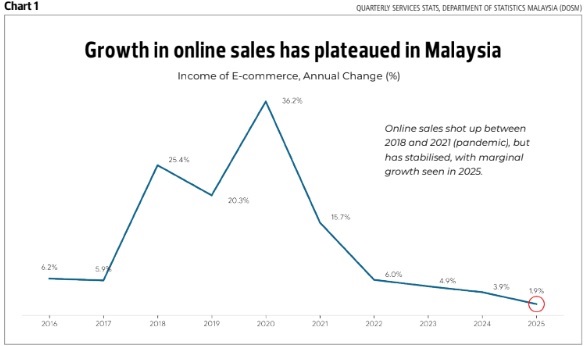
“E-commerce has changed the way we buy some goods, but overall, we still prefer to engage in shopping experiences first-hand,” Richard says, adding that the impact of e-commerce has not been as pronounced on Malaysian shopping behaviour as compared to other countries (Chart 1).
“Even at neighbourhood malls, equally engaging leisure focal points and community level events can be created at a local scale, if they stay attuned to the demand of their catchment population. The danger for them is not the emergence of large dynamic malls, it is remaining stagnant in a changing environment,” he says.
Success is more than just about footfall now
The fundamentals continue to matter, for new malls and old, says Sunway’s HC, as footfall and rental yield remain important indicators of performance. It should also be measured against tenants’ per square foot sales, which is another important indicator of success.
“The per square foot sales is basically a measure of sales conversion from traffic. Quantitatively, a successful mall will perform well in these three metrics. In terms of qualitative [performance], if a mall has a strong branding, sets industry standards and constantly refreshes with relevant tenancy mix that resonates, then it is successful,” he says.
“To attain that, because of the speed and complexity of competition, having a good understanding of the market it serves and the right positioning are fundamentals that need to be addressed conscientiously and frequently,” HC adds.
However, a new generation of malls has now shifted success measurement away from purely financial and occupancy metrics towards engagement, emotional connection and cultural relevance. Success is now judged by how long people stay and what they do beyond shopping.
“Traditionally, we have always defined success in terms of how many people walk through the doors, i.e. footfall numbers. I’d go a step further and define success as ‘returning footfall’ — the shoppers who choose to come back,” says Wong.
“Strong footfall and healthy rental performance remain important indicators, but they are no longer sufficient on their own. A successful mall today is one that stays relevant to its catchment by giving people reasons to visit regularly, whether it’s for shopping, dining, leisure, wellness or simply spending time with family and friends,” she adds.
The success metrics have now evolved from counting visitations to tracking visitor flow, heatmaps and dwell time to better understand how people move and interact with spaces. It has expanded from sales to experience value, measuring event attendance, social media engagement and repeat visits tied to cultural or leisure offerings.
Sustainability and smart operational methods matter too. A focus on energy efficiency, environmental impact and the use of smart resources can result in a cost-effective, efficient and well-operated mall.
For Richard, it ultimately boils down to good management: a well-run facility that constantly engages with, and provides innovative retail solutions for a catchment market.
Cannibalism a genuine threat


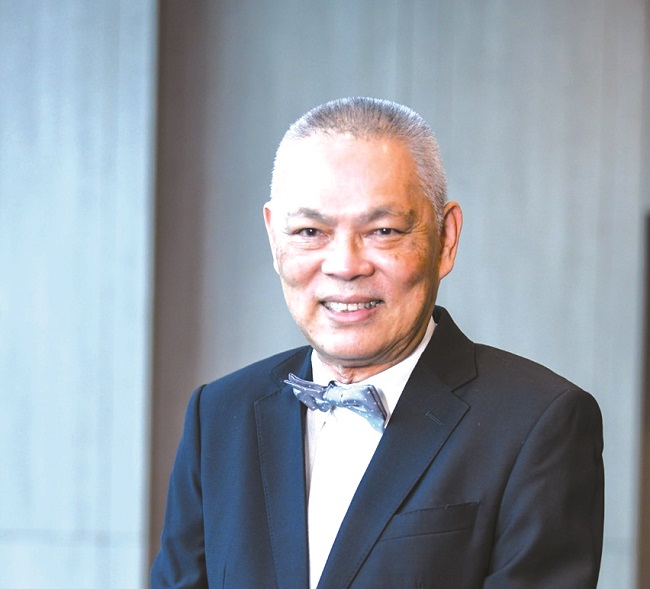
In a red-ocean retail landscape like Malaysia’s, however, the introduction of landmark malls in existing catchment areas risk cannibalising smaller suburban centres — where new venues draw customers, retailers and earnings away from old ones.
“Cannibalisation is a very real risk, particularly in locations where several malls serve the same catchment,” says Wong.
“A newly opened mall often attracts curiosity and enjoys an initial surge in footfall.
However, whether that translates into a lasting shift in consumer spending depends on how well each mall differentiates itself. A new mall may win the first visit, but it still has to earn the second.
“Success ultimately depends on whether individual malls are able to carve out a distinct identity, rather than competing on the same offerings,” she says.
Rather than viewing this as a competition between old and new malls, Wong explains that it is more accurate to see it as a competition for relevance. Those that continue to understand their catchment, curate the right tenant mix and refresh their offerings are generally more resilient, regardless of their age.
Richard says cannibalism is a valid concern for those who stick to cookie-cutter concepts.
When competition increases, it is an indicator that it is time for mall managers to re-assess and re-create.
“Change is the only constant. Even newer destination malls need to constantly innovate and create fresh appeal to generate constant traffic and enjoy long-term success. It is a long-term relationship and commitment to your customer base,” he states.
HC concurs, saying: “Change is the best strategy older malls can employ to deal with competition.
“It is important to re-evaluate and re-invent, [especially when] newer competition enters the market. Malls that do this still continue to command patronage. [For example,] Sunway Pyramid is in its 29th year, and has undergone various transformations to keep its relevancy”.
Re-assess, re-position, re-brand, survive
“Know your market” seems to be the common mantra touted by market professionals when it comes to achieving long-term retail relevance and sustained success.
In today’s market, where shoppers value experiences and social spaces as much as retail products, malls that offer a mix of retail, F&B options, entertainment outlets, and convenient socialising opportunities will become more resilient. Those that remain anchored on old retail-only models without evolution may face declining footfall and tenant churn.
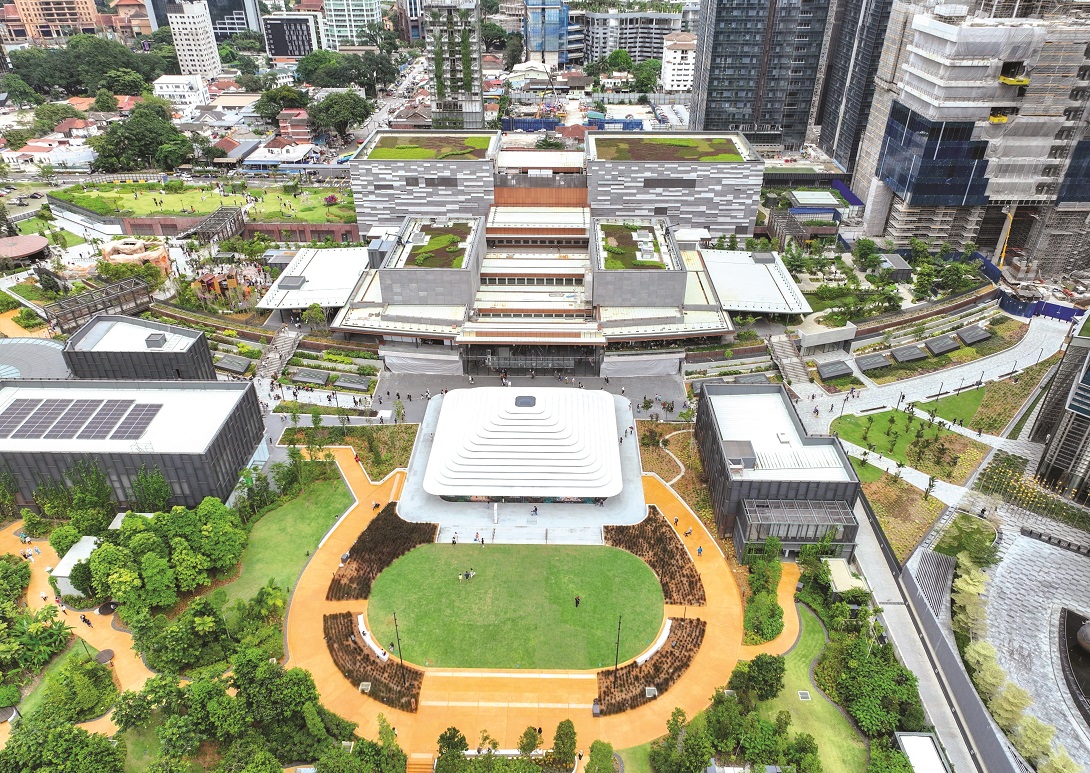
However, Wong warns that an experiential mall is not simply about adding more entertainment or dining outlets.
“The experience has to be authentic and aligned with the needs of its target market. A family-oriented suburban mall, for instance, will curate a very different experience from a city-centre mall serving office workers and tourists. The best-performing malls are those that understand their customers and curateexperiences that encourage them to return,” Wong says.
“We’ve seen standalone neighbourhood malls continue to perform well because they serve a loyal residential catchment, just as we’ve seen integrated developments struggle when the tenant mix or positioning misses the mark.
“Consumer preferences, retail concepts and lifestyle trends continue to evolve, and malls need to evolve alongside them. Repositioning does not necessarily require a complete redevelopment. In many cases, strategic tenant rotation, asset enhancement initiatives and stronger community engagement can be equally effective in maintaining relevance and competitiveness,” she states.
Both Wong and Richard agree that thoughtful upgrades to common areas, improved accessibility, refreshed interiors and a carefully curated tenant mix can significantly improve the overall customer experience while preserving the mall’s existing customer base.
“You don’t have to go big, sometimes going smaller is the pathway to success. Older suburban malls can readjust to become more community-centric, creating an appeal that is niche to specific neighbourhoods and establishing a loyal long-term customer base,” says Richard.
As an example, he points to Bangsar, KL, where two well-known neighbourhood malls (Bangsar Shopping Centre and Bangsar Village) co-exist within the same catchment of the significantly larger Mid Valley Megamall plus The Gardens Mall shopping destination.
The former two continue to enjoy success because of market understanding and differentiated retail offering and experience.
“Importantly, older malls can actually capitalise on their ‘social standing’... their reputation, sentiments of nostalgia, knowledge of community habits, and tap into communal relationships. In fact, from this perspective, they have the upper hand in the form of a deeper understanding of the surrounding community.
This is a distinct competitive advantage that they can build on,” says HC.
Wong concludes that for lasting success, relevance is more important than novelty: “The objective shouldn’t be about becoming the newest mall again, it’s about being the most relevant one”.
..........
Read about emerging trends, data-backed insights, growing subsectors, and expert commentaries in EdgeProp print. Subscribe now for your free copy!
Follow Us
Follow our channels to receive property news updates 24/7 round the clock.


Telegram


Latest publications
View AllFollow Us
Follow our channels to receive property news updates 24/7 round the clock.
Malaysia's Most
Loved Property App
The only property app you need. More than 200,000 sale/rent listings and daily property news.