Flood risk does not always sink property values
This article appeared in the July 9, 2026 issue of the monthly print edition. Subscribe now.
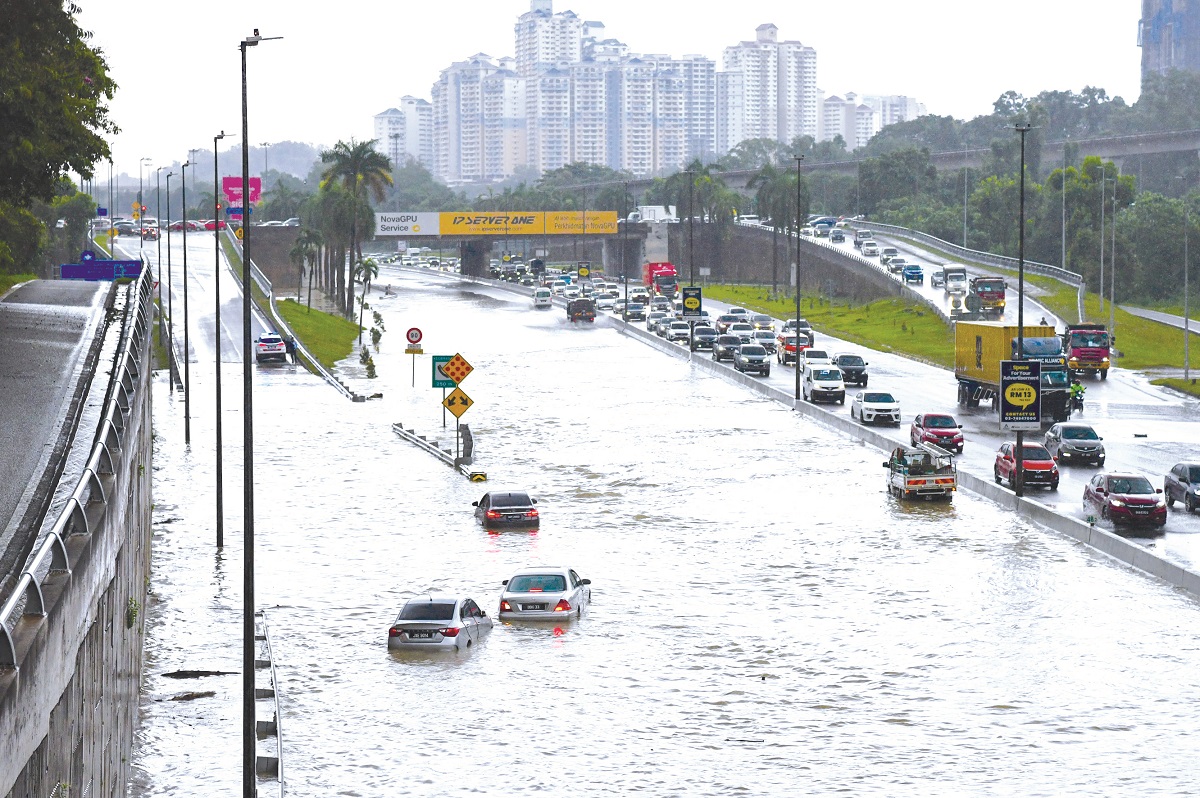
In Malaysia, flooding no longer raises eyebrows, but buyers are beginning to include “low flood risk” into their checklists when shopping for homes. Conversely, one would naturally assume the property markets in flood-prone areas to be rather dampened.
However, in parts of Selangor where floodwaters have repeatedly made headlines, the data show a curious story.
Taman Sri Muda in Shah Alam, Bandar Bukit Tinggi and Taman Sentosa in Klang, and Kota Kemuning are among the neighbourhoods often linked to swamping concerns.
Yet, subsale data, as recorded in EdgeProp EPIQ, show that prices for landed residences between 2016 and 2025 in these mature townships have largely remained resilient, with no obvious signs of a widespread “flood discount” at township level.
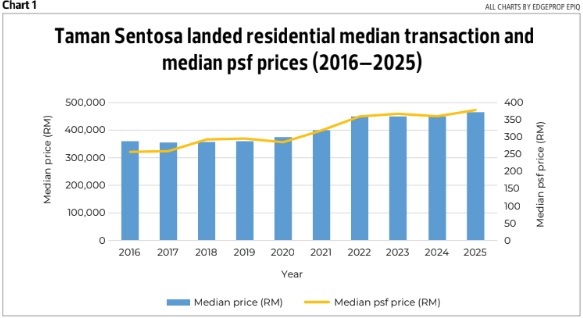
Taman Sentosa, for instance, has continued to attract buyers. Median subsale prices rose from RM360,000 in 2016 to RM465,000 in 2025, while median psf prices increased from RM257 to RM378.34 (Chart 1). Annual transaction volumes also remained relatively active, with 87 in 2016, and 158 in 2025, suggesting sustained demand for homes in the area.
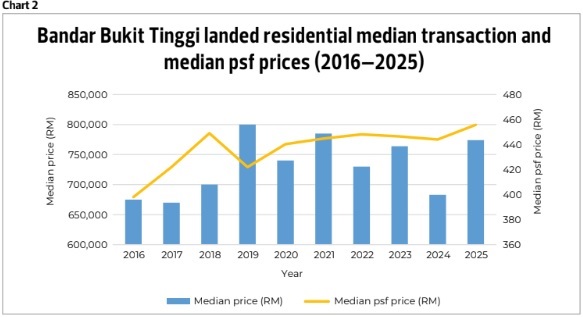
A similar pattern can be seen in Bandar Bukit Tinggi. Median prices climbed from RM675,000 to RM774,000 over the same period, while median psf values rose from RM398 to RM455.78 (Chart 2). Despite fluctuations across the 10 years, transaction volume recorded an ascent from 46 in 2016 to 76 in 2025. Overall, the data point to a township that has continued to hold its value.
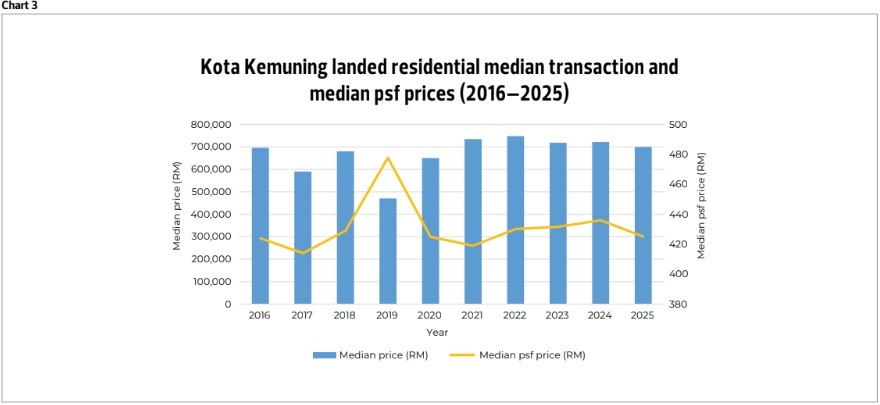
Kota Kemuning tells a slightly different story. Median prices have remained largely unchanged over the past decade, moving from RM696,000 in 2016 to RM700,000 in 2025.
However, median psf values consistently stayed above RM400 (Chart 3), indicating undaunted buyer preference for the township’s location, amenities and established community.
Taken together, the numbers suggest that flood risk may not impact property values that significantly, particularly in mature neighbourhoods where connectivity, convenience and long-standing demand continue to shape buying decisions.
Taman Sri Muda, nevertheless, remains a unique case.
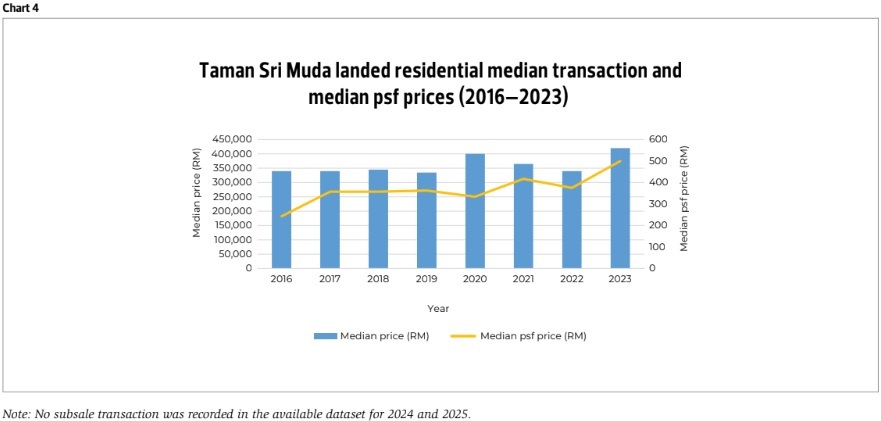
The township became the face of the devastating December 2021 floods, with residents rescued by boats after entire neighbourhoods were submerged. In the years leading up to the disaster, median subsale prices stepped up from RM340,000 in 2016 to RM365,000 in 2021, and median psf prices hiked from RM243 to RM417. Post-flood, median prices slid back to RM340,000 and RM375 psf in 2022 (Chart 4).
In addition, a plummet was observed in volume, from 23 transactions in 2021 to six in 2022, before dropping to just one transaction in 2023. However, this one single unit fetched RM420,000 at RM500 psf — the highest recorded figures within the eight-year period. Then, no subsale transaction was recorded in the available dataset for 2024 and 2025.
The contrast raises an important question for Malaysia’s property market: When it comes to buying a home, how much weight do buyers actually place on flood risk?
Location and fundamentals carry weight
While the 2021 floods caused significant short-term disruption in Sri Muda, property prices are influenced by many factors beyond flood risk, says Skudai Universiti Teknologi Malaysia (UTM) Civil Engineering Faculty Hydraulics and Hydrology Research Group leader associate professor Nor Eliza Alias.
“An area’s strategic location, existing infrastructure and continued housing demand may outweigh the negative effects of floods.
Nor Eliza observes that, while in principle, higher flood risk should be reflected in lower property values, such risk in established urban areas is often managed through engineering measures, planning controls and disaster preparedness.
“As a result, property values may not always decline significantly. Disaster insurance also plays an important role in helping communities absorb financial losses from flood-related events,” she says.
Flood risk not permanent
Nawawi Tie Leung Real Estate Consultants Sdn Bhd executive advisor Eddy Wong concurs: “Flood risk has been minimised in most modern townships as planning guidelines have been designed to address this issue”.
He also states that there are many areas in the Klang Valley that have experienced floods at one time or another during prolonged heavy downpours, some more serious than others.
They are due to a myriad of factors, some of which are inherent, such as being located in low-lying terrain or proximity to a river, which may increase an area’s susceptibility to flooding. The impact of flooding also varies with flood depth (depth of water), duration (how long before it recedes), and frequency (how often events occur).
“Timing is also a factor, for example, a heavy downpour coinciding with high tide causing a river to overflow its banks.
“Other contributing factors could be human causes, for example, the irresponsible disposal of garbage into drains, clogging them and affecting the discharge of water during a prolonged thunderstorm. As such, the flood risk is situational and dependent on a case-to-case basis,” he tells EdgeProp.
“Actions are usually taken by the community and the authorities to prevent and mitigate future occurrences. As such, the flood risk is not permanent, and any repricing adjustments are usually dependent on the actions taken and whether they are effective in preventing future occurrences.
“There is also recency bias at play, where there is a heightened sense of negativity in the immediate aftermath of a flooding event, but the negativity dissipates with the passage of time,” Wong adds.
However, buyers will negotiate on anything and everything to get the best deal in a transaction. This may include any information or news on the flooding history of the property or neighbourhood, he concedes.
Planning for flood mitigation from the outset


Nor Eliza says the relationship between flood exposure and long-term urban development outcomes is well recognised.
“Based on land-use changes, higher-surface runoff needs to be anticipated through flood mitigation structures such as detention ponds.
Flood studies and mitigation projects have been anticipating this for a long time,” she says.
Authorities should consider including flood risk assessment, along with flood mitigation planning, for proposed development sites and their surrounding and downstream areas, ensuring control at source during the planning permission stage.
“Such comprehensive procedures and guidelines, particularly for floods, are still new in Malaysia. However, several authorities have included these in their guidelines and governing acts, but they are not yet fully comprehensive and still require gap-filling,” Nor Eliza adds.
Unless comprehensive flood risk assessments with mitigation measures are made part of planning approvals, mitigation will continue to happen after development takes place.
“Authorised flood hazard maps and flood risk maps still have limited public access in Malaysia,” she notes.
Flood mitigation structures are generally designed to a certain level of average recurrence interval (ARI).
“Designing a structure to the 100-year ARI provides protection against a flood event, with a 1% annual probability of occurrence, corresponding to an approximate 63% chance that the design event will be equalled or exceeded at least once during a 100-year design life.
“Higher ARI design means higher costs, so some structures are designed below the 100 year ARI, which increases the probability of system failure. These mitigation systems are designed to manage an accepted level of flood risk based on budget, technology and resources,” Nor Eliza elaborates.
On the same note, Wong explains that from a planning and engineering perspective, modern townships are designed for a 100-year flood contingency plan to ensure structural safety and prevent severe property damage in the event of floods.
“As such, fundamentals like connectivity, maturity of the township, developer’s reputation, and track record matter more to the property purchaser as the flood risk is presumed to have been addressed and taken care of at the design and planning stage,” he adds.
..........
Read about emerging trends, data-backed insights, growing subsectors, and expert commentaries in EdgeProp print. Subscribe now for your free copy!
Follow Us
Follow our channels to receive property news updates 24/7 round the clock.


Telegram


Latest publications
View AllFollow Us
Follow our channels to receive property news updates 24/7 round the clock.
Malaysia's Most
Loved Property App
The only property app you need. More than 200,000 sale/rent listings and daily property news.