Malaysia remains one of Asia’s most accessible property markets for foreign buyers in 2026

This article appeared in the July 9, 2026 issue of the monthly print edition. Subscribe now.
Malaysia is one of a small number of countries in Southeast Asia that permits foreigners to hold freehold or leasehold titles to residential properties in their own names, without local partners, trust structures, or nominee arrangements. Thailand restricts foreign land ownership entirely.
Vietnam imposes a strict quota and leasehold caps. Indonesia does not allow foreigners to hold freehold residential titles at all.
In Malaysia, a non-citizen can acquire a condominium unit, serviced apartment, or certain categories of landed property in his or her own name — with a legal title, bankable collateral status, and the right to lease, sell, or bequeath the asset, subject to applicable regulatory conditions.
That legal architecture sits on an established statutory foundation. Malaysia operates the Torrens land registration system, and registered ownership rights are recognised and enforceable under the National Land Code (NLC).
Amin, Yap & Co partner Datuk Peter S K Yap says this makes Malaysia’s framework immediately legible to international buyers:
“Foreign buyers have certainty of ownership as their names are registered as the owners of the properties, and a search with the land office can easily confirm the details of ownership”.
Chan Lee & Co law firm partner Mike Lee Seang Yik echoes that assessment, while noting a nuance that is frequently underappreciated: “One aspect that is often misunderstood is the perception that foreign property ownership in Malaysia is overly restrictive or legally complicated.
“In reality, while there are regulatory requirements such as state authority consent and minimum-purchase-price thresholds, the legal framework itself is relatively structured and manageable with proper legal guidance.
Once the commercial terms are ironed out, the process is generally more administrative than prohibitive”.
The real cost stack
The flat 8% stamp duty on residential-property transfers involving non-Malaysians, effective Jan 1, is the single largest component of the foreign acquisition cost. On a RM1.5 million property, this amounts to RM120,000, which is higher than the tiered rates applicable to Malaysian citizens under the Inland Revenue Board (IRB) schedule.
Foreign buyers must also factor in state authority consent fees under Section 433B of the NLC, legal fees, disbursements and registration charges.
Yap puts the all-in figure at approximately 10–11% of purchase price for a cash buyer acquiring a residential property. Lee places the range slightly wider at 10–12%, noting that state land office administrative charges can vary by about 1–2% between states.


Crucially, both practitioners note the 8% stamp duty applies only to residential property. Commercial property remains subject to a flat 4% rate.
Against this backdrop, Malaysia’s all-in acquisition cost remains materially lower than several competing regional gateways. Australia’s foreign investment surcharges run between 8% and 12% depending on the state, layered with ongoing land tax obligations. Hong Kong imposes a 15% buyer’s stamp duty on non-permanent residents.
Singapore applies a flat 60% Additional Buyer’s Stamp Duty for foreign buyers, unchanged since April 2023, according to its Ministry of Finance.
Has the 8% stamp duty dampened demand?
Knight Frank Malaysia’s Real Estate Highlights 2H2025, published in January 2026, noted that residential demand from foreigners remained active heading into the year, although buyers were becoming more selective — a dynamic attributed to pricing discipline and product alignment rather than weakening underlying demand.
Knight Frank Property Hub executive director Adrian Yeoh says Malaysia’s 8% foreign-buyer stamp duty has not removed interest, but has made buyers more discerning.
Instead of simply comparing Malaysia to higher-priced regional markets, they are increasingly asking whether a property is correctly priced within its own local market after factoring in stamp duty, legal and financing costs, furnishing, vacancy risk, and potential resale discounts.
Some practitioners report a shift in behaviour following the January implementation.
“We have observed a noticeable slowdown in residential property acquisitions by foreign buyers following the implementation of the 8% flat stamp duty,” says Lee.
“The increase has significantly raised upfront acquisition costs, particularly when coupled with existing minimum-purchase-price thresholds. As a result, other than foreigners who have applied for MM2H (Malaysia My Second Home), and are duty bound to purchase residential properties, other foreign buyers are becoming more cautious and selective,” he adds.
Ramesh Dipendra Jeremiah Law partner Jeremiah R Gurusamy adds that the post-January environment is pushing buyers towards higher-value assets.
“Foreign buyers appear to be taking a longer-term view before committing to acquisitions,” he says.
“There is greater emphasis on higher-yield or premium assets where the increased acquisition cost can better justify the investment.”


State consent: the process buyers overlook
Beyond stamp duty, one of the most consistently misunderstood requirements is state authority consent. Under Section 433B of the NLC, all disposals of property to foreign nationals require prior written approval from the relevant state authorities.
In practice, this means the transfer and registration of title cannot be completed until consent is obtained, adding a procedural layer that many buyers do not anticipate.
Both Yap and Lee estimate typical processing time at one–three months, subject to complete documentation. Yap notes that applications are generally handled efficiently by authorities, with clients often surprised by the relatively smooth process compared with other countries’ jurisdictions.
Jeremiah confirms that buyers are often unaware of the acquisition requirements until advised by legal counsels.
“Most are not aware of the detailed costing and timelines,” he says.
The most common legal misunderstanding, identified by both Yap and Lee, is the assumption that signing the sale and purchase agreement confers immediate, unconditional ownership. In practice, transactions remain subject to state consent and other regulatory approvals.
“For this reason, foreign buyers must ensure the purchase price paid to the vendor is properly secured (in trust accounts) until all conditions of the sale are fulfilled,” Yap says.
Minimum thresholds, and where genuine demand sits
Foreign access to Malaysia’s residential market is further shaped by minimum-purchase-price thresholds, which differ across Peninsular Malaysia, Sabah, and Sarawak.
Many states maintain thresholds of approximately RM1 million for strata residential property, with higher benchmarks for landed homes — effectively concentrating foreign demand in the premium segment.
Real Estate and Housing Developers’ Association Malaysia (Rehda) immediate past president Datuk Ho Hon Sang says this structure explains the premium skew of foreign transactions, but adds that conditions are not uniform across states.
“There are still certain states with lower minimum thresholds,” he notes, calling for further rationalisation.
“We opine that more can be done to attract foreign home purchasers. For instance, we can lower thresholds in cities such as Kuala Lumpur to at least match the minimum requirement for the MM2H programme, where the minimum price for its compulsory residential purchase is set at RM600,000.”
Ho argues that such a move would enhance Malaysia’s appeal as an investment destination and lift transaction volumes among foreign buyers, with broader economic spillovers.
Despite accounting for approximately 1% of residential transactions by volume — based on the National Property Information Centre’s Property Market Report 2025 — Ho says foreign buyers remain considerable in specific segments.
“Our biggest contributor and clientele are still the rakyat, but property purchase by foreigners is still significant to the industry,” he says.
On location preference, Ho points to established economic hubs such as KL, Johor Bahru (JB), and Penang as primary draws, while acknowledging rising interest in lower-density lifestyle markets.
“We must also take into account the attractiveness of smaller cities and towns for those seeking a quieter lifestyle, such as Langkawi and the East Coast region,” he says.


Infrastructure is turning Johor’s story into a lived reality
The JB–Singapore Rapid Transit System Link (RTS) is scheduled to commence operations on Jan 1, 2027, with a journey time of approximately six minutes between Bukit Chagar and Woodlands North, as confirmed by both governments.
Construction on the Malaysian side is targeted for completion by Dec 31, with testing already under way.
More than 300,000 Malaysians currently commute daily between Johor and Singapore, according to multiple government and industry sources.
Knight Frank’s Yeoh says the RTS does not create demand but reduces friction in an existing economic ecosystem.
Property consultants tracking the RTS corridor note rental yields in prime city-centre locations are trending above 5%, with select units higher.
Prime KL: a globally underpriced gateway city
KL’s prime residential market — centred on KLCC, Tun Razak Exchange, Bukit Bintang, and Mont’Kiara — continues to offer international-grade products at price points difficult to replicate in other gateway cities in the region.
Yeoh says international buyers are often surprised by the pricing gap between KL and comparable cities when benchmarked on a per-square-foot basis.
Even as premium launches in KL approach and exceed RM2,000 psf in the most sought-after addresses, he notes that the city continues to screen competitively against regional gateway markets such as Singapore and Hong Kong RHB Investment Bank maintained an “overweight” call on Malaysia’s property sector in January, citing a solid sales momentum of 11.4% year-on-year growth in the first nine months of 2025, alongside infrastructure catalysts and potential real estate investment trust (REIT) listings, and merger and acquisition (M&A) activity.
The RPGT structure rewards patience
Under the Real Property Gains Tax (RPGT) Act 1976, foreign owners are subject to a flat 30% RPGT on gains from property disposals within the first five years of ownership, according to IRB guidelines.
The rate drops to 10% from Year 6 onwards. The key threshold is Year 5: the full 30% rate on chargeable gains is imposed for exits before this period, while exits thereafter reduce liability to 10%. RPGT applies only to net chargeable gains, not gross sale price.
FAR Capital founder and CEO Faizul Ridzuan notes that the key variable for foreign buyers is not nominal price after currency conversion, but whether entry pricing allows for sustainable rental yield and eventual resale under local demand conditions.
Yeoh echoes this framing, noting that liquidity in Malaysia is “real, but location-specific, segment-specific, and price-specific”.
He cautions that the biggest pricing mistake foreign buyers make is assuming a property is “cheap” simply because Malaysia is cheaper than Singapore or Hong Kong, rather than benchmarking against local resale comparables, rental demand, and exit liquidity.
He adds that buyers who maintain discipline around entry pricing, location selection, and holding period — particularly six years and above — are best positioned to allow Malaysia’s cost structure to work in their favour.
What long-term residents, agents, advisers say about property ownership in Malaysia
The MM2H programme now operates across three tiers — Silver, Gold and Platinum — each carrying different fixed deposit (FD) thresholds, visa durations, and property purchase requirements under revised 2024 guidelines administered by the Ministry of Tourism, Arts and Culture (Motac) (Table 1).
In practice, most applicants gravitate towards Silver. PropNex Malaysia group district leader Sean Cheah says the reason is straightforward: financial accessibility.
“The FD requirement is US$150,000 (approximately RM600,000) for Silver, compared with US$500,000 for Gold,” Cheah says.
“From an applicant’s perspective, many prefer not to lock such a large amount of funds in an FD unless their overall net worth and longterm plan justify it,” he adds The Gold tier’s 15-year visa validity — its headline advantage over Silver — is also less compelling in practice than it appears.
“The visa endorsement is still issued on a five-year renewal basis.
“Ultimately, the preferred tier depends on the applicant’s financial position, liquidity preference, and long-term objectives in Malaysia,” Cheah notes.
Platinum, which permits holders to work, invest, and conduct business activities, targets a distinct profile: high-net-worth individuals seeking operational as well as residential access. Silver and Gold are primarily long-stay residency programmes, and do not automatically grant unrestricted employment rights.


The working clause is broadly understood and largely uncontested among the long-term holder community, says Hongkongers in Malaysia Facebook Group founder and MM2H consultant Gary Crestejo.“Most people have no problem with that.
[Yes,] a lot of people would still like to have the option to work if they want to, but mostly these [Silver and Gold applicants] are already at retirement age, so even if you let them work, I really don’t think many would choose that option,” he explains.
However, the investment clause is where Crestejo sees unrealised potential: “Even if they’re retired, they’re not idle — they still have money, they want to invest in small businesses, they want to do something. Not really for the money sometimes, just to stay active”.
He notes that foreign nationals are generally allowed to invest as shareholders in Malaysian companies, subject to sector-specific rules and approvals.
“As long as the money is not sitting in the bank — you take it out, you make transactions, you invest in a business — you need to pay for SSM (Companies Commission of Malaysia) registration, accounting services, and runner services. There are a lot of business activities and economic activities going on once you allow them to invest and make use of that money. That will surely benefit the country as a whole,” adds Crestejo, who is a long-term holder with direct experience of how the programme operates in practice.
Institutional perspective: how foreign demand is behaving in 2026
Knight Frank’s Yeoh says Malaysia’s foreign buyer profile is increasingly segmented, with demand splitting into lifestyle-driven and investment-driven cohorts.
He observes that policy shifts such as higher stamp duties, minimum thresholds, and administrative tightening tend to reshape behaviour rather than suppress demand outright.
“Foreign demand is not disappearing, it is becoming more disciplined,” he says. Ultimately, activity concentrates in well-located, infrastructure-linked and supply-constrained developments.
Yeoh adds that Malaysia continues to screen differently depending on segment and pricing band, with a widening divergence between prime institutional-grade assets and mid-market residential stock.
How to apply, what an agent actually does
Under the current framework, applicants generally need to apply through a licensed MM2H agent approved by the Motac, and PropNex’s Cheah says this is essential.
“An agent’s role goes beyond form submission. They coordinate document preparation, ensure compliance with evolving requirements, liaise with immigration and Motac, assist with bank account opening, FD placement, visa endorsement, and post-approval matters,” Cheah says.
He adds that experienced agents reduce rejection risk and prevent costly errors, particularly for applicants unfamiliar with Malaysian immigration procedures.
On processing time, he says: “It usually takes around three to five months”, subject to documentation completeness and administrative cycles. Fixed deposit mechanics FDs can generally be placed with major Malaysian banks including Maybank, CIMB, Public Bank, RHB and HSBC.
Applicants may withdraw up to 50% of the deposit for approved purposes such as property purchase, medical treatment, and education, subject to documentation.
Interest is typically accessible, though principal remains locked under programme rules.
Property purchase under MM2H: what changes and what does not
MM2H does not exempt participants from standard foreign ownership rules. State minimum price thresholds, consent requirements under Section 433B, and the 8% foreign buyer stamp duty generally still apply.
“Certain incentives may exist at state level, but these are not broadly guaranteed,” Cheah says.
The programme requires a minimum stay of 90 days per year.
Spouses and children below the eligible age limit may be included as dependants. However, children above the threshold (generally 34 years and above) must transition to alternative visa arrangements.
Cheah acknowledges concerns following the 2021 tightening of MM2H,” he says, but adds that while Malaysia remains competitive against alternatives such as Thailand’s LTR (Long-Term Resident) visa, clearer policy consistency would improve confidence.
What long-term holders actually think
A Japanese national, who finally decided to participate in the MM2H in 2007 after having worked and resided in Malaysia for 11 years prior, says ownership creates a sense of belonging.
However, Kenji Tanaka (not his real name), says processes were more complex in the early days.
“When I purchased it in 2007, the process required multiple approvals from different government and state departments, as well as additional legal fees,” he recalls.
He suggests a more centralised MM2H framework.
“Applicants have already met stringent programme requirements,” he says.
Property lawyers and industry practitioners say the process remains multi-layered but is now more structured and predictable than earlier frameworks.
On RPGT, Tanaka raises a principle issue: “For MM2H holders, it should be the same as locals, as they have met the requirements to make Malaysia their second home”.
When it comes to regional competition, he advises comparing frameworks carefully, including costs, conditions, and exit rules.
What the informed buyer looks like in 2026
The two perspectives — structural critique and cultural integration — reflect the broader tension in Malaysia’s foreign buyer proposition.
The country offers rare advantages in Southeast Asia: freehold access, a transparent legal framework, a functioning long-stay programme, and comparatively attractive pricing.
But the system is not frictionless. The RPGT structure, stamp duty, consent requirements and policy uncertainty remain real considerations.
Crestejo emphasises cultural integration: “While enjoying your stay, adapt to local culture, blend in, respect local norms”.
WHAT FOREIGN BUYERS ARE REALLY LOOKING FOR
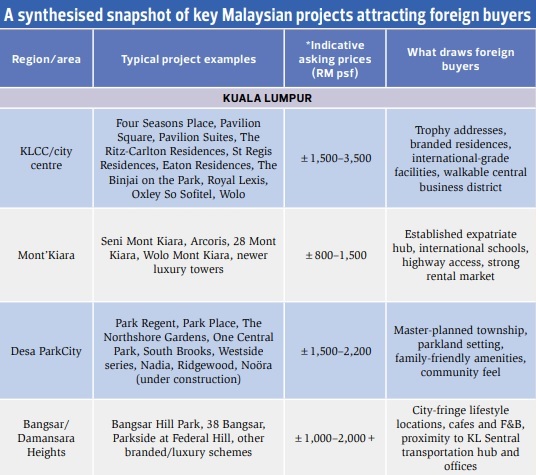
Foreign buyer interest in Malaysia is not spread evenly across the market, but is concentrated in three main areas: the Klang Valley, Johor, and Penang.
Knight Frank Property Hub executive director Adrian Yeoh says these are locations foreign buyers can “understand quickly” because they are close to business districts, international retail, transport links, schools, hospitals, lifestyle amenities, or established expatriate communities, and already have rental depth and resale evidence rather than relying purely on future-location stories.
In the Klang Valley, Yeoh sees the strongest foreign interest in Kuala Lumpur city centre, TRX, Bukit Bintang, Mont’Kiara, Damansara Heights, Bangsar, and selected integrated or mixed-use nodes such as KL Metropolis and KL Eco City.


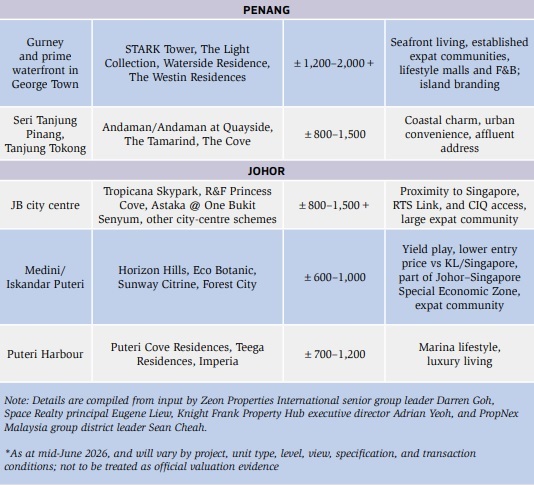
Based on indicative market levels (not formal valuation evidence), he notes that foreign enquiries for prime projects in these areas tend to sit around RM1,200–RM2,500 psf, depending on building, age, view, furnishing, and whether a unit is a new launch or resale.
PropNex Malaysia group district leader Sean Cheah notes that prime KL city centre luxury residences are generally marketed around RM1,200–RM3,500 psf, depending on building, age and specification, while comparable luxury districts in Singapore and Hong Kong often exceed RM5,000–RM10,000 psf, leaving Malaysia with a sizeable price gap that continues to underpin interest.
Similarly, Space Realty Sdn Bhd principal consultant Eugene Liew says foreign buyers now focus on developments that offer strong connectivity, established international communities, comprehensive lifestyle amenities, and proximity to major business districts.
In Penang, foreign purchasers continue to favour seafront or waterfront addresses along Gurney Drive, Gurney Bay, Tanjung Tokong, Tanjung Bungah, and Seri Tanjung Pinang, often gravitating to branded or integrated projects with strong management and facilities.
Meanwhile in Johor, interest is strongest in Iskandar Puteri (particularly Puteri Harbour and Medini) and selected Johor Bahru (JB) city centre and waterfront projects, especially those that stand to benefit from the JB–Singapore Rapid Transit System (RTS) Link corridor.
Editor’s note: Besides the input shared with EdgeProp by the respective experts, this article draws on disclosures and data from the Inland Revenue Board (IRB) of Malaysia, the National Property Information Centre (Napic)’s Property Market Report 2025, and the Malaysia My Second Home (MM2H) portal administered by the Ministry of Tourism, Arts and Culture (Motac).
..........
Read about emerging trends, data-backed insights, growing subsectors, and expert commentaries in EdgeProp print. Subscribe now for your free copy!
Follow Us
Follow our channels to receive property news updates 24/7 round the clock.


Telegram


Latest publications
View AllFollow Us
Follow our channels to receive property news updates 24/7 round the clock.
Malaysia's Most
Loved Property App
The only property app you need. More than 200,000 sale/rent listings and daily property news.