Growing price, performance gap prompt existential dilemma for ageing office buildings
This article appeared in the Aug 13, 2026 issue of the monthly print edition. Subscribe now.
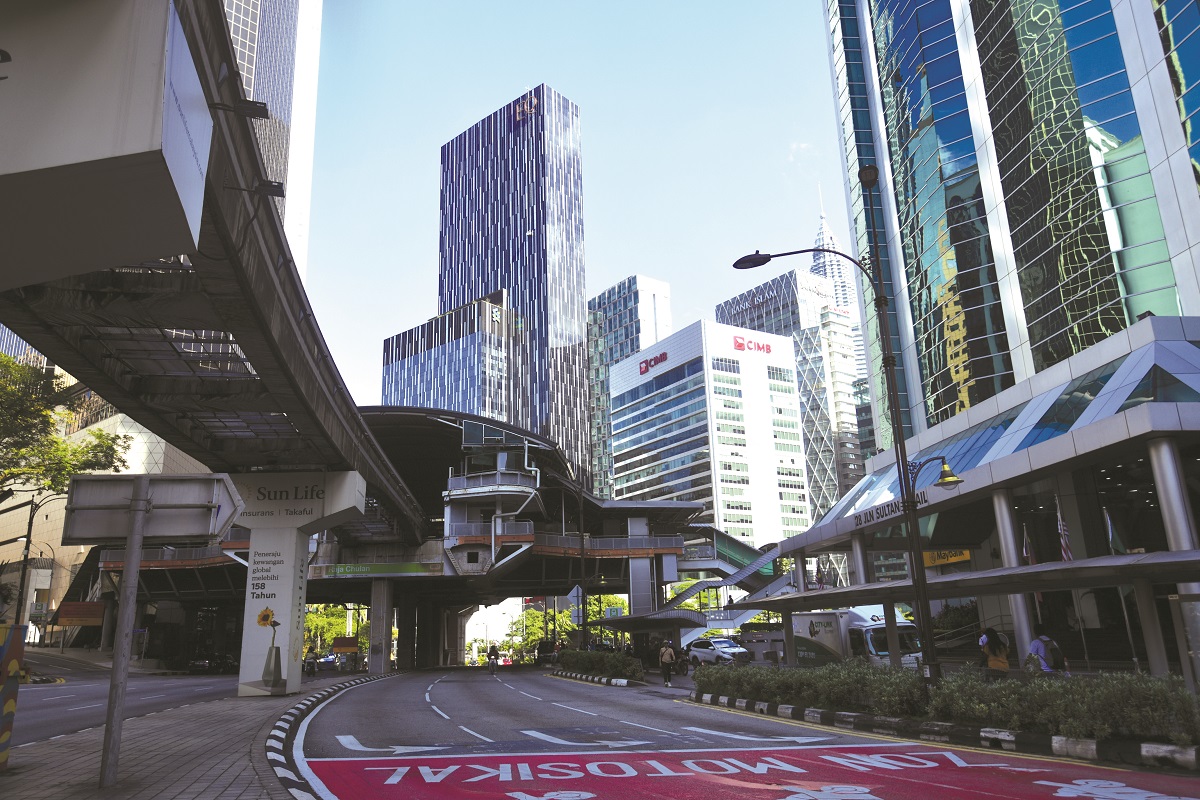
The contrast in Kuala Lumpur’s office skyline is becoming impossible to ignore: sleek, environmentally-certified towers connected by urban transit networks rise beside ageing commercial blocks with design and functionality that struggle to meet the expectations of modern business occupiers.
Driven by a rising tech-centric and socially-conscious global business environment, Malaysia’s office market has embraced a new generation of developments built around sustainability, technology and employee experience. Yet, as the market moves forward, older buildings are increasingly being left behind.
The divide between “old” and “new” is not just evidenced in rental rates. It is also reflected in diminishing demand, shrinking occupancy levels and asset values. This ultimately raises uncomfortable questions about the long-term viability, relevance and survival of ageing office buildings in a rapidly advancing nation.
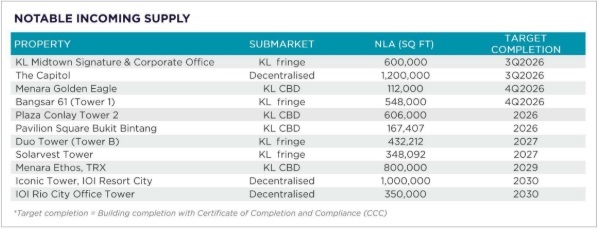
A further influx of new Grade A offices in the country over the 2026–2027 period adds to this existential crisis, placing further pressure on previous-era offices that are already grappling with competitiveness in a landscape that offers roughly 120 million sq ft of existing net lettable space.
Granted, it is not an issue that has gone unnoticed. Concerned that lopsided preference for new office space might eventuate into large volumes of unused space, the Finance Ministry, under Budget 2026, introduced tax incentives for the adaptive reuse of office buildings, while the Federal Territories (FT) Ministry announced its RE_NEW Policy to reduce the cost of such projects in capital districts, while fast-tracking approvals and encouraging sustainable targets.
Highlighting this ongoing dilemma in its Malaysia Real Estate Outlook 2026 report, real estate services and consultancy firm CBRE | WTW Valuation and Advisory Sdn Bhd pointed out that the Klang Valley will likely see an increasing number of refurbished or repurposed office buildings moving forward.
“Overall, older offices should not be viewed as obsolete by default, but they cannot remain passive. Owners need to assess the cost of doing nothing against the value that can be protected or gained from upgrading. If no action is taken, the building may gradually lose tenants, rental income and market value,” CBRE | WTW managing director Lim Chai Yin tells EdgeProp.
“With the right rejuvenation and repositioning, [older office buildings] have a better chance of staying relevant and protecting longterm value,” she adds.
Lim points out that many older buildings continue to have a strong base advantage, especially those located in established commercial areas with good connectivity, mature infrastructure and nearby amenities. For these assets, the right enhancement, refurbishment and asset management can help close the gap with newer stock.
“For older buildings in secondary locations or areas with weaker connectivity, the challenge is greater. These assets may face both ageing specifications and a weaker locational pull, so cosmetic upgrades alone may not be enough.
Owners may need to consider clearer repositioning, more realistic rental strategies, niche tenant targeting, improved parking or shuttle connectivity, flexible space solutions, or even partial repurposing,” Lim says.
What the numbers say
A number of property consultancies have taken note of a growing price and performance gap between outdated and updated offices, identifying this shifting dynamic in various market reports. For instance, CBRE | WTW’s recent findings show demand for older, non-prime offices in the Klang Valley continues to decline as the trend shows tenants are favouring modern, energy-efficient spaces in well-connected locations in newer prime office buildings.
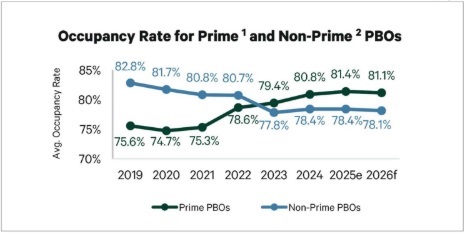
By comparison, occupancy rates for prime purpose-built offices (PBOs) rose from 75.6% in 2019 to 81.4% in 2025, with a slight dip expected this year due to saturation created by incoming supply. In contrast, PBOs in non-prime areas have been on a declining trend since 2019, slipping from a high of 82.8% seven years ago to 78.4% last year, with a further dip expected in 2026 (Chart 1).
Lim notes that this indicates a clear flight to quality. Tenant demand is shifting towards newer or upgraded office spaces, as occupiers are no longer driven by rental cost alone. Many businesses are placing greater emphasis on building quality, efficiency, ESG credentials, connectivity, amenities, technology readiness and the overall workplace experience.
“As a result, the market is becoming more polarised, where newer and well-upgraded buildings are able to attract demand and sustain higher rents, while weaker older buildings face greater pressure to reinvest, reposition or compete mainly on cost,” she adds, suggesting this has led to a widening price gap between old and new (or newly upgraded) offices.
Similarly, Cushman & Wakefield’s KL Office Market 1Q2026 report noted that the overall vacancy rate in KL is 30.02% — a high percentage that indicates oversupply issues. The net absorption has also been on a declining trend of -435,270 sq ft quarter-on-quarter, showing more space is being vacated than leased.
The report also found that in the KL central business district (CBD), where a larger volume of new offices is located (60.55 sq ft million inventory), average rents were at RM7.21 psf and vacancy was at 27.8%. Meanwhile in the KL fringe, with a higher concentration of older offices, vacancy was at 33.5% despite a lower average rent of RM6.61 psf.
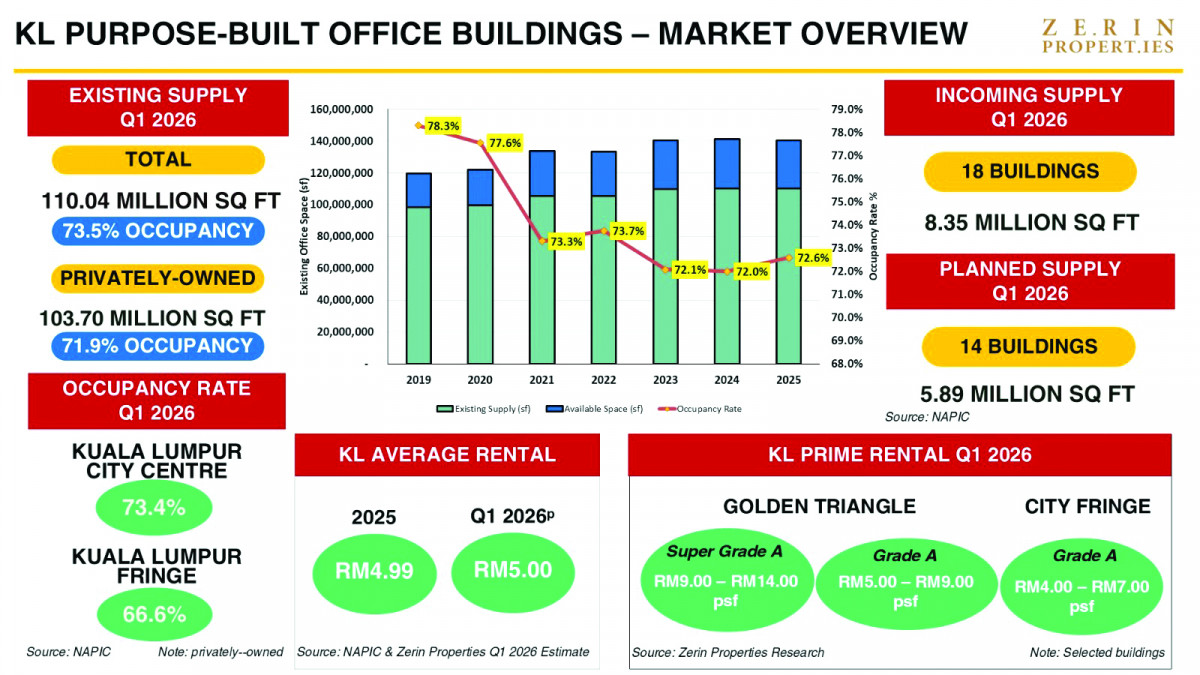
Research by real estate agency and advisory firm Zerin Properties Urus Harta Sdn Bhd takes a closer look at existing supply, available space and occupancy rates within the overall KL district. Its findings also show a general declining occupancy trend, at 72.6% by end-2025, but highlight rising numbers for existing available supply (currently about 110.04 million sq ft).
Added to that, there is a total incoming supply of 8.35 million sq ft and a planned supply of 5.89 million sq ft for all office types (Chart 2).
Zerin Properties also compares current rental price bands for Grade A offices located in the KL’s Golden Triangle and those located on the city fringe, showing that the RM9–RM14 psf range commanded by Super Grade A offices in the CBD carries a considerable premium over other options, both within and without the area.
“The challenge facing the office sector today is not merely one of oversupply. Increasingly, we are seeing an oversupply of certain types of office space and a shortage of future-ready assets,” says Zerin Properties CEO Previn Singhe.
“As a result, buildings are now competing not only on location and rental rates, but also on technological capability, sustainability credentials, flexibility, connectivity and user experience. Today, occupiers are placing much greater emphasis on operational efficiency, employee well-being, environmental performance and longterm cost management,” he says.
Consequently, many older office buildings are finding it increasingly difficult to remain competitive because they were designed for a very different working environment.
“They typically have smaller floor plates, lower parking ratios, ageing infrastructure, higher maintenance requirements and limited digital capabilities,” Previn adds.
Not just a Klang Valley predicament
The widening performance rift between old and new offices is not unique to the Klang Valley landscape. Elsewhere in the country, key economic zones are showing a clear preference for modern office spaces, and similar gaps have emerged.
In Johor Bahru (JB), despite supply continuing to exceed demand, and having low occupancy hovering at the 55% mark, new Grade A offices and those located within transit-linked developments are performing better than most, according to CBRE | WTW’s report.
This has actually propelled average gross rents up from RM4 psf in 2024 to RM4.50 psf in 2025, driven by a flight-to-quality trend in burgeoning economic zones. The draw of sustainable and hybrid-ready office spaces can be seen in the performance of premium developments such as Menara Bank Rakyat @ Coronation Square and South Tower @ Mid Valley Southkey, achieving higher-than-average rents of RM4.50–RM5.50 psf.
In the south, transit-linked properties are experiencing heightened demand, anchored by JB’s positioning as a dynamic cross-border hub. Occupiers see the fusion of lifestyle conveniences with modern workplace trends dovetailing neatly with the vision of a fluid Singapore–Johor business ecosystem.
In Penang, overall occupancy rates have remained stable at approximately 88.3% on the island and 75% on the mainland, resulting in an overall 85% average occupancy rate for the state. With the office market shaped by multinational corporations and the expanding digital economy, demand continues to concentrate on high-specification, purpose-built spaces.
The monthly gross rental for PBOs in Penang island can range between RM2.60 psf for older units and RM5.50 psf for newer ones. However, newly launched PBOs in the pipeline are already marketed at rates of RM6 psf and above.
Employee experience, modern business expectations reshaping demand
Lim observes that contemporarily-designed new offices are better positioned to provide workplace environments that are aligned with current occupier requirements and evolving business needs, which some older buildings may find difficult or costly to match.
“This is not just about having a newer lobby or modern finishes, but about the basic building infrastructure and design that support modern business operations. Key elements include larger and more efficient floorplates, better ceiling heights, stronger power supply, better internet and digital infrastructure, more reliable lifts and air-conditioning systems, improved energy efficiency, better security systems, and more flexible layouts for collaboration or hybrid working,” she elaborates.
While some older buildings can be improved through enhancements and refurbishment, Lim believes there are limits. Outdated structure, components and design could be uneconomical to retrofit fully. This is where newer offices already have a competitive advantage.
For many organisations, design plays a huge role in developing workplace strategy and meeting employee expectations, says Workplace Design Association president and Thinkspace Design Group CEO John Jong Ching Nien.
“Companies are beginning to understand that the cheapest office is not necessarily the most economical workplace. Rental is only one component of the true cost of occupation. The conversation has shifted from cost per square foot to value created per employee. The market is no longer chasing premium buildings, it’s chasing better-performing workplaces,” says Jong.
“The industry often calls it a ‘flight to quality’, but I believe it’s really a ‘flight to value’.
Companies aren’t simply paying more for newer buildings — they’re investing in workplaces that strengthen culture, attract talent, enhance wellbeing and improve business performance,” he points out.
Jong explains that perspectives have changed and the office space is no longer viewed purely as a place for employees to work. People will come to the workplace when it gives them something meaningful that they cannot easily obtain elsewhere: connection, learning, mentorship, collaboration, social energy, access to leadership and a sense of belonging.
“This is why progressive companies are using workplace design as part of their talent and business strategy. The workplace has become a physical expression of the employee value proposition. It tells people how the organisation thinks, what it values and how seriously it takes their wellbeing and development,” he says.
Jong notes that inside the office, companies are moving away from uniform environments towards a wider variety of settings. Employees today need spaces for focused work, collaboration, confidential conversations, learning, social interaction, restoration and larger community gatherings.
“Inclusion also matters. A well-designed workplace should accommodate different generations, personalities, physical abilities and ways of working,” he adds.
Previn agrees, saying: “Increasingly, employers realise that workplace quality has a direct influence on talent attraction, employee engagement and overall business performance”.
“Another important factor is the growing emphasis on sustainability, operational efficiency and technological readiness. Features that were once regarded as additional benefits have now become fundamental requirements,” Previn says, adding that these are now viewed as long-term cost benefits for organisations”.
He adds that connectivity is also a crucial factor. Buildings located within established commercial centres and integrated developments, particularly those supported by rail infrastructure and mature amenities, continue to outperform because they offer convenience, accessibility and greater long-term value.
Can older offices survive the flight to quality?
Previn maintains that “age” alone does not determine whether a building remains relevant — the real danger is obsolescence.
“Buildings become obsolete when they stop evolving alongside changing occupier expectations and market requirements,” he says.
He explains that for older buildings that continue to benefit from strong ownership, active asset management and continuous reinvestment, age becomes far less important than the quality of management, the strength of the location and the owner’s willingness to adapt to changing market conditions.
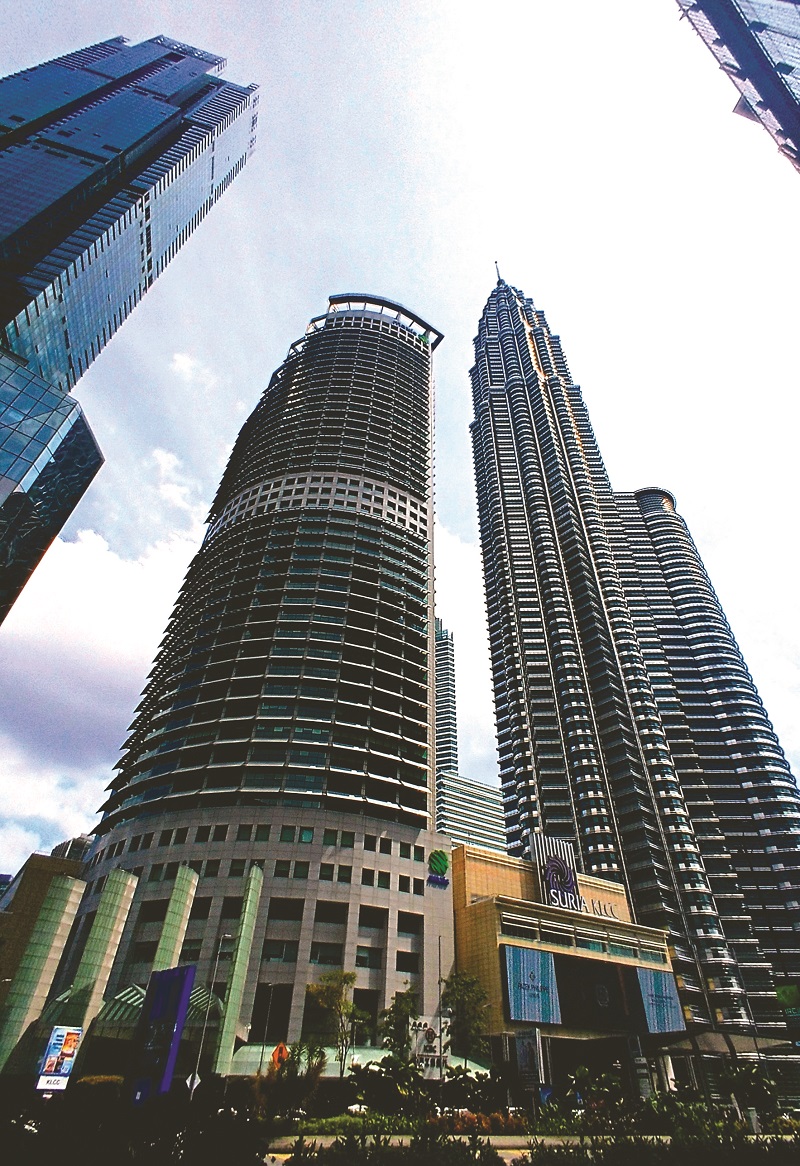
“The Petronas Twin Towers is perhaps the best example of this principle. Despite being almost three decades old, it remains one of the country’s most prestigious corporate addresses because it has been consistently maintained, modernised and aligned with evolving occupier expectations,” Previn points out.
Older buildings strategically located within established commercial districts, despite not offering premium specifications, will likely continue to attract occupiers because the location benefits certain businesses, along with affordable rental rates.
“These buildings remain particularly relevant to small- and medium-sized enterprises, professional service firms, government-linked entities and back-office operations that place greater emphasis on functionality, accessibility and cost efficiency,” he says.
However, Previn cautions that strategic location and affordable rental rates alone are unlikely to be sufficient over the longer term. Buildings that have not benefitted from continuous investment and active asset management will inevitably come under increasing pressure as maintenance costs rise, infrastructure ages and competition from newer developments intensifies.
“In many cases, rental growth may no longer be sufficient to justify the capital expenditure required to maintain the building’s long-term competitiveness. At that stage, owners may need to consider more extensive asset enhancement initiatives, repositioning strategies, adaptive reuse opportunities or even redevelopment,” he adds.
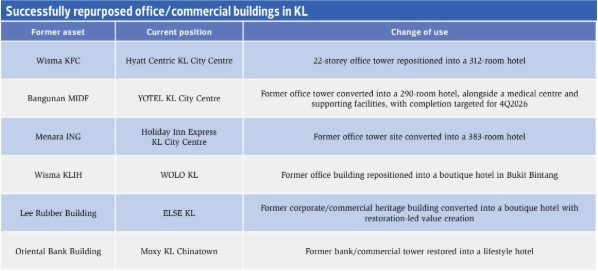
The case for repurposing
Lim believes that there is no “one-size-fitsall” answer on how older offices should be repurposed, as not every building is suitable for every use. The best option depends on the building’s location, its structure, the mechanical and electrical provisions, planning requirements and, most importantly, market demand.
“Generally, hotel conversion is one of the more “Ultimately, repurposing should be guided by feasibility and demand. The key is not to force a building into a particular sector, but to identify the use of the location and building condition, and what market it can realistically support,” Lim explains.
Previn adds to this point, saying: “Successful repurposing is not simply about changing the use of a building. It is about identifying how an asset can continue to create value within an evolving urban environment”.
Will government incentives help make a difference?
The government has taken steps via Budget 2026 tax incentives to make repurposing old commercial buildings a financially attractive proposition. This includes a 10% special tax deduction (capped at RM10 million per project) on qualifying refurbishment or conversion costs for old commercial buildings repurposed into residential use.
The move aims to encourage landlords to pivot towards sectors with stronger demand — namely the hospitality, residential and mixed-use sectors.
Meanwhile, indirect incentives include a reduced service tax of 8% to 6% on rental/leasing of non-residential premises, and a complete tax exemption for MSMEs with a turnover threshold of RM1.5 million. This is aimed at making it cheaper for small businesses to occupy refurbished commercial spaces.
Furthermore, the FT Ministry’s RE_NEW policy adds a number of specific grants for projects that involve heritage preservation, cultural revitalisation and enhanced sustainable features in KL downtown districts.
“Government incentives and policy support are helpful in encouraging owners to repurpose or upgrade older office buildings, but they should not be seen as a complete solution on their own,” says Lim.
She believes that incentives are most effective when they help unlock viable projects that already have a clear market purpose. They are less effective when the asset is poorly located, physically difficult to convert or lacks demand for alternative uses.
“To make the strategy more effective, incentives should be supported by practical measures such as faster approvals, clearer conversion guidelines, more flexible zoning, and better coordination between planning authorities, building owners and operators,” Lim explains, adding that it is a positive policy direction, but one that works best as part of a broader strategy.
Previn opines that incentives can certainly encourage investment and accelerate decision-making, but they cannot create value where the underlying economics are no longer viable.
“Repurposing an office building is often a highly complex undertaking involving technical, financial, regulatory and operational considerations. Every building presents a unique set of circumstances, and what works for one property may not necessarily work for another,” he says.
“Nevertheless, I believe adaptive reuse will become increasingly important as the market continues to mature. In some cases, extending the useful life of an existing asset may prove to be more practical, economically viable and environmentally sustainable than demolition and complete redevelopment,” he adds.
EdgeProp Research: Strata office market: where’s the momentum in Klang Valley?
For decades, exposure to prime commercial real estate was strictly an institutional game. Major real estate investment trusts (REITs) and institutional funds held full enbloc ownership of Grade A purpose-built office (PBO) towers, leaving private retail investors restricted to older, secondary-grade office suites or suburban shop-offices.
Over the past decade, that boundary has blurred. Major developers began fractionalising premier, transit-oriented PBO developments into individual strata titles. Private buyers could suddenly purchase 1,000–4,000 sq ft units inside high-spec, centrally-located developments like Q Sentral in Kuala Lumpur Sentral, Menara The Stride at Bukit Bintang City Centre, and Pavilion Damansara Heights.
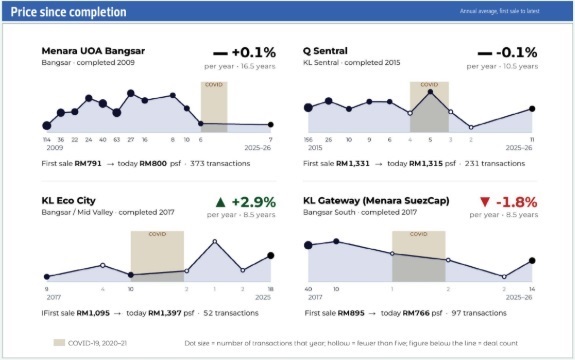
To evaluate how this asset class has performed for private owners, EdgeProp EPIQ analysed transaction records across the Klang Valley’s 10 most expensive strata office developments over the last 16 years. The findings point to a clear trend: capital gains have remained flat over the long term, leaving rental yield as the primary driver of total returns.
Most expensive strata offices
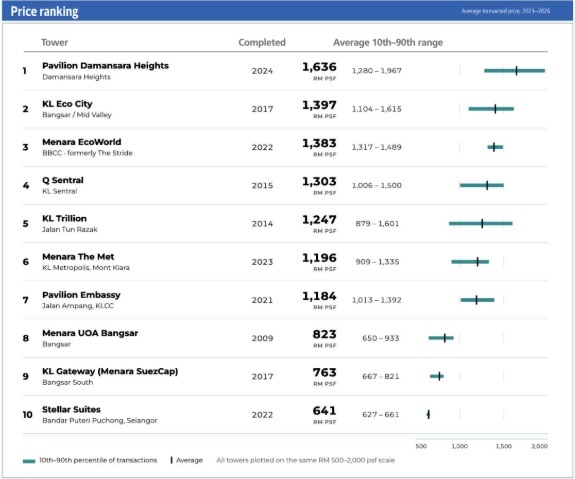
Pavilion Damansara Heights commands the highest price tag among Malaysia’s premier strata offices, averaging RM1,636 psf across transactions over the past three years. KL Eco City follows at RM1,397 psf, Menara The Stride at RM1,383 psf, and Q Sentral at RM1,303 psf.
Further down the “top 10” table sit Menara UOA Bangsar (RM823 psf) and Menara SuezCap at KL Gateway (RM763 psf) — both highly sought-after, well-connected addresses.
Rental yield provides another perspective
When the same developments are compared by rental yield, the ranking changes noticeably.
Menara UOA Bangsar records signed rentals averaging RM4.91 psf. Against its average transacted price of RM823 psf, this translates into an estimated gross rental yield of about 5.7%, assuming a 20% vacancy allowance. Menara SuezCap follows at approximately 5.5%.
At the other end of the spectrum, Menara The Stride and KL Trillion record estimated yields of around 3.8%, while Q Sentral delivers about 4.5% and Pavilion Damansara Heights approximately 4.1%.
The analysis suggests that developments with lower entry prices do not necessarily generate lower rental returns, highlighting the importance of evaluating both capital values and income potential together.
Asking rents versus signed leases
The analysis also identified differences between advertised asking rents and concluded lease transactions.
For example, office space at KL Eco City is commonly marketed between RM6.80 psf and RM7.30 psf, while signed tenancies average RM5.93 psf. Similar gaps are observed at Menara SuezCap and Q Sentral.
Asking rents may therefore provide an indication of market expectations, while completed leasing transactions offer a closer reflection of rents that tenants are ultimately paying. Investors evaluating rental returns may benefit from considering both sets of data.
The investor’s takeaway
The transaction data suggests that income generation has played a more consistent role than capital appreciation in the performance of many premium strata office developments over the period analysed.
There is value in assessing both rental performance and purchase price rather than relying on capital appreciation alone.
It also underscores the importance of distinguishing between asking rents and concluded lease transactions when estimating potential returns.
For buyers seeking direct ownership, strata offices offer access to financing that is generally unavailable through listed REIT investments. While this may appeal to some investors, investment outcomes remain dependent on acquisition price, leasing performance and prevailing market conditions.
..........
EdgeProp monthly brings you data, insights and solutions for an evolving market. Subscribe now for your free copy!
Follow Us
Follow our channels to receive property news updates 24/7 round the clock.


Telegram


Latest publications
View AllFollow Us
Follow our channels to receive property news updates 24/7 round the clock.
Malaysia's Most
Loved Property App
The only property app you need. More than 200,000 sale/rent listings and daily property news.