Johor leads Apac data centre boom as Malaysia tops construction — C&W
PETALING JAYA (Aug 27): Johor has strengthened its position as Asia Pacific’s (Apac) largest data centre market by combined operational and future capacity, while Malaysia leads Southeast Asia in data centre capacity under construction, according to a global real estate consultancy.
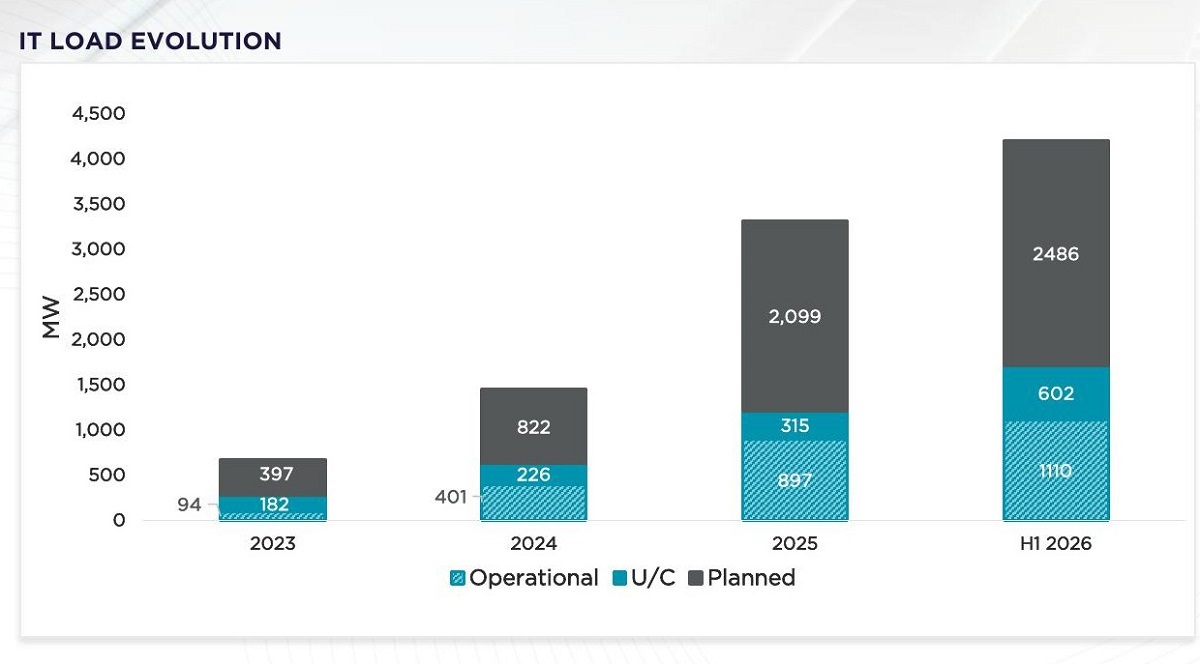
Johor had 4,198 megawatts (MW) of overall stock in the first half of 2026, comprising 1,110MW of operational IT capacity, 602MW under construction and 2,486MW in the planning stage, Cushman & Wakefield (C&W) said in its recently published Asia Pacific Data Centre H1 2026 Update. The consultancy defines overall stock as operational, under-construction and planned capacity.
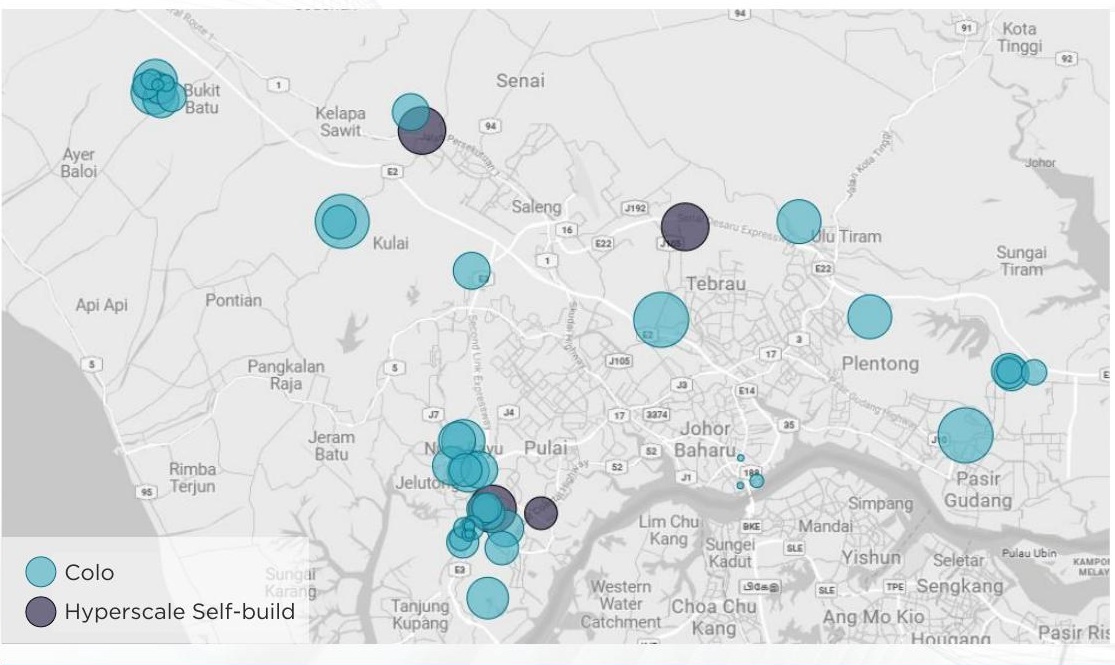
Johor’s operational IT capacity rose 24% from the second half of 2025 to 1,110MW in 1H2026 as additional hyperscale facilities came online. Capacity under construction increased from 315MW to 602MW, while planned capacity rose 19% to 2,486MW.
C&W said the growing share of projects entering construction marked a shift from project announcements towards large-scale delivery.
The distinction is significant from a construction perspective. C&W defines “under construction” as IT capacity where construction has commenced at the site and a ready-for-service date has been announced. Planned capacity, meanwhile, has been committed and announced by an operator, but physical construction may not yet have started.
Pipeline expands, vacancy tightens
Johor’s development pipeline, comprising under-construction and planned capacity, expanded 29% to 3,088MW during the period, reflecting what C&W described as sustained investment as developers advanced large-scale projects to meet hyperscale and artificial intelligence (AI)-driven demand.
Despite more than 212MW of new operational capacity coming online, colocation vacancy tightened to 0.7%. C&W said this showed newly completed facilities were absorbed almost immediately.
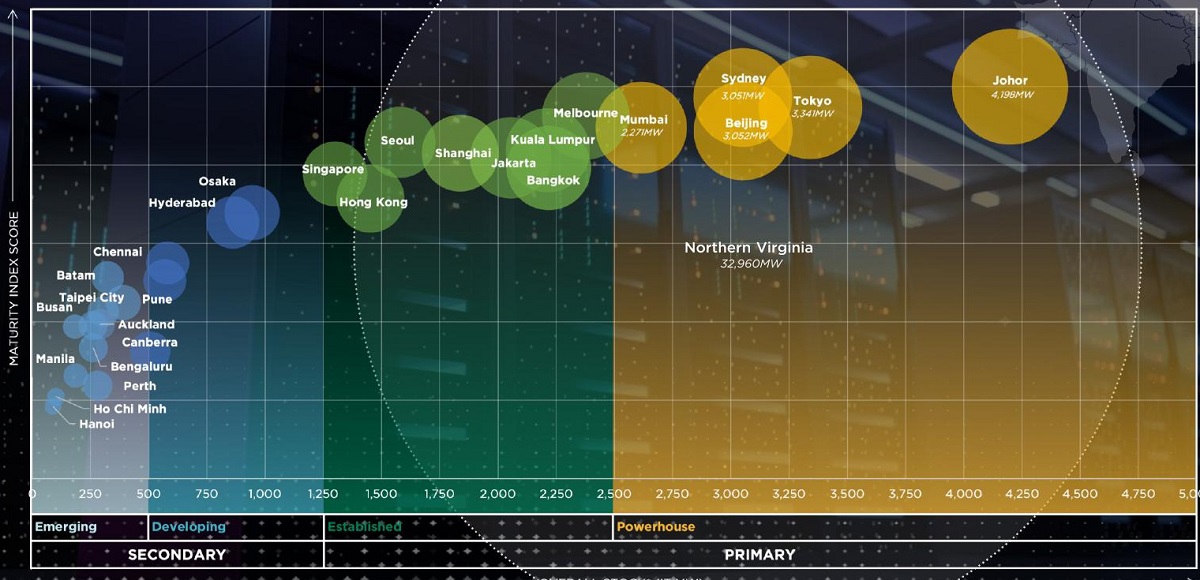
C&W’s Asia Pacific Data Centre Maturity Index places Johor in its “Powerhouse” category alongside Tokyo, Beijing, Sydney and Mumbai.
The index tracks 30 data centre markets across Apac and incorporates overall stock — operational, under-construction and planned capacity — alongside factors including vacancy, colocation and hyperscaler presence and asset-level build capacity.
C&W said Johor had further solidified its position as the region’s largest data centre market under its measure of combined operational and future capacity.
Land sales signal development demand
The scale of Johor’s expansion is also being reflected in its industrial land market.
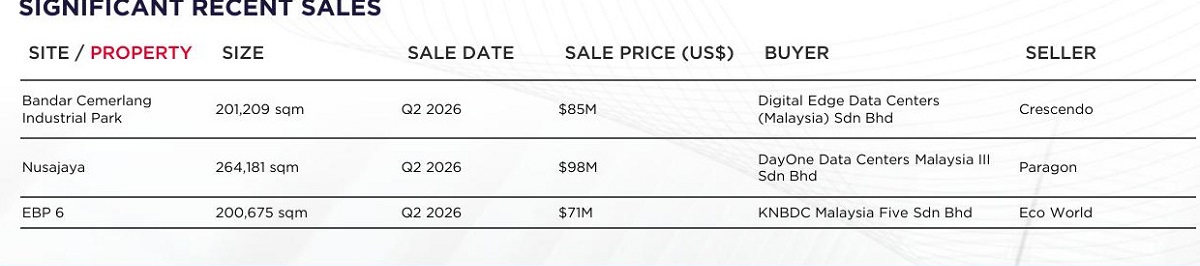
C&W recorded three sizeable Johor land sales involving data centre developers during the second quarter of 2026.
According to the report, Digital Edge Data Centers (Malaysia) Sdn Bhd (a wholly-owned subsidiary of Singapore’s Digital Edge (Singapore) Pte Ltd) acquired a 49.72-acre site at Bandar Cemerlang Industrial Park, Kota Tinggi from Crescendo Corporation Bhd for US$85 million (RM346.53 million) cash in April.
C&W also recorded Paragon Globe Bhd’s sale of a 65.28-acre site in Nusajaya to DayOne Data Centers Malaysia III Sdn Bhd for US$98 million, as well as Eco World Development Group Bhd’s sale of a 49.59-acre EBP 6 site to KNBDC Malaysia Five Sdn Bhd for US$71 million.
C&W said Johor’s momentum had also been reinforced by the rollout of the Johor–Singapore Special Economic Zone (JS-SEZ), cementing the state’s role as a strategic extension of Singapore’s capacity-constrained data centre market while improving cross-border connectivity and its appeal for infrastructure investment.
The consultancy cited Alibaba Cloud’s launch of a new Johor cloud region, AirTrunk’s plans for 280MW of new capacity, the topping out of Digital Halo’s first facility, and US$283 million in financing secured by DayOne Data Centers Singapore Pte Ltd for its Johor campus as evidence of continued investment and project execution.
Malaysia leads Southeast Asia construction
Johor’s rapid expansion forms part of a much wider Malaysian data centre construction wave.
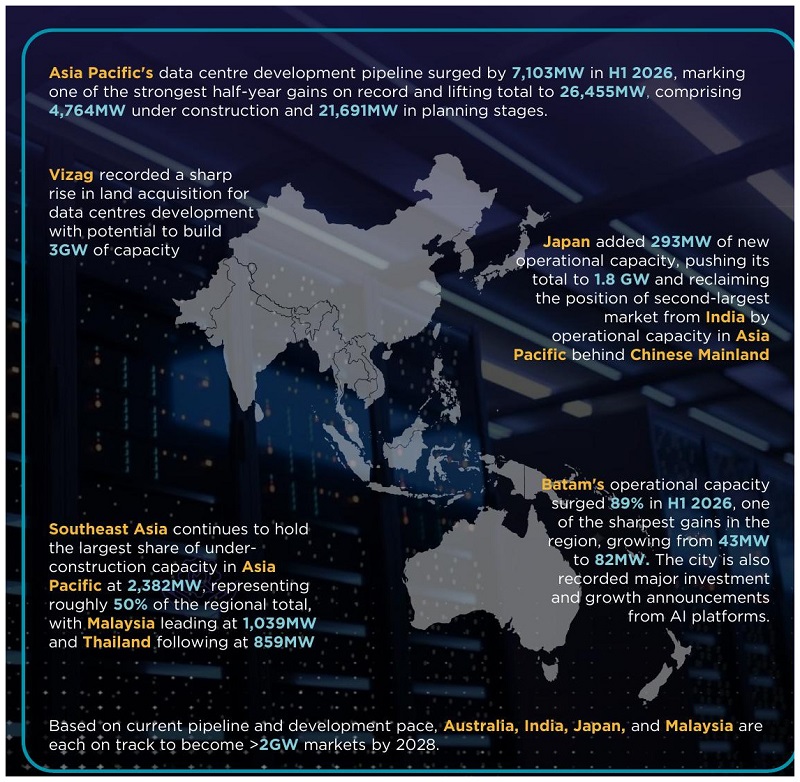
Southeast Asia had 2,382MW of data centre capacity under construction in 1H2026, representing roughly half of the Apac total. Malaysia led the region with 1,039MW under construction, followed by Thailand with 859MW, according to C&W.
Based on the report’s figures, Johor’s 602MW alone represents more than half of Malaysia’s current under-construction capacity.
C&W also identified Malaysia as one of four Apac markets, alongside Australia, India and Japan, on track to exceed 2GW by 2028 based on its current pipelines and pace of development.
Malaysia’s position also comes as data centre development across Apac becomes increasingly selective.
C&W said Malaysia was attracting higher-value AI-grade deployments, while Indonesia and Thailand were absorbing overflow demand as land constraints and tighter policies intensified in established hubs.
Across Apac, about 1,372MW of new operational capacity came online in 1H2026, while another 7,103MW was added to the development pipeline.
The regional pipeline consequently reached 26,455MW, comprising 4,764MW under construction and 21,691MW in the planning stage.
Despite that substantial increase in supply, Apac vacancy edged down from 10.9% in 2H2025 to 10.3% in 1H2026, which C&W said demonstrated the market’s ability to absorb additional capacity amid robust demand.
Power becomes the next constraint
But the scale of the construction pipeline is also changing the factors that determine where the next generation of data centres can be built.
C&W described 1H2026 as a period of rapid but “power-constrained” execution for AI and cloud investment across Apac, with hyperscale capital expenditure accelerating even as electricity availability increasingly became a bottleneck.
Capacity growth is consequently moving away from saturated hubs towards peripheral areas and entirely new locations.
That makes the availability of suitable land only one part of the development equation. C&W expects future investment to become increasingly concentrated in markets capable of providing scalable power, developable land and robust network connectivity, which it said would increasingly determine the pace of new capacity development.
For Johor, where the pipeline has already expanded rapidly, the issue is increasingly one of managing that growth.
C&W said the state had introduced stricter sustainability requirements, including lower power usage effectiveness (PUE) and water usage effectiveness (WUE) thresholds, while tightening approval standards to prioritise more efficient and higher-value facilities over speculative developments.
Operators are also facing higher utility costs and minimum power-utilisation requirements, while being expected to secure alternative water and renewable-energy solutions as data centre campuses become larger.
The requirements underline how the next phase of the data centre boom is becoming as much an infrastructure and planning issue as a question of investor appetite or land availability.
C&W said the measures could moderate the pace of future approvals in Johor, but were expected to improve the quality and long-term resilience of its data centre ecosystem as the market shifts from rapid expansion towards more sustainable growth.
Taken together, the report suggests that Johor’s rise and Malaysia’s lead in Southeast Asian data centre construction are moving the sector into a new phase: one in which the ability to deliver sufficient power, water, land and connectivity will increasingly determine how much of the announced pipeline can progress into construction and ultimately become operational.
Note: All data and images by Cushman & Wakefield
..........
EdgeProp monthly brings you data, insights and solutions for an evolving market. Subscribe now for your free copy!
Follow Us
Follow our channels to receive property news updates 24/7 round the clock.


Telegram


Latest publications
View AllFollow Us
Follow our channels to receive property news updates 24/7 round the clock.
Malaysia's Most
Loved Property App
The only property app you need. More than 200,000 sale/rent listings and daily property news.