Penang’s shrinking divide is narrowing property price gap across strait
This article appeared in the Aug 13, 2026 issue of the monthly print edition. Subscribe now.
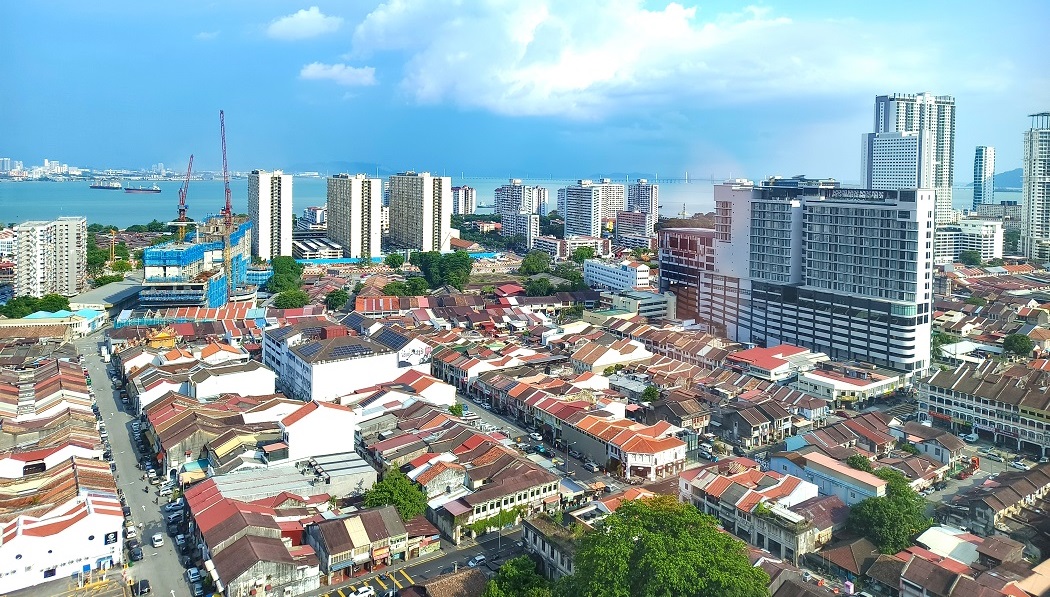
Penang’s real estate market has never been one that can easily be painted with a single brushstroke. For decades, it has been a story about water, where a narrow channel serves as a great divide that cleaves the state into two parts — a wealthy island and a working-class mainland.
But that story is changing. Where once its residential property landscape was almost entirely defined by transactional activity on the island, the emergence of a dynamic mainland market has now broadened the narrative, demanding that growth be now viewed via a dual perspective.
Now, Penang is a tale of two markets. One is shaped by heritage prestige, seafront luxury, and along with it, land scarcity; another is pushed by industrial expansion, professional migration, and inadvertently, rising living standards. The strait still exists as a partition, but the premium that once separated both shores is shrinking.
However, distinctly different forces propel housing demand on each side of the water. While shrinking land and aspirational lifestyle opportunities are preserving high residential prices on the island, robust economic growth buoyed by industrial expansion is driving demand for enhanced living standards on the mainland, which is steadily closing the house price gap.
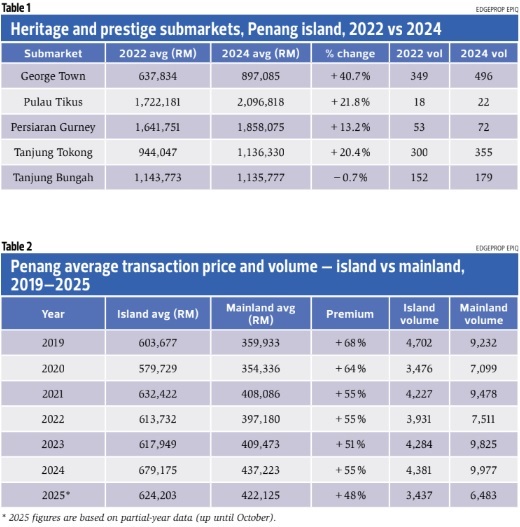
A study of EdgeProp EPIQ data over a five-year period shows that the percentage by which the average island home exceeds the average mainland home has contracted from 68% in 2019 to 55% in 2024.
This changing dynamic is also reflective of two different evolution ambits: a matured island market that continues to sustain its high price tag due to limited land opportunities, but could be close to reaching its price ceiling; and a mainland market that is reaping the benefits of an economic boom, with still plenty of room to grow.
Overall market maturing amidst supply challenges
Industry professionals actively engaged in Penang say the property market is entering a more selective phase. They identify stronger market fundamentals, evolving buyer preferences and infrastructure-led growth as key drivers of long-term demand, despite persistent supply challenges in certain segments.
While oversupply concerns continue to shape discussions surrounding the state’s residential market, the consensus is that it is transitioning towards a more disciplined, demand-driven landscape where project quality, product differentiation and end-user appeal will determine future success.
Rahim & Co director Siva Shanker says Penang continues to occupy a leading position within Malaysia’s property market, supported by its established commercial and industrial base.
While Johor’s rising profile is a growing competition, particularly following renewed investment interest and major infrastructure initiatives, Siva believes: “Penang has a slight edge because it’s a little bit more ahead in the game”.
He says the state’s position as Malaysia’s principal industrial centre continues to underpin both commercial and residential demand, while constrained land supply supports longterm property values across industrial, commercial and residential sectors.
He observes that the state’s property evolution has been driven largely by land scarcity on Penang Island, prompting development to expand across the mainland over time.
“If you are coming late in the game, you must accept that you more or less cannot get anything on the island, you’ll already have to go to the mainland [for housing opportunities].” This is part of many factors that have led to steadily rising prices on the mainland.
Describing this transition as a natural progression rather than a structural weakness, Siva compares the mainland’s growing role to neighbouring regional development patterns, suggesting that mainland Penang increasingly complements the island’s mature property landscape.
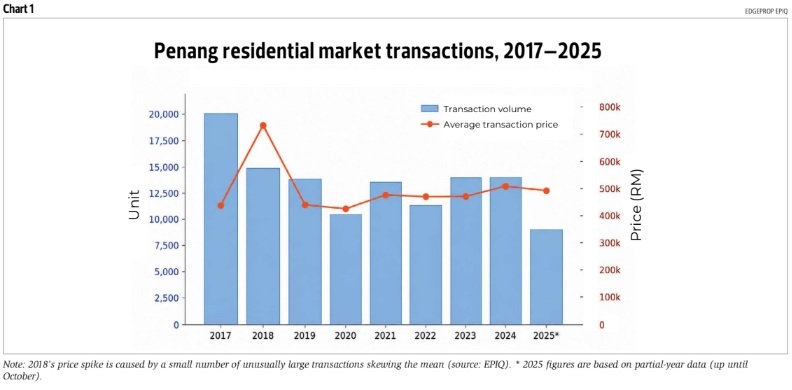
According to EPIQ, Penang recorded 48,496 overall residential transactions in 2023–2025, up from 44,986 in 2020–2022 (+7.8%). Total transaction value stood at RM7.13 billion in 2024, where the average transaction price reached RM508,837, up 19% from the 2020 low (Chart 1).
On the supply side, however, the picture is less positive. The state has 161 active residential projects representing 44,366 units in the pipeline, of which 16,561 (37%) are unsold. Several flagship high-rise launches are absorbing units at rates well below the Malaysian-market healthy benchmark of 2% per month. The most exposed segment is serviced apartments: out of 14 projects with 6,414 units, 3,585 are unsold (56%).
However, PE Land Group CEO Joanna Ling says market discussions surrounding oversupply should be viewed within the context of differing price segments and geographical locations rather than as a blanket assessment of Penang’s housing market.
“From a long-term perspective, I remain optimistic about Penang’s residential outlook,” Ling tells EdgeProp.
“While there has been considerable discussion around oversupply in certain segments of the market, it is important to recognise that Penang’s residential sector is not homogeneous.” She says Penang’s long-term residential outlook remains supported by strong economic fundamentals, particularly the state’s manufacturing sector, semiconductor industry, expanding global business services ecosystem, medical tourism industry and growing technology sector.
Ling believes employment creation remains one of the strongest drivers of housing demand, adding that sustained job growth, improved affordability, strategic infrastructure investment and developments that reflect changing lifestyle expectations will continue to support the residential sector.
According to Ling, developers have increasingly recognised that residential projects must respond to changing consumer expectations rather than relying solely on conventional development models. At the same time, Penang buyers have become significantly more discerning, evaluating developments based not only on size and pricing, but also on how well projects support daily life, work and community interaction.
“One of the biggest lessons from the current market cycle is that developers can no longer adopt a one-size-fits-all approach,” she says, adding that future projects will become more customer-centric, with emphasis on functionality, affordability, quality and community.
Urban Prestige Properties’ team director Eugene Tan observed that demand for serviced apartments has moderated, partly due to higher assessment rates. However, projects in stronger locations continue to attract healthy buyer interest.
Tan said that although more than 10 projects have been launched since 2025, only a handful have achieved significant sales. Location, pricing and developer reputation remain the main differentiating factors.
Buyer profiles also vary by area. While some locations continue to attract investors, most buyers in other residential areas are purchasing for their own occupation.
“I would say pricing is the most attractive attribute to purchasers,” he added.
Industrial growth continues to propel mainland demand
Mainland Penang’s housing market is increasingly shaped by the state’s industrial expansion, with Batu Kawan emerging as the epicentre of growth, anchored by advanced manufacturing hubs and automation facilities.
The influx of multinational firms in electrical and electronics (E&E), semiconductors, and precision manufacturing has attracted thousands of professionals, creating sustained demand for residential properties close to these employment centres.
This industrial boom has spurred the rise of integrated townships in Batu Kawan and Bukit Mertajam. Developers are responding to the needs of families and first‐time buyers by offering larger, more affordable homes compared to the island. These townships combine residential, commercial and recreational elements, providing holistic living environments that appeal to a growing middle class.
As demand strengthens, prices on the mainland have begun to edge upwards, reflecting both rising confidence and the appetite for better quality housing options. What was once seen purely as a value alternative is now evolving into a market segment where affordability is balanced with lifestyle, gradually pushing mainland property values higher.
Retail and lifestyle anchors have further enhanced the mainland’s appeal. Landmark projects such as IKEA Batu Kawan and Design Village Outlet Mall have transformed the area into a lifestyle destination, reinforcing its attractiveness for long‐term settlement. These facilities not only serve residents but also draw visitors from across the state.
Industrial expansion continues to underpin housing demand. The strong performance of Penang’s E&E and semiconductor sectors, particularly in Batu Kawan and Seberang Perai, has created a steady pipeline of jobs. As more companies establish operations, the demand for housing near these industrial clusters is expected to remain resilient, ensuring that residential growth keeps pace with economic activity.
Despite the mainland price growth, Henry Butcher Malaysia Sdn Bhd director Jason Teoh believes affordability continues to be the key driver for buyers. Residential entry prices remain attractively lower compared with the island, which still makes the mainland the preferred choice for first-time homebuyers, young families and owner-occupiers, while those seeking larger homes have also gravitated towards this direction.
“In contrast, the Island is a much more mature market characterised by limited land availability, higher development costs and premium pricing. Purchasers on the Island are increasingly driven by lifestyle preferences, prestige and investment considerations,” Teoh tells EdgeProp.
Infrastructure connectivity is also narrowing the traditional island‐mainland divide. The Second Penang Bridge, along with planned transit projects such as the LRT extension, are boosting accessibility and supporting transit‐oriented developments. These improvements reduce commuting friction, making mainland living more practical for professionals who work across both sides of the channel.
Together, industrial growth and infrastructure upgrades are reshaping the appeal of the mainland’s housing market, positioning it as a rising economic force in its own right.
Penang island buoyed by new catalysts
Nevertheless, Penang island continues to sustain its premium position in the state’s residential property market. Average transaction values remain firmly above RM450,000, supported by a combination of development land limitations and powerful demand drivers that keep the island’s appeal intact.
One of the most significant recent catalysts is the Penang South Reclamation project, dubbed Silicon Island. This RM70‐plus billion mega‐development will add 4,500 acres of reclaimed land, earmarked for advanced manufacturing, mixed‐use precincts and residential enclaves.
The scale of investment is expected to generate long‐term housing demand, particularly from professionals and expatriates tied to the state’s expanding tech ecosystem.

Connectivity is another ongoing driver. The Penang LRT Mutiara Line, a 29.5km elevated rail system linking George Town to Bayan Lepas, is already influencing property values.
Homes located within 500m of planned stations are commanding premiums, reflecting investor confidence in transit‐oriented living.
The island’s role as a global tech hub further underpins demand. Intel, Micron, Infineon and other semiconductor giants are expanding operations, bringing in skilled workers and expatriates who require housing close to industrial clusters. This influx supports both mid‐range and high‐end segments, with developers tailoring projects to meet the needs of knowledge workers and international talent.

Overall, lifestyle propositions and scarcity continue to sustain value on the island. Affluent buyers, expatriates and digital nomads are drawn to Tanjung Tokong, Gurney Wharf and George Town’s heritage zones, where luxury residences and cultural vibrancy converge.
While residential property values on the island have seen limited growth in recent years, George Town is carving out a comeback story by bucking the trend.
In the wake of the Covid-19 pandemic, EPIQ data show the average residential transaction price in the George Town planning region in 2022 was RM637,834. This was essentially unchanged from RM637,986 in 2019, but below the 2018 peak of RM919,880.
Two years thereafter, the picture changed dramatically. In 2024, the average George Town residential transaction reached RM897,085, with 496 sales. This was a 40.7% jump in average price and a 42.1% jump in volume from 2022 (Table 1). Total transaction value in the planning region nearly doubled in two years, from RM222.6 million in 2022 to RM444.9 million in 2024.
A question that naturally arises is: Why did the market jump in 2024, and not before? In George Town’s case, three convergent factors appear to explain the timing.
The first is the international-tourism recovery. Cruise-ship arrivals at Swettenham Pier, which had collapsed during the pandemic and remained subdued through 2022, returned to roughly pre-pandemic volumes by mid-2024.
Hotel occupancy in the Unesco core, which had fallen below 30% in 2021, recovered through 2023, surpassing pre-pandemic levels for several months of 2024. The boutique-hotel business is also back in play with rising tourist arrivals.

The second is the chip-belt spillover. The manufacturing-investment wave that has driven Penang’s broader 2022–2024 economic story has concentrated employment growth in two places:Bayan Lepas on the island and Batu Kawan on the mainland. However, the senior personnel and regional managers from those firms have revealed a preference for living near the heritage core, with the retail, F&B and educational amenities nearby. Average Tanjung Tokong condominium prices rose from RM944,047 in 2022 to RM1,136,330 in 2024, together with a 19% volume increase.
The third reason is more local and more structural. Several large George Town residential and mixed-use projects launched in the 2018–2020 cycle reached either physical completion or final-phase release in 2024. Foreshore Residence, with 674 units, reported 78% sold-rate by mid-2026, and a substantial portion of those sales was recorded in 2023–2024.
What’s closing the island-mainland gap?
In March 2014, the opening of the Sultan Abdul Halim Muadzam Shah Bridge (a 24km link between Batu Maung on the island and Batu Kawan on the mainland), dubbed the Penang Second Bridge, was billed as an economic spine that would knit both sides together in shared growth. Yet, for much of the following decade, market data told a different story.
The price of an average home on Penang island remained stubbornly higher than the price of an average home anywhere across the channel. In 2019, the price gap stood at 68%. Buyers on the island paid an average of RM604,000 for a residential property, compared with RM360,000 on the mainland (Table 2). Then, without policy intervention, the gap suddenly began to narrow.
Between 2019 and 2024, the average mainland transaction rose by 21.5%, from RM359,933 to RM437,223. Over the same six‐year period, the average island transaction climbed more modestly, from RM603,677 to RM679,175, a gain of 12.5%.
This divergence in growth rates has reshaped the premium. The percentage by which the average island home exceeds the average mainland home narrowed from 68% in 2019 to 55% in 2024. In a state where every property conversation for the past 30 years began with the words “island or mainland”, that distinction is starting to matter less.
The convergence is real, but it could be driven by a quiet structural shift in where Penang’s middle-class capital is flowing. What waits to unfold in the next decade is whether the narrowing gap between island and mainland signals a healthy maturation of the state’s housing market, a one-off catch-up after decades of lag, or whether the island has finally reached a price ceiling constrained by buyer affordability.
How the mainland is crossing the divide
Three mainland sub-markets in particular have driven the convergence.
Batu Kawan, the southern mainland district at the foot of the Second Bridge, recorded an average residential transaction price of RM392,070 in 2019. By 2024, that average had risen to RM593,410 — a 51.4% increase in five years. The transaction volume in the district fell slightly, from 189 sales in 2019 to 137 in 2024, which reflects something developers and bankers will recognise instantly: prices rose because the products changed.
Batu Kawan in 2019 was selling RM350,000 terrace houses. Batu Kawan in 2024 was selling RM700,000 cluster homes, RM1.2 million semi-detached units, and a wave of mid-range condominiums anchored on the Aspen Vision City master plan and Eco World’s Eco Horizon.
The second mover is Nibong Tebal, a small town near the Penang-Perak border that has historically been one of the cheapest residential markets in the state. In 2019, the average residential transaction there was RM306,043.

By 2024, it saw a 46.4% price increase, reaching RM448,023.
Nibong Tebal’s appreciation reflects an even more fundamental dynamic: cheap land, the gradual extension of the Penang commuter belt, and a population of buyers who can no longer afford even the lower end of the island market.
The third is Alma, the corridor of small townships running along the trunk road south of Bukit Mertajam. Alma’s average price rose from RM445,776 in 2019 to RM622,228 in 2024, increasing by 39.6%. Alma’s appreciation has a simple explanation: it is now the most realistic option for salaried professionals working in Bayan Lepas or George Town who want a freehold landed home, a school within 10 minutes, and a 35-minute commute by bridge. That commuter math, more than any other single factor, is what is closing the strait.
What the convergence means for the Penang market
One perspective is the convergence is the natural result of three decades of underinvestment in the mainland finally being corrected.
The Second Bridge opened in 2014, and the manufacturing investment wave that followed transformed Batu Kawan from a plantation backwater into a real economic node. The Penang Sentral transit hub in Butterworth, opened in 2018, knit the mainland into the national rail network. State-led industrial parks at Batu Kawan and Bertam created tens of thousands of jobs on the mainland side of the channel.
The continued convergence of the price divide is an eventuality that the data cannot yet accurately predict, but it suggests a possible positive outcome where the mainland grows into the price it deserves, removes decades of economic polarisation, and finally allows Penang to function as a single integrated market rather than two stratified ones.
However, here is what the current data can tell us. EdgeProp’s database based on the Housing and Local Government Ministry’s TEDUH records shows that of Penang’s 161 active residential projects, 76 are on the island and 85 are on the mainland. By units, the picture is more pronounced: the mainland has 27,108 active project units, the island 17,258.
The volume of new mainland supply coming through over the next four years is significantly larger than the volume of new island supply. If take-up rates hold, the mainland will absorb more units, and by that measure it will be taking the helm in defining Penang’s property narrative. This is a significant role reversal.

Moving ahead, however, Henry Butcher’s Teoh believes Penang’s residential market is transitioning from a volume-driven cycle to a selective, fundamentals-driven market, where success is increasingly determined by integration, scarcity, connectivity, and product identity.
“The narrowing gap reflects stronger capital appreciation on the mainland, particularly in locations benefitting from industrial expansion. These areas have experienced sustained demand from owner-occupiers, employees working in nearby industrial parks and investors anticipating long-term growth.
“Nevertheless, the Island continues to command a significant price premium due to its scarcity of developable land, established amenities and stronger locational appeal,” he says.
Teoh says developers have increasingly recognised that the market is no longer driven purely by location or design, but by complete value ecosystems. He identifies continued urbanisation, industrial expansion, medical tourism, expatriate employment and major infrastructure upgrades as among the principal factors supporting future residential demand in the state.
Teoh also cautions that Penang’s market is evolving into a two-tier structure, where well-positioned developments continue to demonstrate resilience while undifferentiated products face stronger competitive pressure.
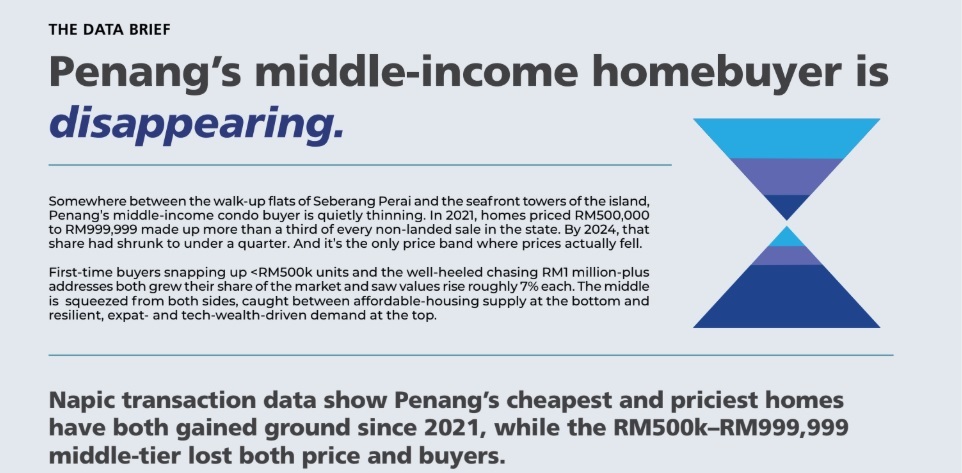
“[Overall,] the long-term outlook for Penang’s residential market remains fundamentally stable, [but] with selective growth pockets, rather than broad-based expansion,” he says.
..........
EdgeProp monthly brings you data, insights and solutions for an evolving market. Subscribe now for your free copy!
Follow Us
Follow our channels to receive property news updates 24/7 round the clock.


Telegram


Latest publications
View AllFollow Us
Follow our channels to receive property news updates 24/7 round the clock.
Malaysia's Most
Loved Property App
The only property app you need. More than 200,000 sale/rent listings and daily property news.