The mainland’s moment: Seberang Perai poised to shape Penang’s next chapter
This article appeared in the Aug 13, 2026 issue of the monthly print edition. Subscribe now.
For decades, Penang’s story has been told from the island. It is where the state’s global identity was forged — through George Town’s Unesco World Heritage status, a thriving tourism industry, multinational investments and a vibrant urban economy.
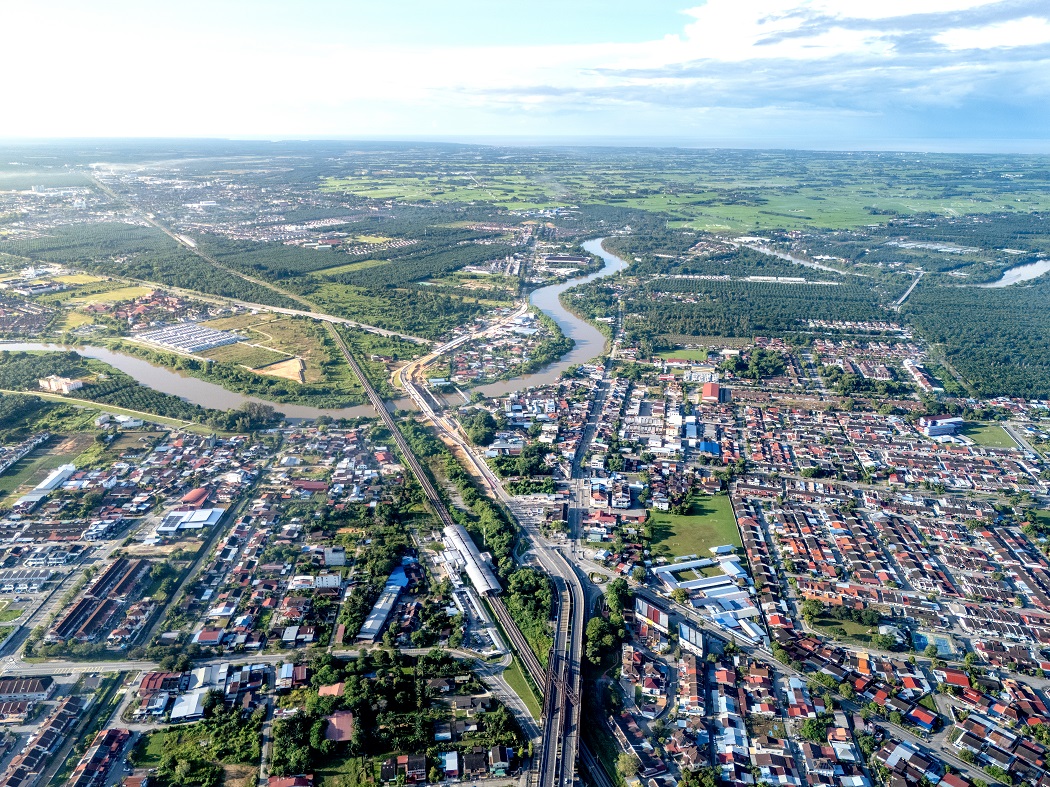
Across the channel, Seberang Perai quietly played a different role. It became Penang’s manufacturing powerhouse, its logistics corridor and one of Malaysia’s most important industrial bases, yet remained largely absent from the state’s broader narrative.
Today, that tale is beginning to change. As Penang grapples with the realities of limited land, increasing congestion and the need to sustain long-term economic growth, attention is shifting towards the mainland. Not because it offers more space to build, but because it presents something increasingly valuable — the opportunity to rethink how a modern region should grow.
The future of Penang is in Seberang Perai.
That was what Chief Minister Chow Kon Yeow said in his winding up speech during a state legislative assembly sitting back in 2022.
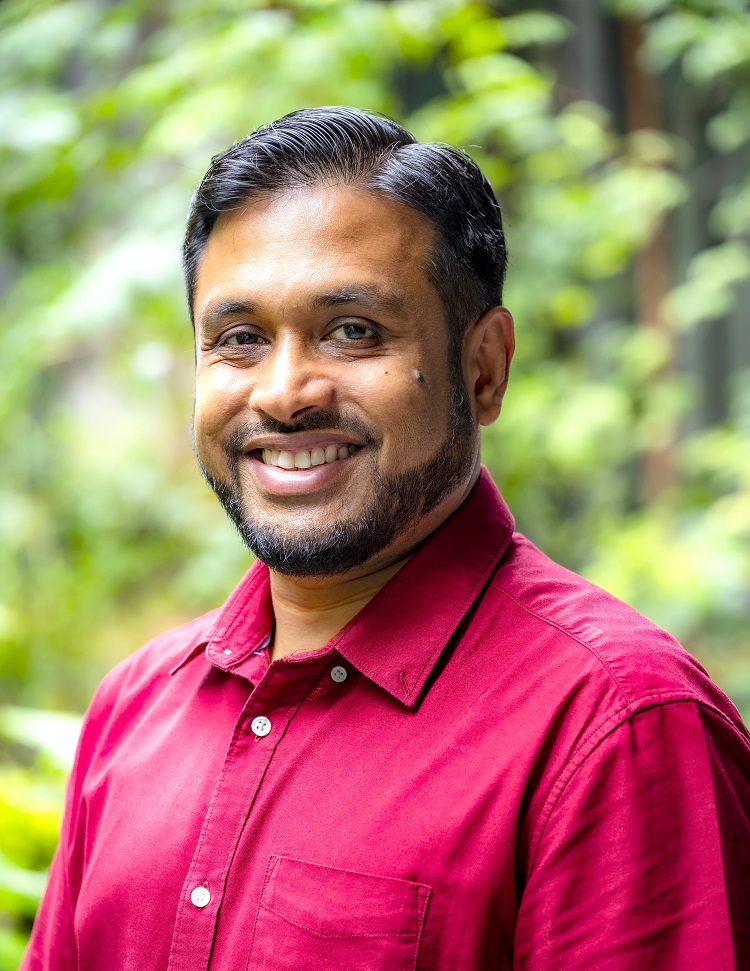
That is a statement that Think City Sdn Bhd managing director Datuk Hamdan Abdul Majeed also repeats throughout the conversation with EdgeProp, having worked on achieving sustainable and inclusive development opportunities in both the island and mainland.
When George Town was listed as a Unesco World Heritage Site in 2008, there was an urgent need to conserve and protect the city’s unique heritage. Think City was created to launch the George Town Grants Programme, designed to spearhead urban regeneration, with the goal of promoting community engagement, and to preserve and celebrate heritage through financial and technical support.
Over the next subsequent years, Think City disbursed 240 grants worth RM16 million in special projects related to improving the public realm, conservation, capacity building and content development. Then in 2014, Think City expanded into Butterworth, Johor Bahru and Kuala Lumpur to actively continue urban rejuvenation projects, shaping and supporting other aspects of citymaking, collaborating closely with both the public and private sectors as well as the community.
For Hamdan, the work of Think City in Seberang Perai is less a declaration of ambition than an acknowledgement of geography.
Occupying about 71% of Penang’s land mass, housing more than half of its workforce and contributing nearly half of the state’s manufacturing value, the mainland has long underpinned Penang’s economic success without enjoying the same level of recognition.
“The next 50 to 100 years of Penang’s growth will have to take place in Seberang Perai,” Hamdan says, “The island is already dense. Every inch of land has been utilised. The mainland still has the opportunity to shape development in a much more purposeful way.”
And the shift is already visible. Major infrastructure projects — including the Penang Mutiara LRT, upgrades to the North Butterworth Container Terminal and improved regional connectivity — are steadily narrowing the physical and economic divide between the island and mainland. Increasingly, Penang is beginning to function less as two separate places and more as a single metropolitan economy.
Hamdan likens that relationship to Hong Kong and Kowloon — distinct urban centres with different strengths, but functioning as one integrated region.
More than another industrial success story
Yet, if Seberang Perai is to become Penang’s next growth frontier, Hamdan argues it cannot simply repeat the development model that brought it this far.
For decades, development on the mainland largely revolved around industrial parks and housing estates. That strategy transformed places like Batu Kawan into major investment destinations, but it also produced fragmented growth, increasing dependence on private vehicles between towns that were often developed independently of one another.
The next phase, he argues, requires a different blueprint.
“We don’t want endless towers creating faceless places. Instead, Seberang Perai’s competitive advantage lies in something many fast-growing cities have struggled to preserve — its rivers, agricultural landscape, heritage towns, fishing villages and close-knit communities,” he stresses.
Rather than treating these as constraints on development, Hamdan believes they should become part of the region’s economic proposition.
“We started in Butterworth in 2014, working closely with the local authority on revitalising the town. Since then, we have gradually expanded our place-based approach to other towns across Seberang Perai. The objective is to strengthen these urban centres while ensuring they remain rooted in their own identity and character,” Hamdan reiterates.
Just as Singapore carefully balances urban growth with environmental stewardship, Seberang Perai must protect its environmental assets, agricultural landscape and waterways while building resilience against future challenges, he stresses.
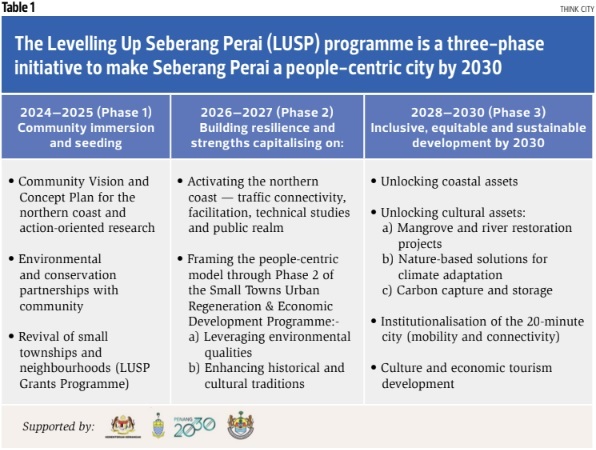
“That is why our approach focuses on creating places that are economically attractive, socially vibrant and environmentally resilient.” Think City adopts the Levelling Up Seberang Perai Programme (LUSP), a community-first approach that empowers local communities with the support, knowledge and resources needed to lead change themselves (Table 1).
“This is the same formula that Think City successfully applied in George Town over the past 18 years, where community grants became catalysts for much larger urban transformation,” Hamdan notes.
That philosophy increasingly underpins efforts to reposition Seberang Perai — not simply as Penang’s industrial base, but as a place where manufacturing, heritage, ecology and liveability coexist.
“We have already seen how places such as Batu Kawan have transformed over the past two decades — from relatively undeveloped land into a major industrial and investment hub. Similar transformations are beginning to happen across other parts of Seberang Perai,” he says.
Growth that begins from the ground up
That people-first approach also explains why one of the region’s most significant regeneration programmes began, not with infrastructure, but with communities.
Instead of preparing a master plan behind closed doors, the LUSP initiative first asked residents what they believed their towns needed. The response surprised even its organisers.
More than 250 applications were submitted from communities across Seberang Perai, eventually resulting in 65 grants that mobilised almost RM8 million in combined grants and co-investment. The projects ranged from heritage preservation and environmental conservation to local entrepreneurship, tourism and community activation, ultimately involving more than 1,200 residents across the mainland.

For Think City senior manager Kishore Ramdas, the exercise challenged one of the biggest misconceptions surrounding regional development.
“What surprised us most was the overwhelming demand and the sophistication of local grassroots initiatives,” he says.
“The community wasn’t waiting for a topdown saviour. They already had ideas and the capacity to make things happen if they were given the right support. Projects like local urban farming and food security initiatives, as well as creative artisan directories, proved that a microgrant could yield macro-impact. It was this self-organising capability, matched with a co-investment of RM4 million directly from the ground, that firmly convinced us the mainland possesses the social capital required for larger-scale, infrastructure-level transformation,” says Kishore.
Rather than acting solely as a project implementer, Think City positions itself as a facilitator, bringing together local communities, government agencies, universities, NGOs and businesses to align individual initiatives into a broader strategy.
The outcome was more than a collection of community projects — it became proof that Seberang Perai possessed not only economic capital, but social capital as well.
A blueprint for the next decade
That community momentum now feeds into a broader vision for Seberang Perai’s future.
At the centre of that vision is the Northern Coast Vision Plan, which seeks to reposition one of the mainland’s most overlooked landscapes as both an ecological and economic asset. Although still being refined, the plan represents Think City’s first attempt to translate dozens of community-led projects into a broader spatial strategy.
Stretching more than 20km, the northern coastline encompasses mangrove forests, river systems, fishing villages, heritage sites and waterfront settlements. Yet, despite its strategic location, much of the area has remained outside mainstream development.
Rather than proposing wholesale redevelopment, the Vision Plan focuses on regeneration. It identifies opportunities to revitalise waterfront districts, strengthen Penang Sentral as a regional gateway, improve public spaces, restore mangrove ecosystems and build climate resilience while preserving the area’s environmental character.
“What we’ve done through the first phase is to create momentum,” Hamdan says.
“The Vision Plan is about taking that momentum and translating it into a long-term direction for how this region evolves. This coastline is one of Seberang Perai’s greatest natural assets and the objective is to manage it holistically by enhancing its mangrove ecosystem, improving public spaces, creating opportunities for quality development, and renewing existing areas rather than replacing them.
“Ultimately, our ambition is to develop similar regeneration plans across other parts of Seberang Perai, with each plan tailored to the unique assets of its respective area.
“However, the emphasis remains the same — bottom-up planning aligned with government priorities while ensuring inclusivity, resilience and environmental sustainability remain central to the development agenda. As we strengthen environmental systems and improve waterways, we also improve quality of life and build greater resilience against future challenges,” Hamdan shares.
More importantly, the Northern Coast is intended to become the first demonstration of a planning model that could eventually extend to other parts of Seberang Perai, with each area shaped by its own landscape, culture and economic strengths.
Where rivers become economic corridors
Few features illustrate this philosophy better than the three river systems selected to anchor the next phase of development.
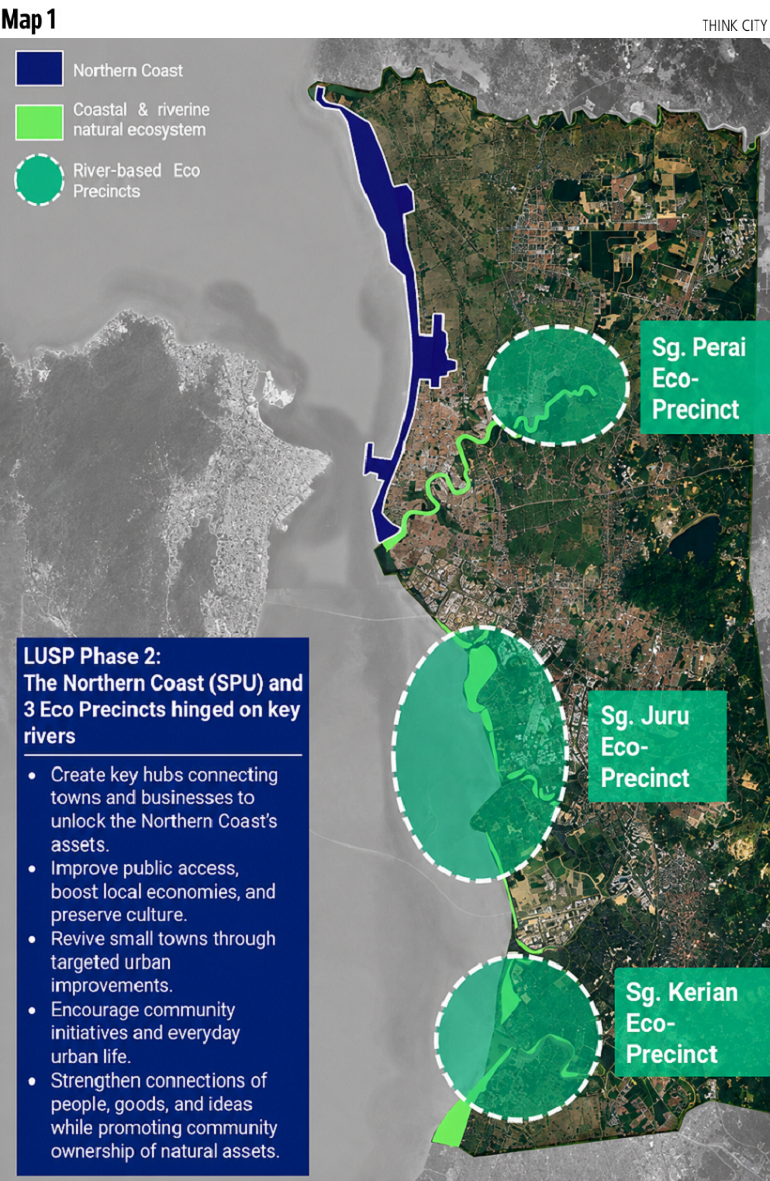
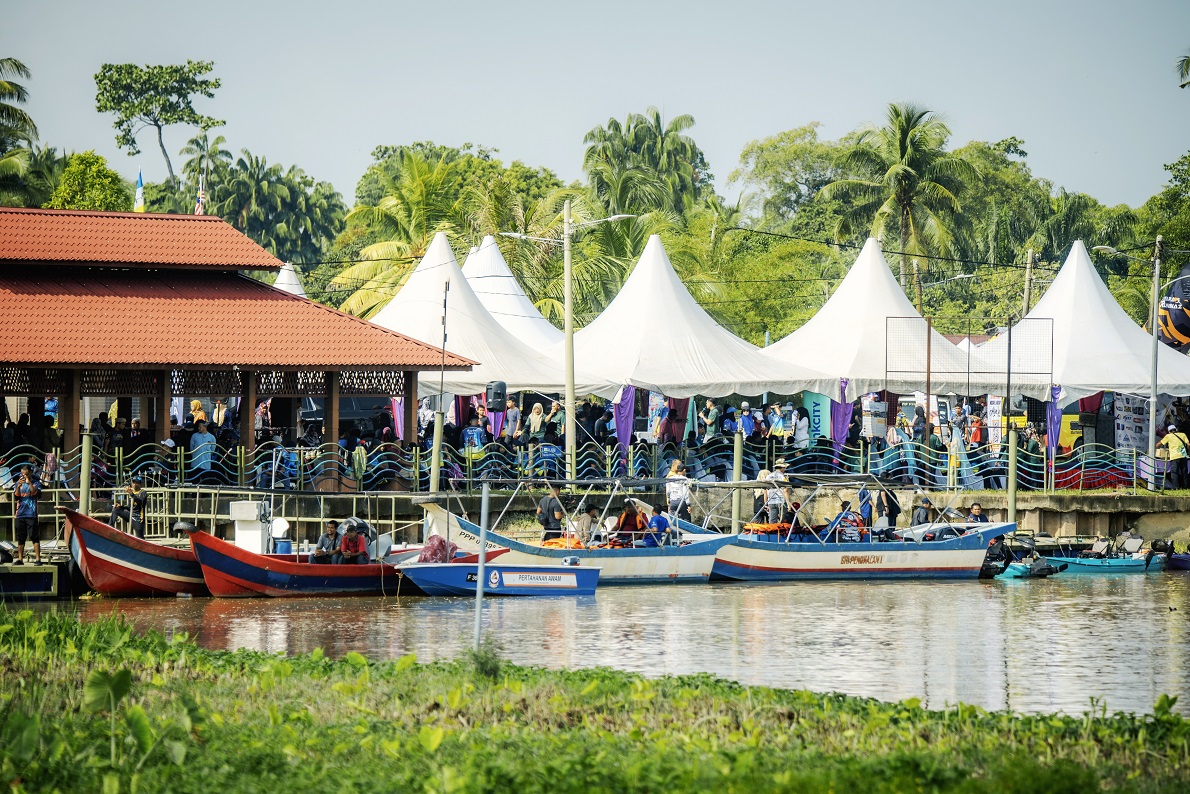
Rather than viewing Sungai Perai, Sungai Juru and Sungai Kerian at the mainland simply as waterways, they are being reimagined as ecological and economic corridors capable of connecting towns, businesses and communities (Map 1)
Historically, the rivers supported trade, settlements and agriculture. Today, they are expected to support a different economy — one centred on eco-tourism, recreation, small businesses and environmental restoration.
“Rivers are the historical lifelines of Seberang Perai. They initially shaped early settlement patterns and trade. Re-centering development around Sungai Perai, Sungai Juru, and Sungai Kerian treats these waterways not as drainage or industrial backwaters, but as the economic, ecological and social backbones of the region. By revitalising these corridors into Eco-Precincts, we address severe water pollution issues while simultaneously creating blue-green recreational corridors, boosting real estate value, and generating community-based tourism, as seen in our recent ‘Kota Warisan Perai’ initiative,” says Kishore.
For him, the rivers represent the point where ecology and economic opportunity meet. Protecting waterways strengthens food security, safeguards vulnerable communities, restores biodiversity and creates opportunities for new businesses linked to tourism and the bluegreen economy.
“If communities derive economic value from environmental assets, they have a reason to protect them. In 10 years, success means these rivers have shifted from being heavily polluted liabilities to thriving civic arteries. Ecologically, we would see restored water quality and rehabilitated mangroves. Economically, these precincts would host a thriving ecosystem of Muslim-friendly tourism, riverside cafes, and local artisanal businesses. Socially, they would serve as active public spaces where the community seamlessly integrates with nature, ultimately becoming a leading example of how river restoration can support environmental recovery, local economies and community wellbeing,” Kishore adds.
Building places worth staying for
Ultimately, Seberang Perai’s transformation is not simply about attracting investment, it is about retaining people. Across Asia, many secondary cities struggle to hold on to young talent as employment, education and opportunities concentrate in larger metropolitan centres.
Hamdan believes Seberang Perai has an opportunity to chart a different path. The objective is to create places where people not only work, but choose to remain. Within the programme, this ambition is sometimes described as creating “sticky places” — towns with strong local identities, accessible public spaces and economic opportunities that encourage people to stay — to raise families, establish businesses and build communities.
That tenet also shapes the 20-minute city concept, where peripheral towns become increasingly self-sustainable through improved mobility, stronger town centres and better access to everyday services.
“While challenging, the 20-minute city concept is highly pragmatic if applied incrementally.
In a sprawling area, the strategy isn’t to build a single dense centre, but to create polycentric hubs — empowering existing small townships like Nibong Tebal, Bukit Mertajam, and Kepala Batas to be self-sufficient. By enhancing local mobility, revitalising main streets, and clustering services, we decentralise dependency on private vehicles.
“Residents are already feeling tangible, micro-level improvements through Phase 1 of our Small Towns Grants, which activated community hubs and local amenities. Larger, systemic shifts aligned with the 13th Malaysia Plan will become apparent over the next three to five years,” says Kishore.
Penang’s next chapter awaits
Hamdan reflects on another city that underwent a profound transformation — Shenzhen, China.
He is careful not to suggest Seberang Perai should become another Shenzhen. The comparison, he explains, is about possibility rather than imitation.
“Few would have imagined that a fishing village could evolve into one of the world’s leading manufacturing and technology centres. Likewise, Seberang Perai’s future should not be judged solely by what it is today, but by what sustained planning, coordinated investment and community participation could enable it to become over the coming decades. The ingredients are already here,” he points out.
Meanwhile, for Kishore, he hopes that people will remember that Think City doesn’t just build infrastructure, but it builds belief.
“We want our legacy to be that we successfully shifted the centre of gravity in Penang — helping Seberang Perai emerge from the island’s shadow to become Malaysia’s premier model for inclusive, grassroots-led, and climate-resilient urban development,” he shares.
Perhaps that is the biggest shift taking place in Penang. Instead of being viewed as the place that supports the island’s success, the mainland is increasingly becoming the place where Penang’s next chapter may be written.
..........
EdgeProp monthly brings you data, insights and solutions for an evolving market. Subscribe now for your free copy!
Follow Us
Follow our channels to receive property news updates 24/7 round the clock.


Telegram


Latest publications
View AllFollow Us
Follow our channels to receive property news updates 24/7 round the clock.
Malaysia's Most
Loved Property App
The only property app you need. More than 200,000 sale/rent listings and daily property news.