Malaysia emerging as student housing investment market — JLL

JLL Malaysia said the country’s location, English-language education offering and relative cost competitiveness could support demand from students from Southeast Asia, South Asia and the Middle East. It also described purpose-built student accommodation (PBSA) as underdeveloped in key university cities, with students continuing to rely largely on older private-rental accommodation.
However, JLL did not disclose a Malaysian PBSA provision rate, national bed count, estimated accommodation deficit, transaction volume or occupancy data in the material released on Aug 27. Its case for Malaysia therefore remains principally an investment thesis rather than evidence of an already deep, institutionally traded student-housing market.
Yulia Nikulicheva, head of research and advisory at JLL Malaysia, said the country represented an “increasingly compelling proposition” for institutional investors seeking exposure to Asia Pacific student housing.

She said Malaysia’s higher-education infrastructure, government support for international student recruitment and accommodation constraints could attract investors seeking opportunities outside the region’s more mature markets.
Student housing attracts institutional capital
Malaysia’s potential opportunity comes amid a broader expansion of Asia Pacific’s Living sector, which includes student housing, multi-housing and build-to-rent assets.
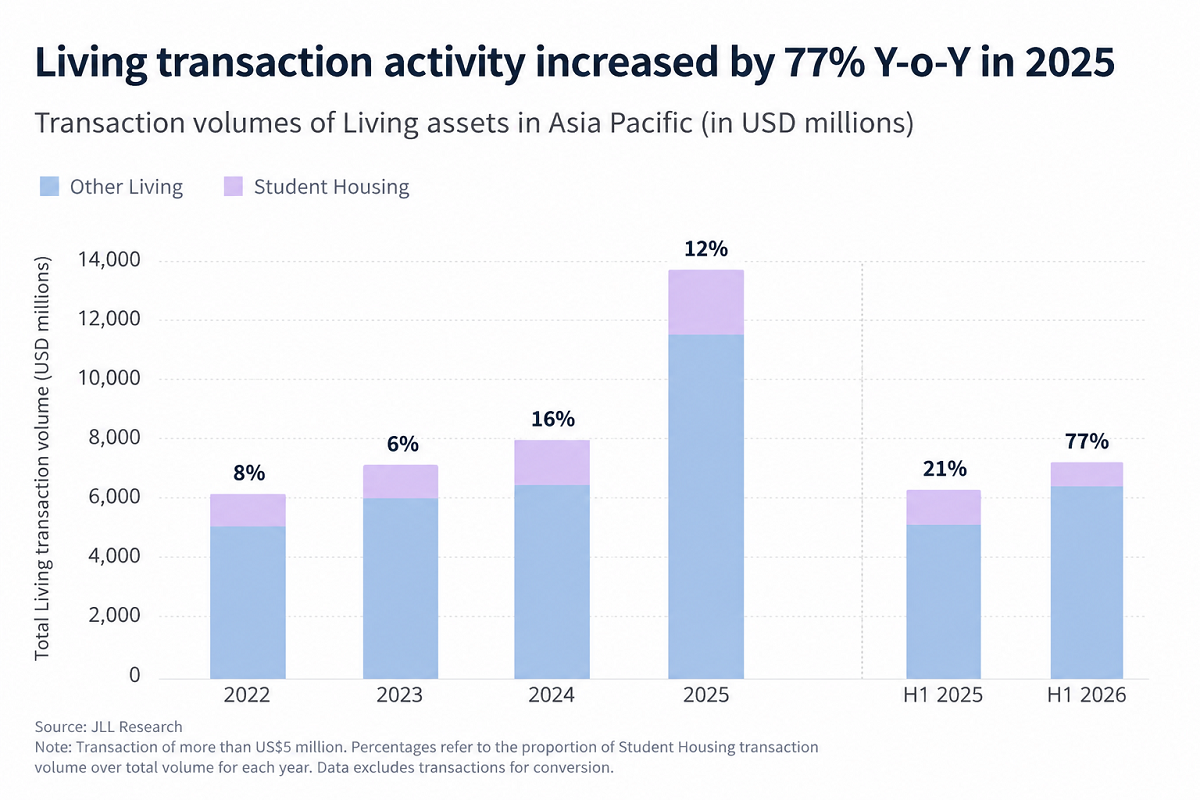
JLL’s Aug 11 regional study showed Living-sector transactions totalled US$12.6 billion (RM50.88 billion) in 2025, up 77% year on year. Transaction volume reached US$6.1 billion in the first half of 2026, up 1% from a year earlier, with multi-housing and build-to-rent accounting for more than 89% of the half-year volume.
Student-housing transaction volume in 2025 was three times its 2022 level, while the sub-sector’s share of APAC Living-sector transaction volume rose to 12% from 8% three years earlier.
Lauren Hetherington, senior director of Living Capital Markets Asia at JLL, said the buyer base had broadened beyond specialist operators to include developers, listed and unlisted real estate investment trusts (REITs), fund managers and education companies.

Cross-border investors accounted for about two-thirds of student-housing transaction volume in 2025, JLL said.
Malaysia remains an early-stage market
For Malaysia, however, that regional institutionalisation has yet to translate into evidence of a comparable investment market.
JLL said nearly RM1 billion had been deployed in education investment assets in Malaysia over the past decade, involving domestic institutional investors, family offices and regional fund managers.
It did not provide a transaction breakdown, define the asset categories covered by the figure or identify how much was attributable specifically to PBSA.
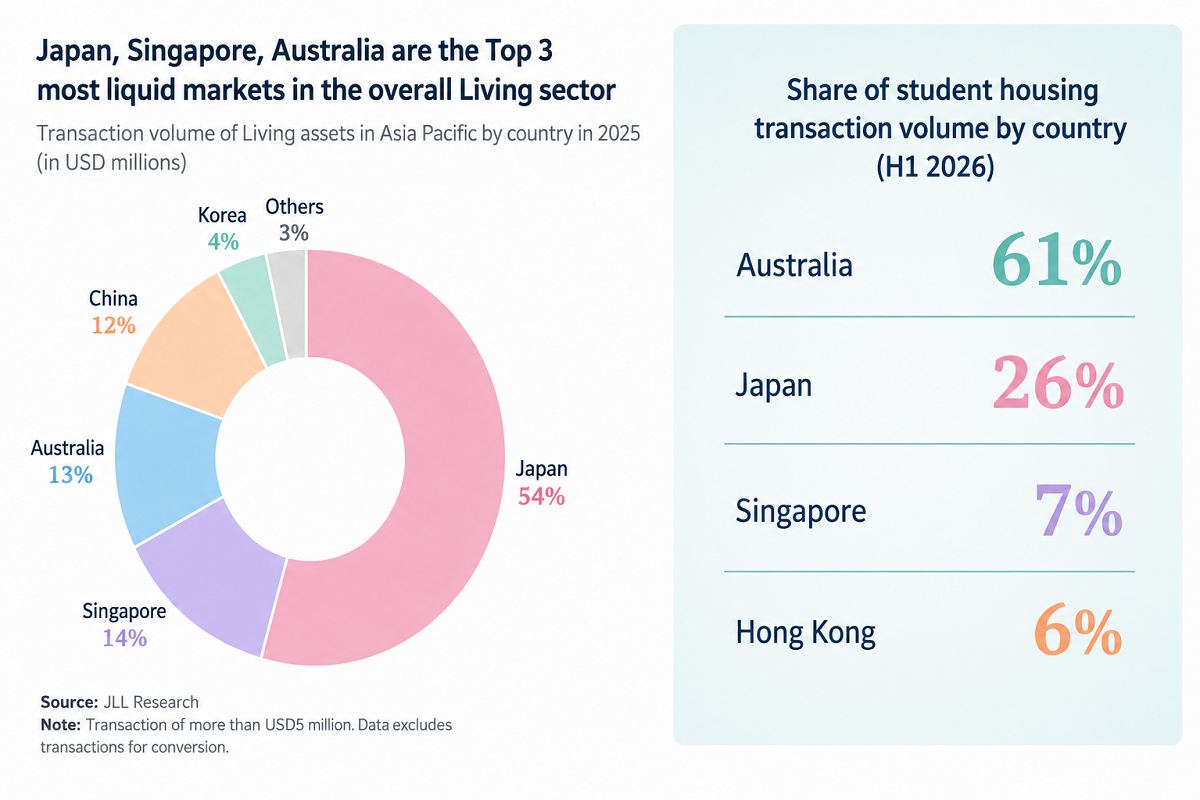
Australia remains the region’s most established student-housing investment market. Transactions in the first half of 2026 were recorded in only four APAC countries, with Australia accounting for 61% of transaction volume. Japan and Singapore followed.
JLL said investors entering Malaysia would need local operating expertise, including an understanding of university partnerships, student preferences, pricing sensitivity and regulatory requirements.
Malaysia has sizeable international student base
The demand backdrop is also expanding.
Figures cited by JLL showed the number of internationally mobile students rising from 2.5 million in 2002 to 7.3 million in 2023, with the total projected to reach nine million by 2030.
Asia Pacific already hosts 19% of globally mobile students and offers more than 20,000 English-taught programmes.
Malaysia itself has a sizeable international student base. Higher Education Ministry data showed public and private higher-education institutions had about 1.26 million students enrolled as at Dec 31, 2025, including 159,138 international students, or 12.6% of the total.
Separately, Education Malaysia Global Services (EMGS) recorded 81,992 international-student applications in 2024, up from 65,208 in 2023 and 51,677 in 2022.
Applications are not equivalent to confirmed enrolments, visa approvals or student arrivals, and should therefore be treated as an indicator of interest in studying in Malaysia rather than occupied accommodation demand.
Malaysia supply gap not quantified
JLL said most APAC markets have PBSA provision rates below 10%, compared with 33% to 88% in mature Western markets.
It estimated Australia would need about 80,000 additional beds to reach a 14% provision rate, Hong Kong about 120,000 beds to reach 33%, and South Korea more than 150,000 beds to lift its provision rate from below 1% to 5%.
JLL did not publish comparable figures for Malaysia. While it described PBSA as underdeveloped across the country’s key university cities, the available data do not establish the size of Malaysia’s addressable PBSA market or a national accommodation deficit.
Local knowledge will be critical
Geena Poon, director of research and advisory at JLL Malaysia, said the country offered “attractive entry points and significant value creation potential” for investors with medium- to long-term horizons and the ability to navigate an emerging-market operating environment.

JLL said it expects Malaysia to attract growing institutional interest as investors widen their search beyond Australia.
For now, Malaysia has an established international education base and a PBSA market that JLL considers underdeveloped. But assessing its institutional investment potential will require more transparent local data on accommodation stock, demand, affordability, development pipelines, occupancy and transaction pricing.
..........
EdgeProp monthly brings you data, insights and solutions for an evolving market. Subscribe now for your free copy!
Follow Us
Follow our channels to receive property news updates 24/7 round the clock.


Telegram


Latest publications
View AllFollow Us
Follow our channels to receive property news updates 24/7 round the clock.
Malaysia's Most
Loved Property App
The only property app you need. More than 200,000 sale/rent listings and daily property news.