Share
Share


This CCRIS & CTOS Guide: How to Improve Your Score Before a Mortgage explains what banks look for and what you can fix before you apply. Buying a home is not only about the right property. In Malaysia, the bank also checks your payment history, current debts, income, and overall credit profile to see if you can handle a long-term housing loan. CCRIS and CTOS do not approve or reject your loan on their own, but they shape how lenders judge risk, set terms, and decide how much to lend. If you want a credit score boost, start before you apply.
What CCRIS and CTOS are
CCRIS, short for Central Credit Reference Information System, is the credit record linked to Bank Negara Malaysia's credit data system. You can view it through eCCRIS, the online service run by Bank Negara Malaysia. eCCRIS is described by BNM as an interactive online service run by the central bank, and the current portal also reminds users about security steps such as multi-factor login.
A CCRIS report is a factual credit record. It shows your active credit facilities, recent applications, approved applications, balances, guarantor exposure, legal flags, and account conduct. In BNM's notes, the detailed credit report includes current loans, approved applications in the last 12 months, pending applications, and accounts under close watch by banks.
CTOS is a credit reporting agency. The Ministry of Finance's Registrar Office of Credit Reporting Agencies manages the register of credit reporting agencies in Malaysia, checks compliance with Act 710, and monitors these agencies. CTOS says it is Malaysia's leading credit reporting agency under the Credit Reporting Agencies Act 2010, and its consumer reports may include a CTOS Score, CCRIS records from BNM, legal and bankruptcy data, trade references, and identity data depending on the report type.
The simple way to remember the difference is this: CCRIS shows the raw repayment record that banks rely on, while CTOS adds a wider credit view and a score that helps sum up credit risk. CIMB's consumer guide also notes that CCRIS is a factual credit record managed by BNM through eCCRIS and does not provide a credit score, while credit reporting agencies such as CTOS and Experian may provide credit scores.
Why lenders care before approving a mortgage
A mortgage is a large, long-term commitment. Before approving it, banks want to know:
-
Do you pay on time?
-
Are you already stretched?
-
Have you sent in too many new applications lately?
-
Is your income stable and easy to prove?
-
Are there legal, bankruptcy, or dispute records that raise risk?
-
Do your bank statements match the income and spending you declared?
Your credit reports do not replace payslips, EPF statements, tax records, bank statements, down payment funds, or the bank's own rules. But they give a fast look at how you handle credit. For CCRIS, the conduct of account section shows the number of instalments late in the last 12 months. A zero means the loan is not late. A blank means the institution did not send data for that month.
One missed payment can matter, especially if it was recent. A bank may not treat one admin mistake the same way as repeated late payments, but both can raise questions. Your job before you apply is to make the report easy to read: steady payment history, manageable debt, stable income, and no surprises.
How to read your CCRIS report before a mortgage application
Start by downloading your CCRIS report and reading it line by line. Do not look only for bad records. Look for anything that affects what you can afford or creates confusion.
Focus on these areas:
-
Outstanding credit facilities: List every credit card, car loan, personal loan, education loan, overdraft, hire purchase, or financing facility shown.
-
Monthly repayment pattern: Look for numbers above zero in the repayment history. A zero usually means the facility is not late for that month, while higher numbers show late instalments.
-
Pending applications: If you recently applied for credit cards, personal loans, car loans, or other facilities, these may show as pending applications.
-
Approved applications in the last 12 months: Recent new credit can make you look as if your debt load is rising fast.
-
Guarantor exposure: If you are a guarantor, that exposure can still matter because CCRIS summary data includes debts where you back another borrower.
-
Legal action or special attention account indicators: These are serious red flags and should be checked early.
If you see a loan that should be closed, an account you do not know, a wrong balance, or a wrong late-payment pattern, contact the bank or financial firm first. CCRIS data comes from the reporting source, so the source usually needs to fix the record before the report changes.
How to read your CTOS Score and report
Your CTOS Score is designed to sum up credit risk in one number. CTOS says the score runs from 300 to 850, with a higher score showing stronger creditworthiness to banks and lenders. CTOS also says the score is shaped by payment history, amounts owed, credit history length, credit mix, and new credit.
For mortgage prep, the main factors are usually the most obvious ones:
-
Payment history: CTOS says this is the biggest part of the score, at 45%.
-
Amounts owed: CTOS says this is another major part, at 20%.
-
New credit: New accounts or fresh applications can signal more risk.
-
Credit history length: A longer, well-run record can help, but a shorter clean record is still better than a longer record with late payments.
-
Credit mix: Different credit types can show experience, but CTOS warns you not to open new accounts just to add mix.
Do not focus on the score alone. A bank may still look at the details behind it, especially your CCRIS payment pattern, current commitments, and debt service ratio. Think of CTOS as the dashboard, while CCRIS and your supporting papers are the engine room.
Calculate your DSR before the bank does
Your Debt Service Ratio or DSR compares monthly debt payments with monthly income. PIDM explains DSR as the share of income used for debt payments. CTOS says it is one of the first things banks look at when they review a loan.
The formula is:
DSR = total monthly debt repayments ÷ monthly income × 100
Example: If your net income is RM6,000 and your current monthly debt is RM2,100, your DSR before a new mortgage is 35%. If the mortgage instalment is RM2,000, your total debt payments become RM4,100 and your DSR becomes about 68%.
Different banks may assess income and commitments in different ways, and there is no single cut-off that guarantees approval.
PIDM notes that banks generally accept DSR below 60% for all debt commitments, while also reminding borrowers that qualify and what you can afford are not the same thing. CTOS also says each bank sets its own DSR limits, and acceptable ranges can change with income level and loan type.
The 90-day credit clean-up plan
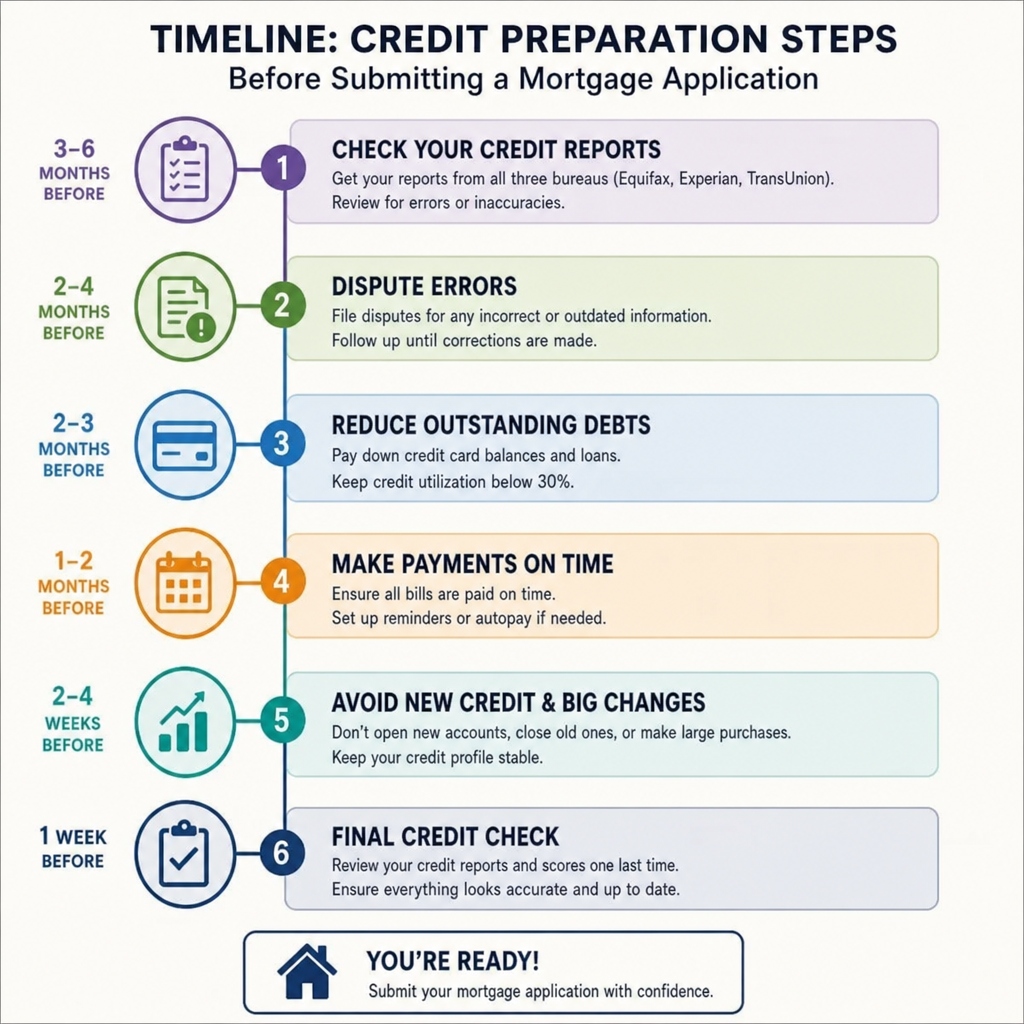
If your mortgage application is still three months away, use the time to make your file cleaner and more predictable. If you want a credit score boost, 90 days can make a real difference.
Days 1 to 15: Pull reports and spot the issue
Get your CCRIS report through eCCRIS and review your CTOS report if you want a score-based view. Make a simple list of every credit facility, balance, monthly payment, credit limit, and any late payments. Do not rely on memory because small debts add up fast.
Check for:
-
Missed payments in the last 12 months
-
High credit card balances
-
Facilities you thought were closed
-
Pending credit applications
-
Old legal or trade reference records
-
Identity details that do not match your current papers
-
Guarantor duties you forgot about
If anything is wrong, start the fix right away. CTOS says consumers should get the latest report, spot what can be removed, and contact CTOS or use its online form if they find errors or items that should have aged off the report.
Days 16 to 45: Fix late accounts and reduce card debt
Your first goal is to stop the damage. Pay every instalment on or before the due date. If you have overdue accounts, call the lender and ask how much is needed to make the account current.
Then focus on revolving credit such as credit cards. Even if you pay on time, high usage can make you look stretched. Try to cut balances before the statement date where you can, and avoid turning lifestyle spending into new instalment plans right before you apply for a mortgage.
If you have several debts, think about clearing small loans that cut monthly commitments in a real way. A fully settled small personal loan or instalment plan may improve DSR faster than a small extra payment on a large long-term loan.
Days 46 to 75: Stop new credit activity
Avoid applying for new credit cards, personal loans, car loans, buy-now-pay-later plans, or instalment plans unless you truly need them. CTOS says its score looks at new credit, including how many new accounts you have asked for recently and when you last opened a new account. Multiple applications close together can make a lender wonder if you are short on cash.
This does not mean you should hide from banks. It means you should be selective. If you are comparing mortgage options, speak to bankers or mortgage consultants about your likely eligibility first, then apply in a planned way instead of sending many applications at once.
Days 76 to 90: Prepare your mortgage file
A good credit score helps, but a clean document file can reduce friction. Gather:
-
NRIC copy
-
Latest payslips or income records
-
EPF statement if needed
-
Latest tax documents if needed
-
Bank statements showing salary or business income
-
Existing loan statements
-
Sale and purchase documents when available
-
Booking form, property details, or developer papers if needed
-
Proof of savings for down payment, legal fees, valuation, insurance or takaful, and moving costs
If you are self-employed, give yourself more time. Banks often want steady income, not just one strong month. PIDM notes that freelancers or self-employed people may benefit from showing steady earnings with bank statements or invoices. (pidm.gov.my)
Mortgage approval tips that really help
1. Pay before the due date, not on the due date
Late payments are one of the fastest ways to weaken your file. Set auto-debit where possible, or set reminders several days before the due date. If your salary date is close to the loan due date, move the payment date so the money is ready early.
2. Keep credit card balances low
For mortgage prep, your credit card should show control, not need. Paying only the minimum may stop a late mark, but it still leaves a balance that affects your total debt and may influence your score. CTOS says the amounts owed part looks at how much of your available credit you have used and how much you owe across account types.
3. Do not take new debt to build credit right before applying
Some buyers think they should take a personal loan or buy a car to show credit activity. This is usually a bad idea before a mortgage. New debt raises DSR, cuts free cash, and may create a new-credit signal. A clean, modest file is often better than a busy file with new debts.
4. Keep old well-run accounts if they help
If you have an old credit card with a clean record, closing it right before you apply may not help. It could cut your available credit history or change usage. If the card has fees or pushes you to overspend, review it carefully, but do not close accounts just because you think less credit always looks better.
5. Fix errors early
Under CTOS's summary of rights, consumers have the right to access credit information and dispute wrong credit data. CTOS also says consent is required before a credit reporting agency gives your credit report to subscribers. If your report has a wrong ID detail, an unknown account, an old negative item, or a wrong legal record, dispute it before a bank reviews your mortgage application.
6. Cut debt before you raise your budget
It is tempting to ask, how much can I borrow? A safer question is, how much can I pay each month while still saving? PIDM highlights the gap between eligibility and affordability, and reminds borrowers that even if a loan is approved, they should check whether they can live with the payment over time.
7. Avoid becoming a guarantor before your mortgage is approved
Guarantor exposure can appear in credit reports and may affect how banks view your debts. If someone asks you to guarantee a loan while you are preparing for your own mortgage, think about the impact first.
8. Keep your bank statements clean
Banks may check account behaviour, not just credit reports. Avoid bounced payments, gambling-related transactions, unclear large transfers, frequent overdrafts, and sudden cash deposits without proof. If you get commissions, rental income, freelance income, or business income, keep invoices, agreements, and transaction records.
What if your score is low or your CCRIS has late payments?
Do not panic, but do not rush into a mortgage application either. A low score can often improve with steady repayment, lower balances, and fewer new applications. Recent late payments may need time. Banks care about patterns, so your aim is to show several months of clean conduct after the problem is fixed.
If you are struggling to keep up with repayments, avoid taking costly new debt just to make your report look better for a short time. Debt counselling and management agencies help credit consumers understand their position and work toward repayment plans based on real ability to pay; they do not give loans, buy debts, or act as debt collectors. Getting help early is better than letting late payments turn into legal action, restructuring, or long-term default.
Common myths about CCRIS and CTOS
Myth 1: CCRIS is a blacklist
CCRIS is better seen as a credit record, not a simple blacklist. It records facilities, applications, payment conduct, and related signals. A clean record helps, but having a loan in CCRIS is not automatically bad.
Myth 2: A high CTOS Score guarantees approval
A strong CTOS Score can help your application, but banks still look at income, DSR, property value, job stability, documents, and internal risk rules. No score can promise approval.
Myth 3: No credit history is always good
No debt may be healthy, but no credit record gives banks less repayment history to review. If you are new to credit, build slowly and responsibly rather than opening many accounts at once.
Myth 4: Once I settle late payments, the report turns perfect at once
Settlement matters, but reporting updates and past conduct may still show for a while. Check with the lender when the account will be updated and review your report again before you apply.
Final checklist before you submit your mortgage application
Before you apply, make sure you can say yes to these:
-
I checked my CCRIS report and understand every facility shown.
-
I reviewed my CTOS report and know the main factors behind my score.
-
I have no unexplained late payments in the last few months.
-
My credit card balances are under control.
-
I have avoided unnecessary new applications.
-
I calculated my estimated post-mortgage DSR.
-
I have stable income documents ready.
-
I can explain any odd transactions or income sources.
-
I have enough savings for upfront costs without draining my emergency fund.
-
I am applying for a property that fits both bank rules and real-life budget.
The bottom line
Improving your credit profile before a mortgage is not about gaming the system. It is about showing a bank that you are organised, steady, and ready for a long-term commitment. Check CCRIS and CTOS early, fix errors, pay on time, cut extra debts, and apply only when your papers and DSR are ready.
The strongest mortgage applications are usually not the ones with complex stories. They are the ones that are easy for a lender to read: stable income, clean payment history, manageable debt, and a property budget that makes sense.
Continue your property journey with our FREE monthly newspaper, featuring the latest market insights and expert analysis. Subscribe to claim your copy!
Disclaimer: This article is provided for general information purposes only. The Edge Property Sdn Bhd makes no representations or warranties as to the accuracy, reliability, or completeness of the information, including its fitness for any particular purpose, to the fullest extent permitted by law. While every effort has been made to ensure the information is accurate and up to date as of the time of writing, it should not be relied on as the sole basis for any financial, investment, real estate, or legal decision, nor should it replace advice from a qualified professional who can consider your personal circumstances. The Edge Property Sdn Bhd accepts no liability for decisions made based on this article.